Explain how stalagmites and stalactites are formed.
Answer: When rainwater sinks down through the limestone it carries with it the dissolved crystals of limestone. When the water seeps through into a cave, it drips onto the floor. As the drip hangs from the roof, it loses some of its carbon dioxide. Because it is less acidic it cannot hold as much calcite and so it leaves it behind on the ceiling of the cave, forming a stalactite. When the drips reach the floor, more of the crystals remain to build up a stalagmite.






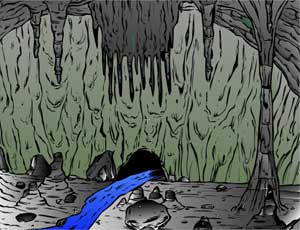 Explain how stalagmites and stalactites are formed.