| |  Written by Neil Scott. Primary 7 teacher. Hills Trust Primary School, Glasgow. Written by Neil Scott. Primary 7 teacher. Hills Trust Primary School, Glasgow.
Introduction
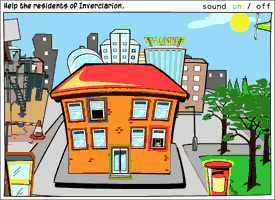
Welcome to Inverclarion Community Centre!
This site is an excellent way of introducing the complicated subject of democracy. It can be used as a stepping-stone to lessons on the Scottish Parliament and other examples of democracy.
"Using Democracy" was designed to help in the teaching of levels C and D, Environmental Studies; Society, Science and Technology with a particular focus on Knowledge and Understanding- People in Society. See pages 35 - 37 of the Environmental Studies National Guidelines for more details; http://www.ltscotland.org.uk/5to14/files/guidelinesenvironmental.pdf
There are two main sections to this site:
 making a fair decision, making a fair decision,
voting.
It is important to point out to the children, when they are exploring the different areas and characters that they need to read everything. Pairing up children and suggesting they each read a different characters speech will help in their understanding. Shared reading can help reluctant readers.
The activities in this site have been successfully carried out by my P7 (Y6) class.
Forward Plan
This site is aimed at levels C and D. How it fits into the lessons built around it can vary, depending on the depth the teacher is prepared to go into. My P7 class, at times, strayed into levels E and F and, of course, into other areas of the curriculum.
Knowledge and Understanding - People in society
| Activities | People and needs in society | Rules Rights and responsibilities in society | Conflict and decision making in society | | 1 | 2 | 3 | 4 | 1 | 2 | 3 | 1 | 2 | 3 | 4 | | Award money activity |  | | | | | | | | | | | | Electing a leader | | | | | | | | | | | | | School council (suggested activity) | | | | | | | | | | | | | Contacting an MSP about a local issue (suggested activity) | | | | | | | | | | | | | Visiting the Scottish Parliament (suggested activity) | | | | | | | | | | | |
Strand
People and needs in society.
Developing an understanding of individual and social needs and the relationship to economic factors.
Level C
1. Describe the difference between needs and wants.
2. Suggest ways that individuals, families and communities help to meets the needs of and care for others e.g. health care providers, extended families, etc.
Level D
3. Explain that different groups and cultures have different needs e.g. the elderly, the unemployed.
4. Describe in simple terms how some local services are financed, e.g. swimming pool, refuse collection.
Strand
Rules Rights and responsibilities in society.
Developing an understanding of individual and collective rights and responsibilities in a democratic society.
Level C
1. Describe different rules that apply in different contexts, e.g. formal/informal rules for personal safety, etc.
2. Suggest ways in which they can contribute to the care of others and respect their feelings/views.
Level D
3. Suggest some of the rights and responsibilities of a citizen in a democracy.
Strand
Conflict and decision making in society.
Developing an understanding of conflict and decision making processes including the influence of the media.
Level C
1. Describe ways people can participate in the decision making process in various contexts - in school, work, community.
2. Identify the main features of an election at local and national level, e.g. voters, campaigning, candidates, ballot box, etc.
Level D
3. Describe simply how representatives are chosen and the types of work they do, e.g. local councillors, members of Scottish, British and European Parliaments.
4. Describe the ways in which the media can affect personal decision-making.
Site content.
 Section 1. Section 1.
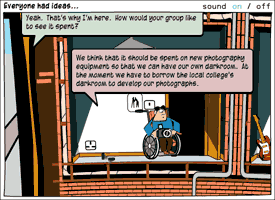
During the "award money" activity children take the role of the community centre leader and have to make a decision as to who should benefit. This character's questions are in the grey speech bubbles. One child could read this whilst the other child could read the club representative's words.
The decisions are purposely difficult to make. After the children meet all of the club representatives, they can either, come back to the class and have a debate about where the money should go, or they can be instructed to make their decisions and report back to the class the result of their decision. See the Scottish Parliament site for notes on how to hold a debate - the printouts on the site are also particularly useful (http://www.scottish.parliament.uk/educationservice/enviro-studies.htm).
As they visit each representative, notes are kept for them to print out to look over when they are making their decision. When they have finally arrived at a decision, they can view relevant comments by the clubs. Some of these comments will be positive and some of them negative.
 Section 2. Section 2.
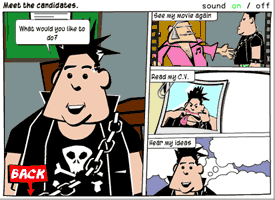
This involves selecting a leader for the "Rock, Rap and Scratch" club. There are three candidates and, to find out about them, the children must click on them. When they do this, three boxes appear beside the character; one is a movie showing something relevant about the character; one is a CV (some children will need to be told about what a CV is) and the third box is a little speech by the candidate about what they will do to make the club a better place. The second two boxes amount to a "Manifesto" which can be brought up when the class lessons are concentrating on Parliamentary elections. This section might also spark a debate in class or they can report back to the class with their decisions already made.
When they have chosen a leader, they can view a short "outcome" highlighting the pros and cons of their decision.
NOTE: In both Section 1 and Section 2, any notes that are required in order to make a decision are printed in the note book. These can be accessed directly from the home page by clicking on the "office" window, or are available within each activity. They can be printed out and referenced in class.
In addition to the two main activities, there are three other minor sections:
A notice board where children can post notes about any citizenship activities they have organised or taken part in. This could be used to report back outcomes of contact with MSPs, MPs etc (see below). It is a great area to publish how the class made a difference in school or out in the community! It is important during the teaching of Citizenship to show that they are part of a wider community and that their views are heard and are acted upon.
Please note, the notice board does not use email and detailed names and addresses are not requested. In addition, the comments sent in are read, edited if necessary and finally posted on the site by the BBC.
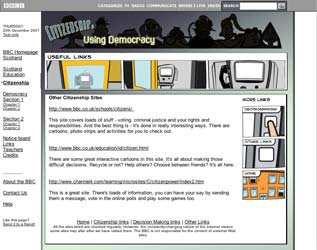
A group of links to other relevant citizenship sites. Some of these are BBC sites, some of them are not.
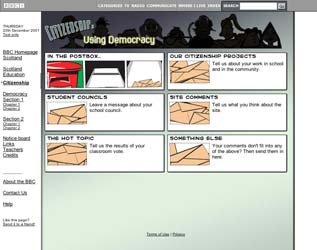
The final section invites the children to debate and vote on a topic. When they have arrived at a decision then they can submit their views to the notice board. The topic changes frequently and can be seen scrolling along the aeroplane's banner on the home page.
Further activities
School Council Week:
1. School Councils usually comprise a boy and girl from each class, making up an "Executive" which can meet weekly, fortnightly or monthly.
Preparation for the elections could take a week - it is a good "introductory activity" at the start of the school year.
The voting for class members should mimic a Scottish Election, i.e. prospective candidates should launch campaigns with the help of assigned helpers (those in the class who did not want to stand as candidates). During the campaigns, the candidates can make posters and rosettes.
Manifestos can be made - these can be as complex or simple as the teacher decides. The political parties of the Scottish Executive are all very willing to send examples of their actual manifestos - some have simplified "children's versions".
Persuasive writing can be introduced during this part of the campaign, to help with speeches and manifestos.
The day before the election, class "Hustings" can be held where each candidate can make their speech and each member of the class could have a (positive) question to ask them.
The actual elections should be made to be as realistic as possible. Voters should be given a stamped voting slip with the names of all of the candidates (from their class). The reasons for stamping the voting slip should be made known (ie for security), and they should have a voting booth to make their secret vote in. When the returning officer is making their announcement of the winners, I would suggest that the amount of votes per candidate is kept secret as popularity contests can hurt feelings!
2. If the school does not have a council, the same procedures could be used to set up a classroom committee. This committee could be briefed to make the classroom area a better place and they could organise the library, set up rotas for class tasks and organise delegations to the Head Teacher, with suggestions for the school.
3. Another very useful activity is to find an issue in their school's area that the children would like to take up with a member of the Scottish Parliament. The children can vote on which MSPs they want to deal with and then they can write or email them with their concerns. Various concerns could be, play-park areas, lack of swimming pool, road safety, dog mess, litter, school meals, various health issues, etc. Once they have written to the MSP, they could also plan a visit to the Parliament. Once contacted MSPs can arrange visits for classes and some are willing to show children around. They also arrange facilities for having packed lunches and most will do question/answer sessions (children can ask about their particular concern and/or different concerns to do with their area, or they could simply ask about the life of a busy MSP!).
Remember - the Debating Chamber is closed to the public at certain times. Check well in advance as to it's availability.
Lots of information about planning a visit can be found at -
http://www.scottish.parliament.uk/visitor/index.htm
4. Children can also create a wall display showing the various representatives for their area, i.e. MEPs, MPs, MSPs, Councillors and School Councillors. They can look up information about each, print out information and photos and look out for newspaper items in which the representatives are mentioned. Summaries of their classroom representatives' manifestos can go with photos/ drawings of them. They can also find debates their MP/ MSP has been involved with by looking up the Parliament sites.
See -
http://www.scottish.parliament.uk/msp/
for a list of MSPs.
http://www.parliament.uk/directories/directories.cfm
for a list of MPs.
http://wwwdb.europarl.eu.int/ep5/owa/p_meps.short_list?ilg=EN&ictry=GB&ipolgrp=&iorig
for a list of MEPs.
http://directory.google.com/Top/Regional/Europe/United_Kingdom/Scotland/Government/Local_Councils/
for a list of local councils and their web-sites.
How to make the most of this site
The sound in this site can be switched on and off through out by clicking the on/off icon.
You will require an up to date Flash player to view the interactive and animated elements of this site. Most new computers already have this software. However, if you are working on an older computer then you may need to update your Flash player. This can be done simply, safely and freely from the following link:
http://www.bbc.co.uk/webwise/askbruce/articles/download/howdoidownloadflashplayer_1.shtml
If you are unable to download an up to date Flash player then don't worry. The HTML version of this site still covers all the learning. In using the HTML version you are missing out on animations, sounds and other interactive elements but children can still have a rich and rewarding experience "Using Democracy".
For more information on downloading and other internet related areas, go to:
http://www.bbc.co.uk/webwise/askbruce/
Worksheet answers
These are the answers to the "Using Democracy- Who gets your vote?" print off. This can be found in Section 2 of the site.
All the sites listed are checked regularly. However, the constantly-changing nature of the Internet means some sites may alter after we have visited them. The BBC is not responsible for the content of external Web sites. | |  |
|