

Thursday 16 October 2014

BBC performance against its public purposes
Sustaining citizenship and civil society
Members considered that the BBC performed strongly in a challenging year, providing high quality coverage and analysis from the USUS election to the economic crisis and the helicopter crash in the North Sea in Aprilin which 16 people lost their lives.
Reporting on the economy brought impartiality to a complex and sometimes controversial story. Coverage of Scottish perspectives on BBC Scotland benefitted from a strengthened BBC Scotland business team and an enhanced web presence. However we noted that coverage of Scottish angles on network outlets was marginal, in spite of the importance of the story for the Scottish economy, so that overall BBC coverage lacked some cohesion for audiences in Scotland.
On television, new bulletins in mid-evening broadened the audience for BBC news. Radio Scotland maintained its position as the nation's leading speech network.
BBC output brought the audience together at key national moments from Hogmanay and the 250th anniversary of the birth of Robert Burns to the commemoration service in Aberdeen for those who died in the North Sea on 1 April. Documentaries from Girls Behind Bars to Margo MacDonald: My Right to Die stimulated debate on important issues.
The launch of BBC Alba strongly enhanced the BBC's delivery of this purpose, extending the range of original journalism from An Là, the nightly Gaelic news programme from Inverness, to documentaries on Scottish political history and contemporary social issues.
Two concerns were highlighted in research undertaken by the Trust. Firstly, although BBC Scotland aimed to provide comprehensive coverage of how Scotland is governed, audiences did not think the BBC as a whole did this sufficiently well. Secondly, only around a third of the audience in Scotland considered that the BBC reflected their local interests and concerns. These concerns were also reflected in our engagement work with audiences. We believe the BBC should respond by expanding and enriching existing television output, while reviewing the opt-out schedule to allow for a better balance of international, UK and Scottish news.
Promoting education and learning
Provision for formal and informal learning remained strong. Scotland’s History reached a range of audiences through mainstream television documentaries, audio walks, an interactive online site and learning packs for schools. The television series found a lively and innovative approach, but was inconsistently scheduled and may have lost impact as a result. Series such as Springwatch drew large audiences for informal learning, while featuring Scottish natural history in a UK context.
Programmes for the 250th anniversary of the birth of Robert Burns found original perspectives and sometimes sparked debate. An audio archive of all of the Bard’s works, launched during the year, will be a permanent educational resource.
The launch of BBC Alba highlighted existing resources for Gaelic learners and added new ones. Programmes like A Rèir an Aimsir, on how weather has shaped landscape and culture in the Western Isles, offered opportunities to learn on more than one level. We welcomed the release, for re-use, of Gaelic learning materials from the former BBC jam.
Our consultation work suggested that more work needs to be done to deliver this and the other public purposes for young adults.
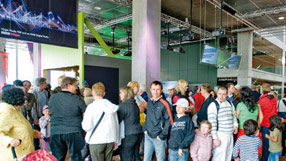
Pacific Quay, Glasgow
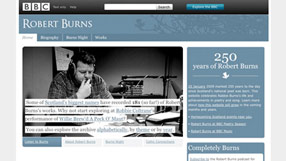
Robert Burns Archive
BBC iD
BBC iDBBC navigation
BBC links

BBC © 2014The BBC is not responsible for the content of external sites. Read more.
This page is best viewed in an up-to-date web browser with style sheets (CSS) enabled. While you will be able to view the content of this page in your current browser, you will not be able to get the full visual experience. Please consider upgrading your browser software or enabling style sheets (CSS) if you are able to do so.
