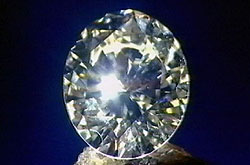
Diamond Labs - programme summary
Top quality diamonds at knock down prices? The only catch is: these rocks don't come out of the ground, but are made in a lab. This is the promise offered by a series of recent scientific breakthroughs.
"For 200 years people had tried to make diamonds and they had failed" |
Prof. Bob Hazen, Mineral Scientist, Carnegie Trust |
For most of us, it seems we may soon be able to bejewel ourselves like movie stars. But for De Beers, the world's largest diamond trader, could this, one day, be a serious threat?
Following a dodgy meeting in Moscow, retired US Army General Carter Clarke acquired some experimental diamond growing machines, originally destined for the Russian military. He created the world's first gem diamond production line, to mass produce highly prized coloured diamonds.
In a secret location south of Boston, a father and son team developed a different technique. Robert Linares and son Bryant have made colourless diamonds, allegedly higher quality than those found in nature.
De Beers, at vast cost, set up a new scientific division called the Gem Defensive Programme. Its goal: to find ways to tell apart their natural diamonds from these new synthetic gems.
But will the new synthetics slip through De Beers detection net? And could anyone really tell the difference? Horizon tells the story of the Diamond Labs.