
The history of the Bahá'í faith proper begins with the 19th-century nobleman Bahá'u'lláh.
Bahá'u'lláh
Last updated 2009-09-28
On this page
- Early life
- Imprisonment and revelation
- Baghdad
- Adrianople, mission and family conflict
- Final years
- Find out more
Page options
Early life
Bahá'u'lláh, which means the glory of God in Arabic, was born Mirza Husayn Ali in 1817 into one of Persia's most noble and privileged families.
Education
In his early life he had a relatively limited education (which was normal for the class from which he came). He learned horsemanship (he was known as a fine horseman), swordsmanship, poetry and calligraphy (he was also renowned as an excellent poet and calligrapher).
His Islamic education was strictly non-technical, but despite this, his knowledge of Islam (and of other religions) was far beyond what could have been expected of someone from the wealthy governing class.
This is important because Bahá'u'lláh used his limited education to reinforce his claim to divine revelation. He argued that since he had not spent years studying the Qur'an and Arabic, how else could he be able to write as he did in Arabic? And there is no evidence to suggest that he devised his writings through his own intellectual thoughts.
Contact with the Báb
In 1844, just 3 months after the Báb's declaration, Mulla Husayn carried a scroll of the Báb's to Bahá'u'lláh.
On reading it, Bahá'u'lláh recognised the claims of the Báb and at the age of 27 became his follower.
From then on, although they never met, Bahá'u'lláh and the Báb were in constant correspondence and when the Báb knew that he would soon die, he sent his pens, seals and papers to Bahá'u'lláh.
It was at Bahá'u'lláh's explicit instructions that the remains of the Báb were removed from Tabriz to Tihran and hidden in a place of safety.
Imprisonment
Two years after the Báb's death, Bahá'u'lláh was imprisoned in Tihran, accused of taking part in the attempted assassination of the Shah of Persia.
He was put in stocks and, for three days, given neither food nor water.
Other Bábis were imprisoned with him and as they sat in chains, Bahá'u'lláh taught them to chant prayers which were heard by the Shah.
The reasons for Bahá'u'lláh's arrest were not straightforward and included:
- his stature and influence as the leading member of the Bábi community
- the jealousy of the Grand Vizier
- the hatred of the Shah's mother, who levelled unjust accusations at Bahá'u'lláh
Bahá'u'lláh's own actions also contributed to his arrest:
- he ignored advice to keep himself hidden
- he went of his own volition to army headquarters to be arrested
Imprisonment and revelation
Prison - a central experience
Bahá'u'lláh was jailed underground in a prison with a very significant name: the Siyáh-Chál, or Black Pit. It had previously been a reservoir for the public bath.
His experiences in this dreadful place have close parallels with the descendent of the Holy Spirit in the form of a dove on Jesus, the appearance of the Angel Gabriel to Muhammad in the cave on Mount Hira, and the enlightenment of the Buddha under the Bo tree.
While in prison, Bahá'u'lláh had a vision of the 'Most Great Spirit' in the form of a heavenly maiden who assured him of his divine mission and promised divine assistance.
Bahá'u'lláh himself wrote that he had the feeling of something glowing from the crown of his head and of hearing words of protection and victory.
This is as significant for the Bahá'í revelation as the visitation of Gabriel which caused Muhammad such consternation, or the vision of God that caused Moses to swoon.
This event is regarded by Bahá'ís as marking the birth of the Bahá'í revelation. It stands at the heart of Bahá'u'lláh's claim to be the Manifestation of God.
Survival
The Bábis were often tortured and killed but the authorities were reluctant to kill Bahá'u'lláh.
This was partly because of his family's influential social position, and partly because of a personal intervention by Prince Dolgorukov, a Russian ambassador.
But the main reason was that the would-be assassin of the Shah had already confessed to the crime and completely exonerated the Bábi leaders of any involvement.
The prime minister of Persia decided that it was preferable for Bahá'u'lláh to be banished from the state and he was released from prison in 1853. He was stripped of his wealth and possessions and travelled to Baghdad with his wife.
Exile and Dissent
Bahá'u'lláh and his family arrived in Baghdad, Iraq, in 1853 where he stayed for 10 years.
On arrival, he met followers of the Báb and his influence grew to the extent that it caused dissension, conflict and jealousy amongst the followers of the Báb.
His own brother Azal, for example, grew jealous of him and proclaimed himself as the Messenger of God.
To escape the conflict, Bahá'u'lláh left Baghdad and spent the next 2 years living as a hermit in Kurdistan. His family eventually begged him to return to the city, which he did in 1856.
In Baghdad, he found the Bábi community had become dispirited and divided. It seemed that his brother had not provided effective leadership, so Bahá'u'lláh spent the next 7 years teaching the basic teachings of the Báb by both word and example.
Baghdad
Writing and teaching
Bahá'u'lláh wrote 3 important books in Baghdad:
- Hidden Words
- Kitab-I-Iquan (Book of Certitude) (1862)
- The Seven Valleys
In them, he emphasised the importance of the spiritual paths and outlined the religious goals of the spiritual life.
The Seven Valleys was a mystical work, written in response to questions from the Sufi mystics whom he met during his period as a hermit.
He also set out religious doctrines, the concept of the Manifestations of God and the fulfilment of prophecy.
He continued to experience visions from the Maid of Heaven and was soon recognised as the pre-eminent Bábi leader.
In trouble again
Eventually, the teachings and influence of Bahá'u'lláh reached the Muslim leaders of Baghdad and caused such concern that they called for his banishment.
In 1863, the Governor of Baghdad reluctantly gave way to these requests and told Bahá'u'lláh that he had to leave the city.
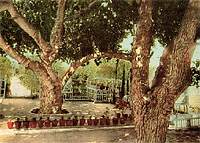 An old picture of the Ridván garden ©
The announcement was greeted with uproar, and such were the crowds lamenting his banishment that Bahá'u'lláh moved out of the city to a garden where he stayed for 12 days. He named this garden Ridván (Paradise) and it was here that he said goodbye to his followers.
He also announced to some of his immediate disciples that he was 'Him whom God shall make manifest'.
Ridván is now recognised as a Bahá'í holy place and the whole 12-day period is celebrated as a sacred festival.
Bahá'u'lláh then left Baghdad and travelled ultimately to Adrianople (now known as Edirne), unofficially a prisoner of the Ottoman Empire.
Adrianople, mission and family conflict
Bahá'u'lláh proclaims his mission
In Adrianople, where he stayed from 1863-1868, Bahá'u'lláh began to reveal himself to his followers and to religious and civic leaders as the one promised by the Báb and, in so doing, formally established his mission.
The Bábi community became the Bahá'í community, and their focus centred on the teachings of Bahá'u'lláh.
Family conflict
Bahá'u'lláh's half-brother, Mirza Yayha (who had been given the title of Subh-i-Azal (Dawn or Morning of Eternity) by the Báb, refused to acknowledge Bahá'u'lláh's claim to be the one promised by the Báb and declared himself to be the Manifestation of God rather than Bahá'u'lláh. Azal tried to alter the writings of the Báb to make it appear that he was the One.
Azal tried to poison Bahá'u'lláh and, while Bahá'u'lláh became seriously ill, he did not die, although the effects of the poison lasted for the rest of his life.
Bahá'u'lláh then went into isolation, instructing his followers to choose who to believe, calling his followers 'the people of Bahá'. Almost all of them chose Bahá'u'lláh, which confirmed his calling, and from this point on the Bahá'í faith emerged as a distinct religion.
The authorities were aware of the religious teachings of both Bahá'u'lláh and Azal and aware of the tensions between them. Both the brothers were exiled; Bahá'u'lláh to Akka in Syria and Azal to Cyprus.
Final years
Syria - exile
Bahá'u'lláh arrived in Akka in August 1868, so fulfilling prophecies made by Muhammad, and by Jewish prophets, about the importance of the city.
He was banned from associating either with others of his party, or with the inhabitants of the city.
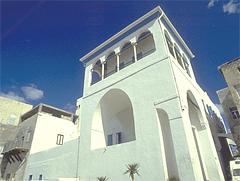 Bahá'u'lláh's house ©
When pilgrims arrived to see him, they would stand for hours in the hope of glimpsing him from his prison window.
At this time, Bahá'u'lláh wrote to the monarchs of Europe, including Napoleon III, the Czar of Russia, Francis-Joseph of Austria and Pope Pius IX, to proclaim his mission.
Queen Victoria is alleged to have replied "If this is of God, it will endure. If not, no harm can come of it."
It was during this period that the Bahá'í greeting Allah-u-Abha (God is All-Glorious) came into use.
Death of a son
In Akka, Bahá'u'lláh's second son, the 'Purest Branch', fell through an unguarded skylight in the prison roof and, as a result, died.
Bahá'u'lláh spoke of the event as an act of atonement rather like the crucifixion of Jesus, or a sacrifice like Abraham's willingness to sacrifice his only son Isaac.
Recognition
In time, the townspeople and officials of the town began to recognise and be drawn to Bahá'u'lláh's wisdom and spirituality - as had happened in Baghdad, Constantinople and Adrianople - and gradually, the terms of his imprisonment were relaxed.
Freedom and death
In 1877, following the overthrow of the Sultan Abdulaziz, Bahá'u'lláh could leave the city and he moved to nearby Mazraih and later that year to Bahji. Apart from visits to Mount Carmel, he spent the rest of his life at Bahji and died there in 1892.
Successor
Bahá'u'lláh's eldest son, Abdu'l-Bahá, was appointed his successor. He was recognised as the first to believe in Bahá'u'lláh's mission, and the only authoritative interpreter of Bahá'í teachings.
BBC iD
BBC iDBBC navigation
BBC links

BBC © 2014The BBC is not responsible for the content of external sites. Read more.
This page is best viewed in an up-to-date web browser with style sheets (CSS) enabled. While you will be able to view the content of this page in your current browser, you will not be able to get the full visual experience. Please consider upgrading your browser software or enabling style sheets (CSS) if you are able to do so.

