
The story of the Bahá'í movement's continuation after Bahá'u'lláh's death, under the leadership of his son Abdu'l-Bahá.
Abdu'l-Bahá
Last updated 2009-09-28
Abdu'l-Bahá
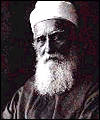 Abdu'l-Bahá ©
Abdu'l-Bahá was born in 1844 in Tihran, on the same night that the Báb declared his mission. He grew up mostly before Bahá'u'lláh had declared his mission but claims to have recognised his father's greatness at an early age.
The phrase 'Abdu'l-Bahá' means 'Servant of Bahá'.
While his father was in the wilderness for two years (1853-56) Abdu'l-Bahá memorised the Tablets of the Báb and spent much time in solitary meditation.
He became his father's closest companion, vetting his father's visitors and only permitting those who were genuinely interested in his father's work to see him.
After the declaration of his father's mission, Abdu'l-Bahá took on the domestic responsibilities of the household and became a teacher in his own right, earning the name 'Master' by those who came into contact with him. He didn't do this to gain power and influence - one of the accusations made against him by his enemies - but did it with the full approval of Bahá'u'lláh.
Bahá'u'lláh himself referred to Abdu'l-Bahá as 'the Master'. Agha in Persian is a term of respect for religious teachers and doesn't have the kind of negative connotations that the term 'the Master' might have in English.
Inheritance
His father chose Abdu'l-Bahá as his successor, and he became head of the cause and interpreter of the teachings following the death of Bahá'u'lláh in 1892. Some relatives were resentful and made false accusations against him.
In accordance with the instructions he received from his father, Abdu'l-Bahá started to build on the side of Mount Carmel. The aim was to secure a permanent resting place for the remains of the Báb and for meeting rooms and services for Bahá'ís. Because of his relatives' allegations, the authorities were led to believe that he was planning to build a fortress and, as a result, he was imprisoned in Akka.
Prison
Despite being in prison he was able, by correspondence, to continue to spread the message of the Bahá'ís throughout Asia, Europe and America.
In the early 20th century, there was much persecution of believers in Akka and Abdu'l-Bahá encouraged many to leave. He himself chose to remain and await his destiny and said that he would not run away from his enemies.
Release and Travel
Abdu'l-Bahá was released as a result of the Turkish revolution in 1908.
In 1911 he started a tour of the western world, travelling extensively throughout Europe and America. He gave daily talks and addressed congregations and made the message of the Bahá'ís available to a much wider audience.
He returned to Haifa in 1913 and lived out his life teaching, writing and meditating daily. He died on 28 November 1921.
He appointed his grandson, Shoghi Effendi, to succeed him.
Teaching
Abdu'l-Bahá always referred the Bahá'ís back to the writings of Bahá'u'lláh.
The Will and testament of Bahá'u'lláh established what Bahá'ís call the Covenant and gave Abdu'l-Bahá the authority to lead the Bahá'ís; to be the one to whom the Bahá'ís turned for authoritative guidance and interpretation.
BBC iD
BBC iDBBC navigation
BBC links

BBC © 2014The BBC is not responsible for the content of external sites. Read more.
This page is best viewed in an up-to-date web browser with style sheets (CSS) enabled. While you will be able to view the content of this page in your current browser, you will not be able to get the full visual experience. Please consider upgrading your browser software or enabling style sheets (CSS) if you are able to do so.

