
This week a celebration of the power of crafting - MAKE! Craft Britain returns to BBC Four. The series looks at the art of hooky rugmaking, traditional letterpress and much more.
Alongside the series BBC R&D have created a Make-along - a special interactive Origami tutorial which gives viewers the ability to change camera angle, repeat steps in the lesson and take the exercise at a pace suitable for whoever is following it. In the first of two posts on the experience, Commissioning Editor of Digital Projects for BBC Arts, Stephen James-Yeoman writes about how this interactive tutorial is a step towards a BBC which allows audiences to create, shape, and curate our content.
When I was eight years old I knew exactly what I was going to do for a living when I was older. There were no lofty ambitions to become an astronaut, or sensible plans to be a train driver or fantastical ideas to be an internationally-renowned footballer (anyway, they were paid less in the 70s). I wanted to become a music teacher. And with that pin-point focus and clarity I set about learning as many musical instruments as I could safely handle in my podgy eight year old fingers. Guitar, flute, drums, violin, piano – if it could be plucked, blown, hit or tinkled then I was in the queue to master it to achieve my unshakeable goal. And I definitely owe my dutiful and patient parents an apology for every bum note they had to endure. Fate had other ideas for my future career path but that clamour for creative expression was as much a means to an end as an itch that I needed to scratch.
I have a memory of my piano teacher Reg demonstrating the correct way to tease Danny Boy from 88 keys and then having to patiently (and painfully) hear me clunk my way through my decidedly unpolished version. It took me an age to conquer that piece of music but I did it through instruction, practice and time. Time to make my mistakes, to go back and copy and try out and test and alter and fail and eventually succeed. Because when you’re trying to master a creative skill whether it’s playing the piano, knitting a scarf, painting a picture or origami paper folding there is no substitute for imitation and practice. It is for those reasons, and in homage to Reg, that I’m thrilled that BBC R&D rose to the challenge to craft an innovative creative tutorial - we’re calling it a Make-along - to accompany the return of BBC Four’s gentle and celebratory MAKE! Craft Britain, a captivating series which embraces the sheer joy of craft, creativity and making.
- BBC Taster - Make-along: Origami Jumping Frog
- BBC Four - MAKE! Craft Britain
- BBC Arts - Get Creative Festival
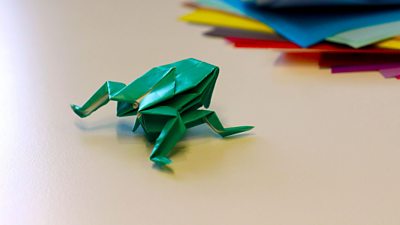
Where Reg was my constant companion as I tackled each piece of music, the Make-along has Sam Tsang, an enthusiastic origami expert who takes the viewer on a step by step guide to making an impressive origami jumping frog. Through clear instruction and demonstration anyone can mimic Sam’s lead. But while instruction videos are commonplace across the internet, the Make-along puts the viewer firmly in control, able to choose between three different camera angles to best follow each tricky fold, or display a diagram showing exactly what the paper should be doing. And rather than the film being a distant and disconnected playout, Sam’s Make-along pauses after each instruction waiting for, and interacting with, the viewer to ensure each move is easy to follow or repeat. Our Make-along is a digital and very up-to-date interpretation and expression of instruction, practice and time.
From a producer’s point of view, the Make-along feels completely complimentary to the programme. Sam’s film was shot by the same indie that created and produced the series, RDF Television, so it achieves a consistent style and look of what viewers see on television. It was important that it didn’t feel like an uncomfortable and incongruous add-on. I’d previously been shown an R&D prototype of how object-based media had been used to create a Cook-Along Kitchen Experience, a similarly interactive baking guide which walks the viewer through each stage of a recipe and it wasn’t a difficult leap to see how the technology could be applied to a companion for MAKE!, a programme which rests on the recent upsurge and interest in all things crafty. However, this would be the first time an OBM product would be aligned to a broadcast series.
And as for the novice origamist, there were lessons for us along the way. We were lucky to have enthusiastic commissioners in Owen Courtney and Clare Patterson and a willing indie and exec in RDF Television and Teresa Watkins, who embraced the idea warmly and provided the raw film of Sam’s instructions during their own capture for the programme. The idea for Make-along came about after the programme was green-lit and there are undoubtedly further gains to be made for any similar projects in the future being conceived at the same time as the on-air commission for traditional channels. There are both editorial - and let’s face it, economic - advantages to similar make-alongs in the future being commissioned alongside the broadcast programme. Being part of a holistic editorial proposition should be the goal for commissioning teams in the future and can only be a benefit to the overall offer for audiences.
At BBC Arts we have been working closely with BBC R&D to test how technological advances can provide innovative ways of storytelling. For the landmark Civilisations series we’ve put some of those cutting edge R&D tools in the hands of museums and libraries to encourage them to tell their own stories and demonstrate their expertise to broaden audience engagement around a series and theme. And the broadcast of MAKE! and the release of the Make-along coincides with the Get Creative Festival, a partnership project which encourages everyone to try, do and share something new and creative with 1,000 events across the UK. I think both those examples show how what we do is no longer limited to a box in the corner of the living room disconnected to the rest of our lives.
I believe that lean-in and interactive elements such as the Make-along can have a real impact on audiences. In the summer of 2017, the BBC director general outlined his vision of how he wants us to create willing communities with our audiences, building on the successes of programmes such as Springwatch and Stargazing Live which have shown what can be achieved by inviting people with a passion to join forces with our on-air experts. Tony Hall said he wants to see a future BBC doing “so much more in letting audiences help create, shape, and curate our content, so they can become their own schedulers, our next advisers, our future innovators”. I hope by having the Make-along accompany MAKE! Craft Britain it will help nurture seeds of creativity and go some way to address that ambition.
- Tweet This - Share on Facebook
- BBC Taster - Make-along: Origami Jumping Frog
- BBC R&D - Object-Based Media
- BBC Four - MAKE! Craft Britain
- BBC R&D - Cook-Along Kitchen Experience
- BBC Arts - Get Creative Festival
- BBC R&D - The Mermaid's Tears
- BBC R&D - Responsive Radio
- BBC R&D - Forecaster
- BBC R&D - Story Explorer
- BBC R&D - Newsbeat Explains
- BBC R&D - Visual Perceptive Media
- BBC R&D - Living Room of the Future
Future Experience Technologies section
This project is part of the Future Experience Technologies section
Topics
Search by Tag:
- Tagged with BlogBlog
- Tagged with ProductionProduction
- Tagged with Content FormatsContent Formats
- Tagged with InternetInternet
- Tagged with ParticipationParticipation
- Tagged with PersonalisationPersonalisation
- Tagged with InteractivityInteractivity
- Tagged with User InterfacesUser Interfaces
- Tagged with VideoVideo
- Tagged with Future Experience TechnologiesFuture Experience Technologies
