Live and immersive: Reimagining live music for younger audiences
Real-time volumetric streaming - placing audiences into live events is making music more accessible - through immersive, browser-based experiences that feel like being there.
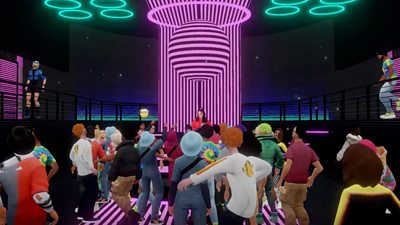

Immersive technology is changing how people experience live events - especially for those who can’t attend in person. We’ve been exploring how it could bring audiences closer to music in new, more inclusive ways.
Inclusion is very important to the BBC, and so our focus has been on how use this transformative technology to build experiences that resonate with young people who face barriers to attending real-world events because of their location, finances, age, or other social factors.
In the UK, an estimated 14.8 million under-24s identify as gamers. While platforms such as Fortnite and Roblox are widely recognised as gaming platforms, for many, they act as digital hangouts for connection, creativity, and shared experiences.
This shift in audience behaviour opens up new possibilities for live content - especially with audiences raised on gaming and who expect more than passive viewing. By combining immersive formats with BBC programming, we’re exploring how to make events more accessible, more interactive, and more engaging - letting audiences take part in the moment as it happens.
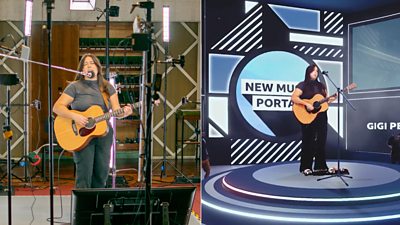
To do this we partnered with Bristol-based tech company Condense on their Condense Live system that uses volumetric capture to stream real performers into virtual spaces, preserving their authenticity and energy. The performance within a capture area is picked up by a system that tracks every movement. This transforms the performance into a live 3D model and streams it into a browser-based virtual venue to view it from any angle. This realism sets the experience apart from pre-recorded animated virtual concerts that use motion capture to animate avatars. And our experience works on mobile or desktop, with no downloads or special equipment required. Inside the virtual venue (the Portal) users appear as an avatar, and it feels like watching a photorealistic performance inside a video game.
The experience is shaped by multiple elements: the performance, the venue, atmospheric lighting, crowd dynamics, individual customisation, and interaction. Conversation happens on the instant messaging platform Discord, where we built our live immersive community. Altogether, these compelling components create a compelling whole that resonates with audiences.
This approach opens up creative possibilities for radio. Traditional broadcasts - live or pre-recorded shows, and in-person events - can now add a new dimension: the ability to host a live virtual audience for broadcast performances. It also enables the creation of unique, immersive moments that aren’t possible in the physical world.
Immersive performances to date
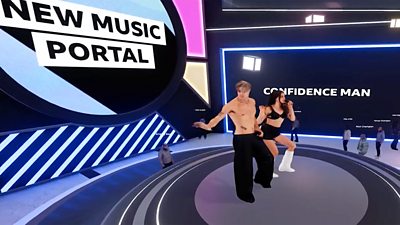
We’ve now delivered many events alongside Radio 1 shows. Most were captured at the BBC’s Maida Vale live music studios and include:
- The New Music Show with Jack Saunders: 30-minute live sets from artists Sam Tompkins, Good Neighbours, Joey Valence & Brae, Nilüfer Yanya, Confidence Man, NIKI, Royel Otis, Magdalena Bay, and Gigi Perez.
- The Future Pop Show: Live sets from artists Elle Coves, and Lily Knott.
- Rave Lounge: A 3.5 hour Radio 1 DJ show with Danny Howard, Jaguar, Pete Tong, Sarah Story, Jerry Asiamah, and Martha
- BBC Introducing: A virtual festival, featuring thirteen up and coming performers.
We have also delivered the ambitious capture of the Dance stage at Radio 1’s Big Weekend outdoor festival in Liverpool - one of the BBC’s largest live outside broadcast events. Over three days, we streamed hours of DJ sets virtually in the Dance Portal to complement traditional radio and TV shows from the other Big Weekend stages.
It has been our biggest technical challenge so far. We had started by capturing individual performances at Maida Vale, using a 500mbps internet connection that met our initial requirements. But we knew replicating this setup elsewhere would be ambitious, especially at an outdoor festival. Despite the risks, we took the chance to experiment and learn, overcoming some hurdles along the way.
The challenges
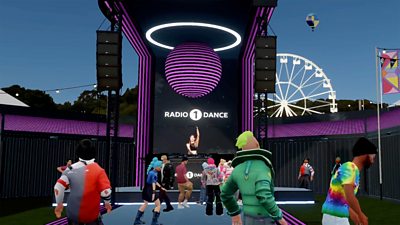
The shared internet infrastructure at Big Weekend quickly became a bottleneck, which severely limited our ability to stream the performances in the Portal. We resolved this by securing a direct-to-ISP line with the dedicated bandwidth that we needed.
Condense also worked to reduce our internet demands from 500mbps to 100mbps – with the potential to go as low as 50mbps. This breakthrough, achieved by moving the data compression algorithm from the cloud to a local rack-mounted GPU server, was key to making our capture rig mobile and ready to stream.
Another issue was camera placement. Our cameras demand precise positioning and stability, but moments before going live, a camera was knocked and affected the capture. We negotiated a two-minute window between DJ sets - unheard of on dance stages - to recalibrate. This meant we could fix this when it happened and let us keep the stream running.
While in real life haze is essential for light effects on stage, it interferes with our depth-sensing cameras. We were able to switch off the haze effects on the last day to unlock the clearest depth-sensing performance yet for our virtual audience. Combined with a stable rig, this gave us the clearest insight yet into our system’s capabilities.
What we’ve learned - in the rig, less is more
From our trials at Radio 1’s Big Weekend, we have now defined an immersive festival spec, ready to guide future outdoor events.
The rig performs best in a 2x2m square and accommodates one to two band members. The available resolution gets split across whoever and whatever is in the rig, so more surface area to capture will lead to reduced quality.
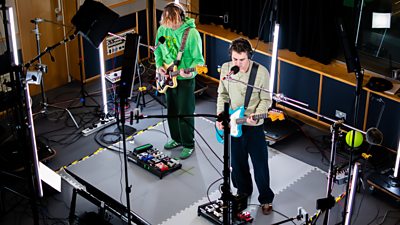
Pictured above are Royel Otis with their guitars and pedalboards. We discovered elements like guitar pedalboards on the floor introduce technical challenges as they result in many small polygons that create visual noise and makes compression more difficult. Learnings fed back into product improvements, as well helping us determine which music acts make for a good representation of the technology.
Volumetric video: Making it practical
We describe the volumetric capture rig as a ‘production kit in a box’ - equipped to film, capture audio and provide lighting. The rig includes ten depth-sensing cameras to capture RGB and depth data around each performer, processed in real time by mini-PCs and a rack-mounted GPU server to create a live 3D mesh.
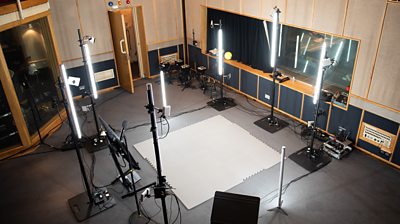
Volumetric video has long been costly and complicated, and streaming it live is challenging since compression standards do not yet exist. Condense’s compression algorithm delivers volumetric video in a fraction of a second, a breakthrough in real-time 3D capture and streaming. We worked with them to develop mesh and texture compression pipelines which could potentially inform standards in the future.
Our insights: Accessibility and engagement
Throughout the project, we’ve consistently heard these immersive experiences help overcome barriers - whether age, geography, finances, or social circumstances - that prevent audiences from seeing their favourite artists or attending nightclubs and festivals. At Radio 1’s Big Weekend, virtual attendees described the powerful emotional and social impact of feeling like they’d seen their favourite DJs live and experienced a real festival. This was intensified by the noise of the live crowd - something repeatedly mentioned as enhancing authenticity.
Also, we use browser-based experiences to expand impact. While VR offers exciting possibilities, not everyone owns a VR headset, and optimising for browser-based experiences accessed via laptops and mobile devices ensures a broader audience can take part, making the technology more relevant and inclusive.
Reimagining audience connection
These events layer traditional live radio and TV with immersive experiences, to create hybrid experiences that extend beyond physical spaces. This is pioneering innovation, setting new standards and reimagining BBC content in ways that truly resonate with audiences in the online, social, and connected spaces and places where they already live. Audiences can explore, interact, and feel part of a community while performers are captured authentically.
We’re continuing to learn, experiment, and create immersive experiences that we hope to bring to you soon… music is only the beginning!
We’re partnering with forward-thinking teams inside and outside the BBC on the Future World Design and we’re always looking for partners with bold ideas for strategic commercial collaborations at the intersection of media, tech and culture.
If you have a commercial opportunity we should be working on next, contact us at [email protected].
Search by Tag:
- Tagged with ImmersionImmersion
- Tagged with InteractivityInteractivity
- Tagged with VR AR and 360 VideoVR AR and 360 Video
- Tagged with Content FormatsContent Formats
- Tagged with Graphics and EffectsGraphics and Effects
- Tagged with FeaturesFeatures
