| |
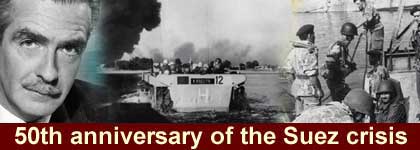
Did you serve in 1956? Were you involved in public policy or do you have relevant photos or even audio material from that year? Or do you simply have a view as to what impact Suez had? Whatever your role and whatever your recollections or thoughts - however minor - we'd like to hear from you.
Here are a selection of the emails we received from you.
My sister and I were born in Suez. My father was an engineer for Shell and one of the last out. Many of his colleagues were imprisoned in Cairo for weeks. My sister and I travelled on one of the last planes out - an old Comet. We had 12 hours to get out. We lost most of our toys which was traumatic at the time. We were interviewed at Heathrow airport by Reginald Bosanquiet, where I responsed to a question " that I did not know much about the war but if there was one I hoped the Egyptians won". A foreign office official who had begun to relax as the adults had finished being interviewed , jumped up all of a fluster and demanded that this part of the interview be censored. I guess my response reflected the fact that most of my school friends were Egyptians and I was worried about them. Anyway a civilian childs perspective!
From: John Wheeler
I was a Troop Officer in command of General Stockwell's Rover Group which consisted of two Saracen Armoured Cars. We left the UK in a requisitioned Merchant Navy Landing Ship Tank for Malta. At Malta, I was informed by the army commander there that the sealed box of maps I had been given was not to be opened until I had heard personally that war had been declared on Egypt. We set sail again with the sealed box of maps held in the ship's safe. However war was never declared, so when we were within twenty four hours of landing, I opened the sealed box and found that it contained maps from Algeria, North Africa and Syria, with the exception of Port Said! The ship's captain was excellent and gave me a whole bundle of ship's charts of Port Said which were superb maps for our requirements.
From: Peter Flear
I was serving in the R.A.S.C. - with the No- 10 Brigade- Army Fire Service. I don't think my recollections will be very interesting, but, here goes! I was sent with a small detachment of nine men to Cadoxton in South Wales. We were 'guarding' petrol stacked in four gallon 'jerry cans' in an enclosed area used as an ammunition depot. This was fuel that was to follow ground troops to Suez, should it be needed, of course, it never was. Although petrol was 'rationned' in Civvy St. we had access to it 24 hrs a day, cleaning fire appliances, igniting barrack fires, (very dangerous!) and any other task we thought fit. As part of our duties we were required to carry out 'pump testing' and went o to the dockside where there was a cargo ship that had been 'requisitioned' from Newcastle-upon-Tyne, by the War Office, eventually to go to Suez. This ship only had a skeleton crew whilst awaiting loading, during the weeks before the Emergency broke out. Our NCO, who also came from Newcastle, dared the youngest member of our crew to shout up at the ship's crew on the deck. The NCO said shout 'Who hung the monkey?' - so he did! The response to this was that the crew, who were obviously from Newcastle, became very angry, and proceeded to come running down the gangplank with heavy batons in their hands! You never saw a fire crew haul a one-ton fire pump to get out of a dock yard so quickly! I recalled an old story about a Monkey who was thought to be a spy and hung by Newcastle people during W W2. The N C O who was in charge of our Detachment in Cadoxton was from Manchester, and he would take our Land Rover on sorties to Cardiff every few days. He hinted he had found a 'market' for petrol there. We didn't believe him as he was an habitual liar! Anyhow, Army fuel had red dye in it, so we thought he would never be able to sell it. However, the L Rover always had a strong smell of petrol in it! Months later, after I was demobbed, I remember reading in the Daily Mirror that he had been jailed for six months by a Manchester court. Obviously his enterprising ways had caught up with him. For me, the Suez Emergency was quite an interesting experience, on a personal level. After returning a few weeks later to my main Unit in Warwickshire, we had a War Office inspection. The Brigadier inspecting the men on parade picked on me to ask my opinion on being sent to Cadoxton, and not wanting to disappoint him I related the first part of the story above, I didn't relate the second as I didn't know the full outcome at that time, The Brigadier said that he was responsible for sending the Brigade Detachment to Wales. I was just thinking how pleased I was that the taxpayer's money hadn't been wasted!
From: Bill Hill
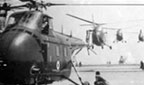
We landed on the beach at Port Said in amphibious "ducks" as infantry support to the Marines.When the anti-tank gun was fired the back-flash from the breach knocked the concrete parapet down on top of a Royal Marine below. He was injured but I cannot recall to what extent. After 2 weeks we left Port Said and returned to the Marine Barracks on Malta and moved onto Cyprus to rejoin my battalion.
From: David "Bob" Pierce - Royal Berkshire Regiment Anti-Tank Platoon
I was serving in the Royal Navy during the 1956 Suez campaign, on a small Landing Craft H.M.S. Parapet. My position on the ship was Chief Bosun's Mate, responsible for all seamanship and ships general maintenance.The ship took part in the Suez landings, going up onto Coronation Beach in the first wave of the landings. We carried onboard soft- wheeled armoured vehicles, namely Saracens. My duties during the beaching was at the stern of the ship, manning the stern Kedge Anchor. This anchor is dropped on the approach to the beach, and is then hauled in, to take the ship off the beach. We unloaded the vehicles without any mishap, and while we were moving off the beach we had a radio signal from the lads that we had landed, saying there was a lorry loaded with rockets, primed and ready to fire, which would have taken us out, but the Egyptian soldiers had left their post and not fired the rockets, thereby saving lives and damage to the ship. H.M.S. Parapet was then used as a ferry, taking troops from larger ships and transferring them to the beach. After the initial landing we were then put into service in the harbour ferrying goods. At the end of the campaign our role was reversed, taking troops and stores back to the large ships. We then made secure all the ships that the Egyptians had sunk in the harbour, and we were the last to leave Suez, wondering what it had all been about! We set sail to Malta, and on Christmas Day encountered a fierce storm, which put paid to all our celebrations, think of a small flat bottomed craft in a storm, not very pleasant! I was also serving in the Suez Canal onboard H.M.S. Chevron, when in 1952 the Canal was nationalised by Nasser. We spent many months, at different periods, patrolling the Canal. Coronation Day we were berthed at Port Said. During these stays we had to be vigilant against attacks by under water divers. We lost one of our clearance divers, thought to be by attacking Egyptian divers.
From: Bernard Seale
I was serving in a 'T' Class submarine at the time of the Suez crisis. Our boat returned to Faslane at the end of a six week ' Mystery Trip', all Cold War submarine crews know what is meant by a mystery trip. After removing our clothes for the first time in six weeks and having a shower on the depot ship we heard that the RAF were in action at Suez. We were put on notice to provision and fuel the boat and sailed when that was done to the Med where we kept an eye on who was in the area . It made a change from the Arctic and we did pop into Gibraltar for a couple of days where we made up for the night out we had missed in Glasgow at the end of the mystery trip. The submarines at the time were the diesel variety, conditions were basic to say the least but we could always get a seat to ourselves on a bus because of the smell coming from us.
From: Trevor Coppock
In August 1957 as an eleven year old I was returning from Malaya on board a troopship, I think it was SS Oxfordshire. As we sailed up the Red Sea one of the lighthouses signalled the ship, and the ship replied. Shortly afterwards the captain came on the tannoy and told us this story. The last time the ship had sailed down the Red Sea before the Suez crisis, the lighthouse had signalled asking if they could have medical help, as they had a sick man. A doctor was sent over to the lighthouse and he brought back a patient suffering from appendicitis. The lighthouse was running short of supplies and only had some aspirin left in the medical box. The patient was duly operated on and dropped off at Aden. This was the first time since, that the ship had come up the Red Sea, and the lighthouse was signalling its thanks for the help. We were the first troopship back through the Red Sea following the Suez War. I clearly remember seeing some sunken ships to the side of the canal, and needless to say we were not allowed off into port.
From: Janet Scott
As a young soldier I served in the Canal Zone from April 1952 to June 1954 for which service I recently received the 'Canal Zone' bar to my General Service Medal (GSM). I hardly recognised the descriptions of service from some of your contributors, thousands and thousands of servicemen from all three services served over the years and the number casualties was comparatively small and in no way compared to Iraq as was inferred. Later as a young Lance Corporal I was part of an attachment to 3 PARA Group at El Gamil in 1956. Again I had difficulty in picturing the "Storming Ashore" mentioned by another contributor considering that it was two or three days after the first assault by 3 PARA on the 5th November and the helicopter assault by the Marine Commandoes on the 6th November both well documented. I must say that there was confusion over the two entirely separate events, the only real connection was the fact that they both happened in Egypt. I would maintain that the Suez Veterans Association should be for those many personnel who served in the Canal Zone from 1945 to 1955 for whom the 'Canal Zone' GSM or bar was awarded and that any association formed around Operation Musketeer should have a different name as indeed we have a separate bar 'Near East' to the same GSM for that action. It is a matter of great annoyance that the 'typical political cowardice' of the then government prevented it being named more accurately eg 'Port Said 1956' or from our perspective 'El Gamil 1956'. All opinions are of course my own.
From: Peter Boxall.
At the time of Suez I was a thirteen years old schoolgirl with very little understanding of the world outside Egypt . We were part of the ancient and flourishing Jewish community living in Alexandria and I thought of myself as Egyptian. I loved our life there with its mixture of Egyptian, European and Judeo/spanish traditions. On the day the Suez Crisis started for me, my parents were going out for the evening and because my school taught the classical arabic which Gamal Abdel Nasser used they asked me to listen to the important speech he was giving that evening and to leave a message if anything special was said. My note to them read "Nothing important, the Suez Canal is going to be nationalised, good night". My memories of the whirlwind events that followed are overshadowed by a mixture of bewilderment and excitement. There was a war, bombs fell on Alexandria, we hid in a shelter. Suddenly our arab friends and neighbours avoided us, school closed and we were sent home from our Jewish youthclubs with strict instructions not to go out again.There were noisy demonstrations in the street calling for 'death to the foreigners' . Adults looked permanently anxious and sad, the question on everyone lips was 'What's your nationality' . Jews with foreign links were expelled from a country most of them thought of as home. Elderly people who had lived in Egypt for generations found they had a British passport obtained long ago through service in India . They were now the Enemy and were given a few days to pack and leave. Within a few months, the community was dispersed once again to the four corners of the globe, a new generation of refugees was created by international conflict. Because of Suez, I came to live in England and to a very different life. 50 years , I now know more about the Suez crisis and realise that we were the 'lucky refugees, who only lost material goods and a comfortable life. We lost no loved ones and were not harmed physically. For me, childhood in Egypt was a golden time which has enriched every aspect of my life for ever.
From : Viviane Ettinghausen
In response to your request for divers recollections of the Suez episode, my memory is that of a civilian. I was a young woman in my twenties at the time and went with a friend and her 3 primary school children to Trafalgar Square to hear Aneurin Bevan and others speak out against invading Egypt. We were part of a huge crowd of people from all walks of life, very worried by the increasing threat of war and hoping that our presence would help to show the strength of opposition to it. You will know how it all ended. What you may not know is that, as some of us were making our way home, walking towards Westminster tube station via Whiteall, we were attacked by a large contingent of mounted police, who drove their horses up on to the pavement pinning us to the walls. There were many elderly people as well as children among the crowd, all of us terrified of being trampled by the huge animals and the quite ferocious behaviour of their riders. It was one of the most frightening experiences I have ever had and one I have never forgotten, something quite alien to what I'd always thought of as our way of life. I am in my seventies now, a widow living in Wales, still concerned with the state of the world and agreed when a friend asked me to accompany her to the Big March in London against the threat of war in Iraq. We left home at 5 a.m. to get there and that too was a truly memorable experience. There was no charge by mounted police this time, but then it would have been quite difficult to intimidate a crowd of well over a million people, opposed to going to war. However the outcome was just the same. The Conservative government of 1956 paid no heed to the vox pop. of 1956 just as the new Labour government ignored the infinitely greater opposition of 2003. Politicians wonder at the cynicism of electorates. Electorates eventually realise that politicians do not change.
From: Ruth Fisher
As a 19 year old soldier I was serving as Bombardier in the 33rd Para Field regiment RA (No 23177122 - you never forget it !) and remember the following:
1. In early August 1956 as a Regiment we marched early one morning through the streets of Portsmouth on our way to join the Theseus (Aircraft Carrier) which was to take us out to Cyprus as a stepping stone for Suez. We had just been issued with new boots and they were the first rubber soled boots we had seen. Marching through the streets was very difficult since there was not the usual Clip-clop from the old tackety boots and we got hell from our superiors for not marching in step. 2. I was told later by a Naval Officer that we sailed under 2 living VC's. One was the captain of the Theseus and the other was the Army Officer in charge of the 16th Parachute Brigade of which we were all part. At one point in the Med one of our number (The armourer) was washed overboard in the Med and through an extraordinary feat of seamanship by the Theseus rescue boat was found and rescued though later discharged for medical reasons since the 'drop' from the Flight Deck where we lashed ourselves at night for fresh air didn't do his ribs and other bones much good. 3. In Cyprus we were on internal security vs Grivas from August-Nov when we went into Suez. 4. There were only enough parachutes for the 3rd Battalion to drop at Suez at the El Gamil airfield and the 'enemy' had been warned where the drop would occur so they got quite a hot reception. My Regiment went to Suez on a Tank landing craft or ferry that leaked ! 5. Upon our arrival in Port Said there was a typical example of British efficiency and planning for the essentials.We arrived in Port Said harbour, the area was hostile with bullets flying around but there as we disembarked was an army postal orderly with letters shouting out the names of those lucky enough to receive a letter from home. This typical attitude and Army organisation and attention to the important, did much for morale ! 6. My Battery was stationed at El Tinah down the canal and our engineers cobbled together one of those workmans railway trucks (normally driven by hand crank) but this time mounted with a motorcycle engine that sped up and down the railway track between the sweet water canal and the real Suez canal. Our Brigadier asked for a ride and was promptly deposited (by mistake) into the sweet water canal whose name belies its real make up ! 7. In Cyprus I was given the choice of returning to UK to take W.O.S.B. or go to Suez. I chose Suez but the War Office still processed my papers for WOSB so I was flown home to UK 5 days before Christmas 1956, given 2 weeks leave and then went to WOSB. I remember the petrol shortage in UK and wondered why until someone said to me-what do you mean why? It's because of you silly bu**ers out there in Suez !! I hope this may be of some interest ?
From: Ian Mackinlay
I was a national serviceman on leave from the army having just completed training in Field Security. I got an RTU telegram immediately; my parents were worried but everybody else was supportive and some enthusiastic - my pub landlord even bought me a drink. On the train an elderly man in civvies told me I should not be getting involved in a "crime" and urged me to refuse to go. I had no idea what he was talking about - being only 18 - and assumed he was mad. I wondered whether I ought to tell the police that he was inciting soldiers to desert. In the event I never got to Suez and was given a home posting. At the time I regretted not having gone.
From: David Jones
I served in No. 216 Squadron, R.A.F. July 53 - Nov.55. at Fayid in the Canal Zone. I have very different recollections of the period before the invasion from those you expressed. I was frequently away from home and had no reason to feel anxious for the safety of my family, living in a "hiring" near the Great Bitter Lake. Security off-base was the responsibility of the Egytian police. I heard of no attack on servicemen or families. I well remember the distress felt by service people when an Egytian police captain was murdered by a British soldier. At the soldier's trial, which I attended under instruction, Rose Heilbron prosecuted.Our only problem was the risk of theft from our homes off-base, but not of violence. I remember that when an agreement was reached to leave the Canal Zone, there was rejoicing and Egyptian army officers came to the Officers' Club at Fayid and joined in.The Suez invasion was unpopular in the R.A.F. There was open resentment and some opposition. One pilot lifted the undercarriage at Nicosia to avoid taking part in the action. A few years ago, I met one of the prosecutors at his court-martial and he expressed his sympathy for the officer concerned. I didn't hear any mention of Israel and the U.S.A. in your programme. A joint action with Israel was most unpopular. The Israelis were regarded almost as enemies by us in the zone because they threatened military action against any of our aircraft which flew over their territory. The result of that was we had to fly to Aqaba en route for Iraq, a dangerous diversion in bad weather. That cost us an aircraft and the loss of three very fine young men. Many Egyptians and Palestinians worked on the base and were well-liked. The arrival of General Neguib and Colonel Nasser was an opportunity for my country to form a new and valuable relationship in the Middle East but we had no leader with the intelligence and vision to see it.
From :Kenneth Shaw
My father, Major William (Burnie) Burnhill, was killed in Suez while on active service as Quartermaster for the Field Hospital on 19th March 1954. I have read the newspapers that carried the story at the time, it made the front pages, so I don't think that tragedies like this were ignored at the time by the media and the general public. My mother returned home to our extended family in Aldershot with a six month old son (my brother Tom) and myself (just three years old). My father was 46 years old and due to leave the Army having joined as a boy soldier and seen service in the 'medics' during WW2, and with the Field Hospital in Athens (1946) and Haifa (1948). Suez was one post-Imperial posting too far. My mother was 43 years old; they had just enjoyed late parenthood, albeit for a too short a time. The lack of recognition given to Suez participants has effected my uncle, Harry Dalziel, more than my brother and me. Perhaps this is because we have both had to take some things as given, and move on; perhaps it is because he still remembers Bill as first his best friend and then as his brother--in-law (sister's husband). He has been writing to secure that medal. There is formal recognition by the RAMC, as my father's name is listed in the Book of Remembrance that is housed in the West Wing of Westminster Abbey. Ironically this has bestowed on me a right of entry to that part of the Abbey; I have comparable right of entry to the Memorial in Edinburgh Castle where my grandfather, my mother's father, is listed among the fallen at Ypres, 1915. He also joined as a boy soldier, and was in his late 40s and due to leave the Army - in his case the 2nd Battillon of the Seaforth Highlanders. He left behind a widow and family of seven, my uncle being the youngest. These personal tragedies occurred in all our name, they require formal recognition. That said, I cannot say that the MOD neglected the widow and orphans of the soldier who was killed when travelling to the Field Hospital that day in March 1954, and I still remember the yearly Christmas cards 'from your friends at the Ministry' and the odd look from the Bank Cashier when I presented my 'Orphans Allowance'. Although we must all move on, and do not dwell in the past, the phrase 'Lest we forget' is brief but very apt.
From : Peter Burnhill
My father served in Egypt from 1949-54 and we, a family of 6 children, were with him. Memories of "the troubles" remain strong: whispered tales of soldiers torn apart by mobs; the English nun at the French Convent in Ismailia, shot because she stood up to an Egyptian raid; army camps virtually under seige; nightmares that "the enemy" may break through the perimeter at night; the death of the officer who had stood in for my father on one journey; sitting in an army vehicle protected by a young National Serviceman clutching a stun gun as a screaming crowd built up around us. Such things one can't forget.
From: Catherine MacLucas
My family was living in Egypt at the time of the Suez crisis. My father was interned by the Egyptian army along with other personnel who were working in the immediate area, while my mother was given one hour to leave the country together with her - at the time - two small children. They lost all their possessions, but more importantly, that group of internees was held for weeks under fear of their lives; with no news of them reaching their families back home except sporadically via the Swiss embassy. That group was small to start with and with attrition is presumably now very small indeed. I have often tried to get my father to set down his story of that time but, like most who served in WW2 and so on, it's very difficult to get them to do so. One thing I do know - because I remember it vividly in my childhood, was the duffle coat he was given by the Red Cross on release for the journey home - the internees literally had nothing but the tropical gear they had on at the time of arrest. After he finally reached home, believe it or not, a bill for the coat was delivered to my grandparents house where we were staying. Much to my mother's outrage, my Dad actually paid it. He had that coat for years.I don't know whether any real documentaries are being made about Suez or whether any institution is seeking out these real stories, but I think it's such a shame that history is hardly ever written by the modest and retiring.
From: Dr Lloyd Carson
My name is Ray Evans. I was in the RAF and the Egyptian Canal Zone from 1954 - 1956. Actually based in Cyprus during the build up to the hostilities commencing, but lucky enough to be posted back to England just before November of that year.The one thing that I would like to draw attention to is that the withdrawal and the 'shame' that it caused to the regular armed forces was massive and meant that many senior NCO's etc., the actual backbone, decided that to be treated like that was not worth a light and resigned as soon as they could or did not extend their service careers. This I believe was the direct cause of subsequent problems with recruitment. Our forces have never recovered the respect they were held in prior to that surrender to the American demands.
From: Ray Evans
I was doing my national service at the time of Suez in HQ AER Kempston, Bedford. The camp was a collecting point for army reservists, called up to be sent to the middle east. My main memory is of argument, dissent and desertion. Many of the reservists, especially those from Scotland, refused to be sent to Suez. I'm not sure whether this was reported at the time. But it was one of my first experiences as a young man of radical division within British politics. I had not registered as a conscientious objector out of fear of being different in 1955. Here were 'soldiers' refusing to fight in an immoral imperialist war. Talk about 'Look Back in Anger' (wasn't that 1956)! I have never looked back since, and the present crisis for soldiers posted to Iraq, continues the struggle for human rights against the powers that be. As Voltaire said so long ago, il faut ecraser l'infame.
From: John Hoyles
I served my National Service with the 3rd Regiment R.H.A. and was stationed at Homs in Libya when the crisis broke. Our regiment was put on a 24 hour stand-by for a move into Egypt to help re-take the Suez Canal. I was aware of the fact that the British Forces in Libya could not be used for aggressive purposes under the terms of the treaty which had been drawn up to enable our troops to be stationed there. I informed the Battery Commander that I would not be taking out any equipment nor would I be taking part in an illegal move into Egypt. My expectation was that he would have me marched to the guardhouse and later brought before a court martial. He sat for a while and then suggested that the C.O. would be interested to hear what I had to say.
After a couple of days a notice was placed on battery orders to say that the regiment would not now be moving into Egypt because it had been drawn to the Prime Minister's attention that our forces in Libya could only be used for the purpose of the defence of that country.
I have wondered for fifty years if my protest had moved up through the ranks to reach Anthony Eden's ears.
From: William Pickett, Dumbarton
I was the First Lieutenant of a 'Ton' class minesweeper - HMS UPTON in UK waters just before Suez. We were mobilised fairly quickly and steamed out to Suez accompanying the 'Ham' class smaller, inshore minesweepers. Taking shelter in La Rochelle due to very heavy weather which really threw the Inshores about.
We eventually returned to the UK - the same route, except that my 'sweeper was towed most of the way to Malta due to an major engine defect. Our return to UK was long after the allied force had pulled out and I well remember the sense of frustration that all our training, sea exercises and the slof our to Suez had been for nothing due to some damned American politicians putting the pressure on our lot and the Anglo-French weak-kneed response by pulling out.
From: Alan Webb
I joined the Foreign Office wishing to travel with my fluent French and French shorthand on leaving College. At the age of eighteen, I had the privilege of working in African Department, overlooking Downing Street, when the Suez crisis broke out. There were three "girls" working as shorthand typists. It was fraught and I experienced history being made seeing Selwyn Lloyd, the Foreign Secretary and Anthony Eden, the Prime Minister. My images of running feet and heads held in hands are vivid as is the fatigue, pressure and excitement. Would a young girl be given those responsibilities today?
From: Ann Pembroke
I served in Suez in the army during 52 to 54 and called up again for Suez in 56 although I was not involved in the invasion.I remember the constant tensions during my time there,.We were always armed and travelled always in pairs.I was a RAOC driver attached to the 2nd infrantry division near Suez town. We always had to go in convoy with armed guards.Road blocks where you had to wait untill enough vehicles had gathered so that you coulld pass through.We always had the previous nights incidents read out to us on morning Parade and they were numerous with break ins and people being shot at ect.Bear in mind most camps were like mine with a Perimeter barbed wire a big main searchlight and smaller ones at other corners.We all had to man these on guard duties which ended up by being every 2nd or 3rd night We were young so took it as our duty,but it was scary to walk the wire not knowing what might happen particularly during Ramadan .We lived in tents during my time and it was quite tedious .Thanks to the RAF at Shalufa who offered us some of their facilities. Im not suprised the Egyptians wanted their country back as we had been there a long time.
Gordon Chamberlain
I did National Service from 1953 to 1955. In January 1954 I was posted to the 41st Field Regiment Royal Artillery in the Canal Zone. In those days, if my memory serves me correctly, it was thought of as a punishment posting by the regular members of the armed forces. It was certainly a very dangerous place to be and this was brought home to me on the second night in the Zone. I could not join my Regiment straight away and so I was placed on guard duty at the transit camp in Fayid. I was on the entrance gate armed with a Lee Enfield rifle. At the side of the gate was a sandbagged pit with a Bren Gunner. I asked the Guard Commander why it was there and was informed that I was the "Ceremonial" guard for show. The Bren Gunner was the real guard safeguarding the entrance from attack and also me should anything happen.
I am aware that we were supposed to be keeping the Suez Canal open and safe from attack so that vital shipping could reach our shores, but less than twelve months after I returned home the Canal was in the hands of Egypt. We had made enemies of the Egyptians because of our "Occupation" and we had lost many good young men needlesly and without recognition until just a couple of years ago. No wonder so many of my generation are bitter about that era in our history and are opposed to the war in Iraq.
From: John Howard May
I was the youngest hand and sole national serviceman on the only British submarine to take part. We patrolled the mouth of the Nile, were nearly sunk by the French submarine on the next billet, attacked by an Egyptian/Russian frigate, had a periscope's eye view of the landings, and of the US 6th Fleet's attempts to interfere.
From: Anthony Whyatt
I was disappointed that you said so little this morning about the Naval contribution to the Suez Campaign - particularly that of the aircraft carriers and aircraft involved. It always seems to be the same! I was a young - twenty year old - Sea Hawk pilot and this was my first taste of action. We were heavily tasked throughout the six days. I was happy that we saw not one MIG 15 airborne - although we destroyed a lot on the ground . Along with everybody else, I was disappointed, that the force was unable to capitalise on our success. Most of us were in the dark about who our Allies would be and we were relieved to be on the same side as the Israelis!
From: Richard Wren
I was very interested to hear the recollections re. the Canal Zone. My mother, brother and I sailed from Liverpool to Port Said to join my father, who had been posted to Egypt for 3 years in 1951. It was soon after we had settled in Arashia, a part of Ismailia, that the Egyptians began action to get the British out.
As children, my brother and I were not aware of the hostility that the British military presence engendered, but I still have one of the letters that was sent to the wives of servicemen advising them to persuade their husbands to leave or they would be shipped back home to them in coffins. We knew that our father was sent out on night patrol along the banks of the Canal and that he risked being attacked. We returned to England in 1954 but my father was sent to Cyprus in 1956 when the Suez Crisis came to a head. He was on standby, ready to go to the C anal Zone once again. However, his battalion was not needed. I agree that it is time that there is some recognition for those who served in the Canal Zone either before or during the Suez Crisis.
From: Mrs Pamela Hemming
I served in Suez in '51 and '52. As your prog correctly stated, despite large casualties and severe conditions we were not even granted a medal until 50 years after the event. Most of us were teenagers, dreadfully unprepared mentally for the hardship and horrors we were to experience. Much we took in our stride and learned very rapidly how to cope but some experiences have lived with me for the half century since. I was in the RAMC but not trained in trauma procedures, nevertheless, I was posted to work in an emergency operating theatre in a Station Hospital. We collected casualties from the destruction of the Police Station in Ismailia-more than 50 casualties many of whom were too badly wounded to save. We worked for more than a day without a stop. The Padre was washing the floors for us, a dentist was assisting the surgeon, a civilian engineer was our clerk. We were filthy, hot, tired, horrified and traumatised ourselves. There was no post trauma counselling in those days. I have a 20 year old son, if I enter his room whilst he is sleeping his face changes in my mind to one the faces of the dead youths I saw those 50 years ago.
From: Ken Brock
Get in touch with us - via email,
By letter:
Today Programme
Suez 50th Anniversary
BBC Radio 4
Room G630, Stage 6
Television Centre
Wood Lane
London
W12 7RJ
or fax:
0208 624 9630
Add to the recollections on this site and join in the listeners' debate.
 Back to Reports Homepage Back to Reports Homepage
| | | | |
| | |