| | |   | | | | | Michael Wililams's diary | | | |
 Michael Williams Michael Williams
Michael Williams is with the British forces in Kuwait
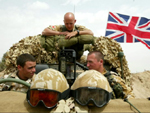
British soldiers in Kuwait
| | | |
Stand alone on the vast sands of the Arabian Peninsula and the enormity of the landscape seems almost overwhelming. The world above is blazing blue and, beneath your feet, the sand and dust and stone stretches to an unreachable horizon.
The desert makes men appear small and in Kuwait, the dunes have absorbed at least a hundred thousand soldiers (the exact number is one of many military secrets here) penned together in their dusty camps.
Yet war is seemingly close (perhaps days, perhaps just hours away as I write this) and modern, industrialised humanity is imposing itself on this landscape.
In normal times, it takes effort and knowledge to interpret the quiet sounds of the desert. Now there are new, harsh sounds drowning out the usual whispers.
Where the armies are massing, the desert is deafening. The rotors of helicopters hack at the hot air and the jarring sound of metal on metal is everywhere. Yesterday I watched as British tanks and armoured fighting vehicles rattled across the uneven ground, throwing trails of dust high into the air behind them.
We had driven in convoy to one of the United Kingdom’s forward bases. I am not allowed to say where the camp is. I am not allowed to say who is based there. Nor can I say how many soldiers are collected on the hot plateau. But the numbers are enormous, the area is vast.
Everyone carried a weapon. Everyone had, strapped to their waist, a bulky bag containing gas mask, chemical protection suit and decontamination kit. It stays with them at all times; in the tent or the toilet or the trenches.
Constantly, almost subconsciously, everyone in this country is listening for the warble of the missile warning sirens or the shout of “GAS! GAS! GAS!”
It is Monday morning as I write this. Monday the seventeenth of March 2003. In the last couple of hours, the Foreign Office has told all UK nationals to leave Kuwait urgently. The United Nations mission here is pulling its people out of the DMZ - the demilitarised zone - which separates Kuwait from Iraq. It may not be demilitarised for much longer.
Politicians and diplomats around the world insist that a conflict can be avoided. But, here in Kuwait, it feels as if we are accelerating towards war.
As you drive through the desert, you see hazy images in the distance. As you speed forwards, the shapes begin to coalesce. Then, at some point, the objects seem to leap towards you, out of the dust and the heat. The shape of a war in the desert is looking clearer now.
| |
| |
|
|