| | | | | | | | | |

| | | VENUS ACROSS THE SUN
|  | |  | MISSED A PROGRAMME?
Go to the Listen Again page | | | | | Duncan Steele reports on a rare Astronomical Occasion | | | |
| |
On June 8, 2004, Venus - the Earth's sister planet - passes in front of the Sun as seen from the Earth. This very rare event (no person now living has ever seen one!) lasts about 6 hours and will be visible from most of Europe, Africa and Asia.
| | | 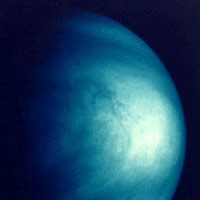 | | | Venus as seen by the Galileo Probe, courtesy JPL/NASA |
Programme 1 - Venus: Portrait of a Planet
In some ways, Venus is the twin of Earth, almost exactly the same size and only slightly less dense, made mostly of volcanic rocks.
But there the similarity ends and it’s certainly not a place to spend your summer holiday!
The thick atmosphere means that it’s always cloudy on Venus and that the pressure on the surface is 90 times atmospheric pressure on Earth.
The atmosphere is mostly carbon dioxide and Venus suffers a runaway greenhouse effect that makes the worst predictions of global warming on Earth seem positively chilly.
The surface temperature is 480oC and if there ever were oceans on Venus, they’ve long-since boiled away.
If you could stand the heat and pressure on the surface, you’d see an orange sky.
If it ever rains, it rains sulphuric acid.
However, Venus is the brightest planet visible in the sky and it is perhaps not surprising those who viewed it from Earth named it after the Goddess of beauty.
Best seen just after sunset or before dawn, a small telescope reveals that, like the Moon, it has phases as the Sun illuminates a crescent, half or full disc, evidence Galileo used to support the idea of planets orbiting the Sun.
 Listen again to Programme 1 Listen again to Programme 1 | | 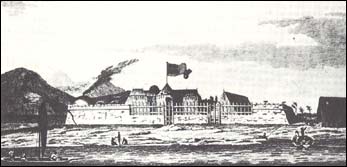 | | Fort Venus, Tahiti, erected by Capt. Cook to protect
his astronomical party in 1769 |
Programme 2 - A Shadow across the Sun
One of the reasons that Venus has so intrigued scientists for thousands of years is that its occasional transits across the face of the Sun provide a good chance to estimate the distances between the planets and the Sun.
In the 3rd Century BCE, Aristarchus concluded that the Sun was ‘nineteen times as high as the Moon’. (A heresy that had him thrown out of Athens!)
In 1639, a young astronomer, Jeremiah Horrocks, predicted and then observed a transit of Venus from the village of Much Hoole, South of Preston.
His estimate of the distance to the Sun was, at 59 million miles, a little short of the 93 million we now know to be true, but it was still ten times more accurate than any before it.
One of the main purposes of the voyage of Captain James Cook to the Southern Seas in 1769 was to observe a transit from there.
His measurements together with those of 137 others around the world, at last gave the correct distance to the Sun.
Only after observing the transit did Cook open his sealed orders instructing him to journey on to explore the ‘Terra Australis Incognito’.
In this programme, we look at some of the historical attempts to measure transits and the adventures that accompanied them.
We hear how to observe the event safely this year, about the observations professional astronomers will be making and how, in a reversal of travel since 1769, a New Zealand school party will be visiting Britain to observe this year’s transit.
Listen again to Programme 2 | | 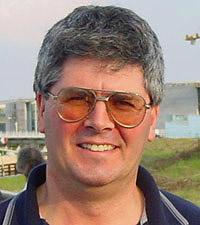 | | | Duncan Steel, Astronomer and Writer |
Duncan Steel is author of Eclipse: The Celestial Phenomenon That Changed the Course of History, published by Joseph Henry Press, where you can find more information on transit events.
| | |
RELATED LINKS | | | BBC Science & Nature - Transit of Venus
NASA Goddard Spaceflight Centre - local transit times worldwide
European Southern Observatory
The University of Central Lancashire
University of Auckland
Royal Society of New Zealand
The BBC is not responsible for the content of external websites
| | |
| | |
|