PROGRAMME 10: Greg Dyke on Captain James Cook
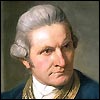 James Cook is one of Britain's foremost explorers. His three voyages to the Pacific added greatly to the fields of navigation, anthropology and biology. His aim was to go, "farther than any man has been before me, but as far as I think it possible for a man to go". James Cook is one of Britain's foremost explorers. His three voyages to the Pacific added greatly to the fields of navigation, anthropology and biology. His aim was to go, "farther than any man has been before me, but as far as I think it possible for a man to go".
Born in Marton, Yorkeshire, in 1728 to the son of a farmer, at 12 James Cook was apprenticed to an habadasher then later a shipowner. He joined the Royal Navy in 1755, gaining his Master's certificate two years late.
During the Seven Years War he commanded a ship charged with surveying the St. Lawrence seaway, then after the war was over surveyed the coast of Newfoundland. During this time he drveloped the skills which ensured his later success.
His first major voyage (1768 - 71) was a joint venture between the Royal Society and the Navy with the aim of witnessing the transit of Venus from Tahiti and also to search for the mythical great southern continent - Terra Australis Incognita.
Sailling in a Whitby collier, the Endeavour, Cook charted over 5,000 miles of new coastline, including that of the freshly discovered New Zealand.
On his second voyage (1772 - 75) he again tried to find the southern continent, sailing further south than any pervious ship. More importantly the voyage was a test run for John Harrison's chronometer, an indispensable aid for calculating longitude.
With his third voyage (1776 - 80) Cook voyaged to the North Pacific to try and discover the fabled North-West Passage. While he was unsuccessful in this he did succeed in charting the coast of North America, Alask and Siberia before returning to the Sandwich Isles (now Hawaii, which he had named after the First Lord of the Admiralty).
Here Cook died after a skirmish with the natives, the exact circumstances of which are still unclear.
Cook's legacy was immense. His voyages gave us the map of the Pacific which remains virtually unchanged to the present day. The fields of anthropology, astronomy, biology, language and oceanography were all greatly strengthened.
However possibly Cook's greatest contribution was his attempts to keep his crew healthy. By insisting on a clean, well ventilated ship, backed by a diet of fresh fruit and vegetables Cook ensured that none of his crew died at sea.
 Greg Dyke began his career as a reporter for the local press before joining London weekend Television as a researcher. From LWT he moved to TV-AM where he became Director of Programmes and Managing Director before returning to LWT as Chief Executive. He became Director General of the BBC in 2000.
Return to Great Lives home page.
|







 to programme 10: Greg Dyke on Captain James Cook