| | | THE LATEST PROGRAMME | | | |
| | The world not only looked a very different place after Captain James Cook's three voyages of discovery, but it was looked at differently too. | | | 
| |
PROGRAMME 3: 'THIS MELANCHOLY AFFAIR'
After the astounding success of his first two voyages, few imagined that Captain James Cook would go to sea again. After all, by 1776 he was already 48, no spring chicken.
In his final programme on the great but enigmatic explorer, Dr Nigel Rigby of the National Maritime Museum learns that Cook, born to a farm labourer in Yorkshire, with no private income of his own, was probably motivated by the prize of £20,000 offered to anyone who found the fabled North-West Passage between America and Asia. Such a route would conceivably have cut the journey time between Europe and the west coast of North and South America.
| 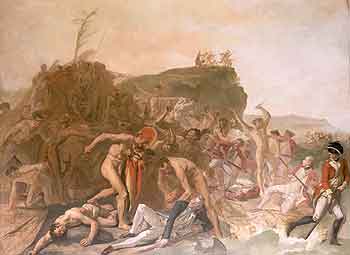
A portrayal of Cook's death. This image is courtesy of The National Maritime Museum ..>> |
It wasn't until the Twentieth Century that Polaris submarines and ice-breakers confirmed the existence of this North-West Passage. Probably the world's leading expert on Cook, Professor Glyn Williams considers the irony that today it's global warming that's likely to make the route passable.
However, Cook died in the attempt to find it, killed on the North Pacific island of Hawaii in 1779. In this programme, Dr Nigel Rigby considers how through his achievements Cook's name has lived on, every bit an influential
Producer: Mark Smalley
Reader: Bill Wallis
Music composed and performed by: John Metcalfe.
FURTHER READING
The Journals of Captain Cook, Phillip Edwards, Penguin Books.
Voyages of Captain Cook, Captain James Cook, et al Wordsworth Editions Ltd.
Captain James Cook, Richard Hough, Coronet. | |
| | |






 Listen to - introduction