

16:30 - 17:30
Sean Rafferty presents a selection of music and guests from the arts world.
Stravinsky's Orchestral Works Stravinsky's works fall conveniently into three periods. The first, his "Russian" period, lasts until just before the First World War. The key works of this period feature lavish and exotic orchestration, influenced by his teacher, Rimsky Korsakov, and the use of Russian folk-tales.
World War 1 created many economic difficulties and many musicians on all sides were either fighting or otherwise involved in the war effort. Stravinsky began to concentrate on using smaller groups of players and developed an interest in the procedures and techniques of classical and baroque composers. This neoclassical phase lasted until the early 1950s.
In his final years Stravinsky became interested in the twelve-note techniques of Schoenberg and his followers and began writing his own distinctive brand of serial music.
Stravinsky's works fall conveniently into three periods. The first, his "Russian" period, lasts until just before the First World War. The key works of this period feature lavish and exotic orchestration, influenced by his teacher, Rimsky Korsakov, and the use of Russian folk-tales.
World War 1 created many economic difficulties and many musicians on all sides were either fighting or otherwise involved in the war effort. Stravinsky began to concentrate on using smaller groups of players and developed an interest in the procedures and techniques of classical and baroque composers. This neoclassical phase lasted until the early 1950s.
In his final years Stravinsky became interested in the twelve-note techniques of Schoenberg and his followers and began writing his own distinctive brand of serial music. Key works
Stravinsky was born in Oranienbaum, Russia, and brought up in St Petersburg where his father was a bass singer at the Mariinsky Theatre. After thoughts of becoming a lawyer he began to study with Rimsky-Korsakov at the age of 20 and this study laid the foundations for his orchestral expertise and his supreme confidence in trying out new ideas. Hearing of an orchestral work the young composer had prepared for his teacher, the impresario Serge Diaghilev offered Stravinsky a ballet commission for his dance company, the Ballets Russes. This ballet, The Firebird, was the work which marked Stravinsky's arrival on the world stage as a significant composer. It was premiered in 1910 in Paris (see stage works) and uses a lavish orchestration. There are three distinct concert Suites arranged from the full ballet by Stravinsky, one in 1910, one in 1919 with reduced orchestration (the most frequently played and best known) and one in 1945, made for copyright reasons and containing more of the original ballet music than 1 and 2. Stravinsky's early successes all had Russian themes, but as an international figure he was soon asked to write purely concert works and the bulk of his orchestral output is from the 1920s, 30s and 40s. During these years he produced five concertos and three symphonic works. The Piano Concerto, written in 1924, is one of a number of works Stravinsky wrote for himself to perform, to help his finances after fleeing the Russian Revolution in 1917 and making his home in the West. It is striking in that the orchestra consists of wind instruments, with only the double basses of the string section taking part. It is in the usual three movements and has many baroque features. The Violin Concerto (1931) was written for violinist Samuel Dushkin who provided the composer with technical advice. It is in four movements and demands a lot of its soloist whilst maintaining the atmosphere and spirit of the baroque period. The Concerto in E flat Dumbarton Oaks (1938) was commissioned by Robert Woods Bliss and named after his house in Washington DC. Its three movements are reminiscent of Bach's Brandenburg Concertos, but always with the modernistic edge that characterises Stravinsky's neo-classical music. The Basle Concerto (1946), commissioned by the influential conductor Paul Sacher for his Basle Chamber Orchestra, is another modestly sized concerto grosso. The Ebony Concerto of the previous year is a different animal. Commissioned by the jazz clarinettist Woody Herman it is written for clarinet and jazz ensemble. Its three movements are rhythmic and vital, but short, the whole work lasting less than ten minutes. Of the symphonic works the first, Symphonies of Wind Instruments (1920), bears little relation to any known symphony. Its sombre wind chorales have been shown to derive from the Russian Orthodox service for the dead and these are interspersed with more lively wind writing. Stravinsky did not expect this work to be a crowd-pleaser but its stark rituals have an austere beauty. The Symphony in C (1940) and Symphony in Three Movements (1945) are much more straightforward with striking themes and ebullient neoclassical rhythms. Four Norwegian Moods began life as a movie score, for a wartime picture called The Commandos Strike at Dawn. The project fell through and Stravinsky was left with a book of Norwegian folk songs from his research into the Norwegian setting. "Although based on Norwegian folk tunes, the title Moods must not be interpreted as 'impression' or 'frame of mind', wrote Stravinsky. "It is purely a mode, a form or manner of style without any assumption of ethnological authenticity." This attempt to distance the music from any attempt at drawing 'meaning' or 'suggestion' from it is characteristic of Stravinsky, even though many listeners can create their own impressions from many of his works. Circus Polka was commissioned by the choreographer George Balanchine for the Barnum & Bailey Circus and was first performed in 1942 with "Fifty Elephants and Fifty Beautiful Girls in an Original Choreographic Tour de Force, Featuring Modoc, premiere ballerina." Modoc was, of course, an elephant who adapted very well to the quirky rhythms and irregular bursts and jerks of Stravinsky's score. Originally scored for a circus band it was later orchestrated by Stravinsky. © Kevin Stephens/BBC  Back to works index page Back to works index page |  |
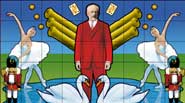
On Radio 3 Tchaikovsky and StravinskyFind out more about them and their music
Related LinksOn the BBC
The BBC is not responsible for the content of external websites | |

BBC iD
BBC iDBBC navigation
BBC links

BBC © 2014The BBC is not responsible for the content of external sites. Read more.
This page is best viewed in an up-to-date web browser with style sheets (CSS) enabled. While you will be able to view the content of this page in your current browser, you will not be able to get the full visual experience. Please consider upgrading your browser software or enabling style sheets (CSS) if you are able to do so.
