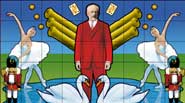
Yevgeny Onegin
Yevgeny Onegin (Eugene Onegin) is the fifth of Tchaikovsky's 10 operas; together with The Queen of Spades and to a lesser extent, Mazeppa, it holds its place in the repertoire - it is Tchaikovsky's most popular opera, and his greatest.
Like the other two operas mentioned here, it draws on well-known stories from Russian literature, in this case by Pushkin. In Onegin, Tchaikovsky builds the drama through concentrated scenes - although the story unfolds over a long period of time until its denouement, the audience's familiarity with the literary background means that the plot doesn't feel as if it is sprawling, as is the case with, for example, Mussorgsky's Boris Godunov and Khovanshchina.
The story concerns the fateful consequences of a visit the poet Lensky makes to the neighbouring country home of Madam Larina and her two young daughters, Olga and Tatyana. Lensky is captivated by the outgoing Olga, and Tatyana, whose head is full of romantic literature falls under the spell of Lensky's friend Onegin, who has accompanied him. In a fit of romantic fervour, Tayana stays up all night writing a letter in which she pours out her adolescent love for Onegin; a few days later, Onegin, whose world view is jaded, cynical and bored, returns to deliver his answer - he rejects Tatyana in patronising terms; Tatyana is utterly humiliated.
Act II takes place at a naming-day party for Tatyana; Onegin and Lensky attend, and Lensky is furious when Onegin, bored, dances with Olga and flirts with her; naughtily, she reciprocates. Lensky's wounded pride fuels an argument which escalates into his challenging Onegin to a duel; next morning, with the honour code rendering the two friends incapable of backing down, Onegin kills Lensky. He leaves the scene and goes into voluntary exile.
 Act III takes place years later and sees Onegin at an opulent St. Petersburg ball, held in the palace of Prince Gremin. Onegin is dumbfounded to find that Tatyana has married the elderly prince; Gremin, in a noble aria, declares the joy his love for Tatyana, and her devotion, brings. Onegin is left alone, bitterly to confess the realisation of his own love for Tatyana. In the heart-rending final scene, Tatyana confronts Onegin at her home: he has been writing to her. She confesses that she still loves him and laments how close they both were to happiness. But, unable to desert her husband, she dismisses him, to Onegin's utter despair.
The mainspring of the Onegin plot is the familiar operatic theme of love/passion versus duty; in this case, it is all the more poignant because in the music Tchaikovsky writes for Tatyana, he paints a rounded portrait of a young girl and her adolescent psyche, and does so in a very short space of time: the famous Letter Scene takes place early on - it's the second scene, and in it Tchaikovsky runs the gamut of a young female's hothouse emotions: performed by a consummate singing actress, it is the high point of the opera and its most memorable scene. In true theatrical style, Tchaikovsky brings down the curtain on the Act as dawn breaks and Tatyana feels the release of irrepressible joy;
Act II ends on an equally dramatic but completely contrasting note of tragedy, with the death of Lensky. Act III intensifies the feelings of loss through Onegin's and Tatyana's thwarted passions; fate has conspired to send the events which are visited upon the Larinas' comfortable domesticity completely out of control: anyone in the audience who has ever felt love, jealousy, rejection, or has ever said to themselves, 'five minutes ago this catastrophic event, which I am responsible for, hadn't happened', or who has lived long enough to know the comfort of the wisdom of years, will know what it is like to be these characters.
Yevgeny Onegin was suggested to Tchaikovsky, as an opera plot, by the singer Elizaveta Lavrovskaya. Shortly beforehand, he had received a letter from a former music student at the Moscow Conservatory, Antonina Milyukova, confessing that she had been in love with him for years. After Tchaikovsky had embarked on the opera, Antonina wrote again; life was not going to imitate art: Tchaikovsky met Antonina, and though homosexual, proceeded to marry her, with disastrous results - an attempted suicide, followed by separation. It's interesting that, in planning for the premiere of Onegin, which is subtitled, 'Lyric Scenes in three Acts', Tchaikovsky was adamant that it should be performed by students: he didn't want the raw, youthful emotions to be clogged up by an overlay of mature operatic professionalism, which would inevitably be provided by seasoned opera singers.
© Graeme Kay/BBC

 Back to the A-Z index