St. Petersburg
In Tchaikovsky's day the capital of the Russian Empire was still a relatively new city, having been created (artificially, as Pushkin saw it) in the 1700s by Tsar Peter the Great as a base for his navy, due to its excellent position on the Baltic Sea looking towards Europe.
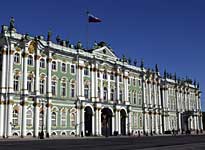 As the nineteenth century proceeded and capitalism took root, factories sprung up around the outskirts while the main street, the Nevsky Prospect, filled with businesses. Industry, commerce and bureaucracy flourished (providing Tchaikovsky with his first job, as a civil servant in the Ministry of Justice) and so did the arts. An expansion in building-work created new public spaces so that concerts were no longer confined to the private residences of the aristocracy. A Philharmonic Society, founded in 1802, brought European artists and repertoire to Russian audiences - it hosted the première of Beethoven's Missa Solemnis in 1824 - and the number of salons where chamber music was played increased. But it was in the field of opera that cultural life took a giant step forward with the staging of Glinka's A Life for the Tsar at the newly refurbished Bolshoi Kamenny ('Big Stone') Theatre in 1836. Hailed as the first 'nationalist' opera, it opened the door for a younger generation of Russian composers to show audiences that serious large-scale music could be produced by home-grown talent.
From 1862 would-be music students could choose between an expensive but thorough education at the Conservatory (where Tchaikovsky went) or try out the Free School of Music where the enthusiastic Mily Balakirev was pioneering a slightly more socialist approach. He offered a free education biased towards Russian music with a strong dash of Orthodox choral singing led by Tchaikovsky's esteemed singing teacher, Gavriil Lomakin. Thus a new wave of trained composers gradually infiltrated their works into the repertoire of the Tsar's own opera and ballet troupes, which had made their home in the sumptuous Maryinsky Theatre (named after the Tsar's wife, Maria) in 1866. Music for the stage had reached its golden age in St Petersburg. A strong artistic team included choreographer Marius Petipa, conductor Eduard Nápravník and singers Nikolai Figner and Fyodor Stravinsky (father of the composer, Igor) who between them gave the public Musorgsky's Boris Godunov, Borodin's Prince Igor and several of Tchaikovsky's mature works including Sleeping Beauty, The Nutcracker, The Maid of Orleans, Iolanta and The Queen of Spades.
© Madeleine Ladell/BBC

Read other people's comments
Philip Brown
I heard my first ever performance of the 1st Symphony at 6pm on Feb 11th. Performed by the BBC Phil.
I must hear it again ASAP.
 Back to the A-Z index