Art and Stage Design
In the year that Tchaikovsky gave up his office job for music and the first Salon des Refusés took place in Paris (1863), fourteen artists, led by Ivan Kramskoi, protested against the conservative dictates of the St Petersburg Academy of Arts by refusing to paint the classical subject stipulated for an examination. Expelled at once Kramskoi formed a new group (with Vassily Perov, Nikolai Ge and Grigory Myasoyedov) who believed that painting should depict society realistically and that art should be available to all; with their diverse wealth of styles and interests the peredvizhniki, or 'Wanderers', circulated exhibitions of their work around different towns from 1870.
 They were joined in 1878 by the more cosmopolitan Ilya Repin who had already set a trend for 'critical realism' with his portrayal of weary hard-working Barge Haulers on the Volga (1873). It reflected a general move towards nationalism that took various forms. Scenes from Russian history with parallels to contemporary politics preponderated: Ge's Peter the Great Interrogating his Son Alexei (1871) showed the Tsar putting the 'people' before his own family; Repin claimed his own harrowing depiction of Ivan the Terrible (1885) seen hugging the son he has just fatally wounded in a fit of rage was inspired by the hasty execution of revolutionaries following the assassination of Tsar Alexander II in 1881; and his They Did Not Expect Him (1883) shows a contemporary situation featuring one of the 'lucky' revolutionaries returning home after his exile sentence in Siberia has been commuted.
But the status of landscape painting changed too. No longer just background, representations of 'everyday' Russia took on greater importance. Ivan Shishkin's detailed forests, devoid of people, and Alexei Savrasov's 'lyrical landscapes' evoking particular moods prepared the ground for Arkhip Kuindzhi's breathtaking painted snapshots of ordinary places caught in passing conditions of weather or time (rain, snow, night), his skilful handling of vivid contrasting colours creating unparalleled intensity and seeming to conjure luminescence (Moonlit Night on Dnieper, 1880; Moonspots in the Forest, 1908).
Such progressive attitudes were slow to filter into the world of stage design, however. How could it be otherwise when expensive art forms such as opera, theatre and ballet were largely under backward-looking Imperial control?
Nevertheless just outside Moscow, at the Abramstevo estate, railway magnate and impresario Savva Mamontov created a private opera house, enticing the talents of Repin and Mikhail Vrubel. Notorious for his erotic Lermontov-inspired Demon series of canvasses, Vrubel was a natural choice as designer for the late fairy-tale operas of Rimsky-Korsakov, which including elaborate costumes for his wife, the celebrated coloratura soprano Nadezhda Zabela-Vrubel. Despite attracting many forward-thinking designers and theatre practitioners (among them Constantin Stanislavsky) the venue saw few premières.
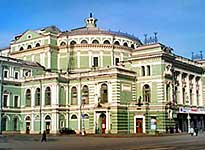
In St Petersburg, as Russian opera gained a foothold at the Imperial Maryinsky Theatre, the staid Italianate and French architectural settings that dominated productions gave way to native townscapes, painted with distracting detail and accuracy by Mikhail Shishkov (Tchaikovsky's Oprichnik, 1874, is a good example). In historical pieces, realistic-looking interiors and exteriors were de rigueur and even the settings of fashionable supernatural stories were circumscribed; lakeside scenes (Swan Lake) became so incumbent that the back row of the corps de ballet became known as the 'ballerinas near the water'. Such rigidity of approach gave little scope for individual artistic expression and often resulted in a finished work lacking integration between music, movement and visual art, which highlighted the problem that designers often worked in a vacuum and were brought in at a late stage of production. When Tchaikovsky was first composing, ballet in particular was dominated by choreographers and dancers renowned for ordering 'music by the yard' to fit their set dances and show off performers' skills. Set and costume designers were called in even later. Tutus and tights were obligatory as were contemporary hairstyles, often including, for women, tiaras, regardless of the social position of the character they were playing!
When he took charge of the Maryinsky in 1881, playwright, librettist and designer, Ivan Vsevolozhsky was well placed to fuse various stage crafts. For Sleeping Beauty (1889) he held preliminary meetings with Tchaikovsky and choreographer Marius Petipa, designing the costumes himself. Its success was taken as a formula for later ballets and led to further collaboration on The Queen of Spades (1889) and The Nutcracker (1892); the production was also allegedly the first ballet ever seen by Serge Diaghilev.
© Madeleine Ladell/BBC

 Back to the A-Z index