Art and Stage Design
Stravinsky's early career coincided with an extraordinary acceleration in the development of visual art. By the 1890s the purposive 'critical realism' of the 'Wanderers' in Russia had yielded to a fin de siècle decadence ushered in by the symbolism of Mikhail Vrubel's late works. With an enthusiasm for art nouveau and a passion for the 18th century (sometimes bordering on a wallowing in nostalgia), St Petersburg-based artists Alexander Benois and Lev (later Léon) Bakst joined Sergei Diaghilev in founding a magazine, The World of Art (1898), which promoted art for art's sake and the pursuit of artistic beauty and excellence. Featuring a wide variety of disciplines (painting, furniture design, clothing, ceramics, architecture) it covered new trends and excavated the work of unjustly neglected masters from Europe and beyond (early issues featured William Nicholson and Katsushika Hokusai).
 Soon Benois was commissioned to bring his brand of 'retropectivism' to the Imperial Theatres, creating for décor and costumes an idealized vision of a bygone era familiar to audiences from his stylized watercolour series The Last Walks of Louis XIV (1897). Diaghilev too secured a job as a junior assistant director at the Maryinsky but was forced to leave after falling out irreconcilably with the chief director Vladimir Telyakovsky. With the magazine's 1904 demise and insecurities following the abortive 1905 Revolution, Diaghilev formed his own creative team - World of Art regulars with leading singers and dancers including Fyodor Chaliapin, Vaslav Nijinksi and Anna Pavlova - which he brought to Paris for 'Russian seasons' of opera and ballet. The Ballets Russes, who never performed as a company in Russia, first appeared in 1909. When the unknown Stravinsky was asked to provide music for The Firebird in 1910 it was Bakst who provided characteristically colourful and exotic orientalist costumes. Benois's designs for Petrushka (1911) followed in a similar vein.
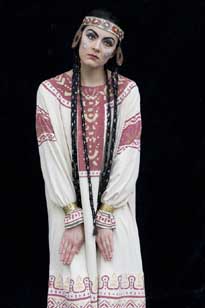
At the same time Russian neo-primitive painters were drawing inspiration from popular folk art and Byzantine icons, as can be seen in the heavy drapery and galumphing movements of the figures in Dancing Peasants (1911) by Natalia Goncharova (not to be confused with her great aunt of the same name who married Pushkin). This world was conjured up in The Rite of Spring (1913), uniting the talents of Stravinsky, Nijinsky (now turned choreographer) and the painter, archeologist, folklorist and Slav expert Nikolai Roerich who developed the scenario of a primitive pagan ritual with Stravinsky and who provided the designs. Though his backcloths were unremarkable - lush, airy rural landscapes in tempera-like pastel colours - his costumes were the antithesis of the tutu-and-tiara style familiar to older audiences: loose, knee-length dresses hiding much of the dancers' cross-gartered legs and peasant hairstyles of long thin plaits. Combined with Nijinsky's anti-balletic movements demanding dancers point their knees, toes and elbows inwards, Stravinsky's heavy, savage music and the barbarous sacrificial subject matter, no wonder it was met with shock. But its success was down to the fusion of creative talents working towards a single vision. As one critic queried at the time, 'Who is the author of The Rite? Nijinsky, Stravinsky, Roerich?'.
In Russia the cubist-like 'rayonnism' of later Goncharova and her husband Mikhail Larionov (1911), the uncompromising 'suprematism' of Kazimir Malevich and technological 'constructivism' of Alexander Rodchenko (1915ish) filtered directly through into straight theatre, but Diaghilev's European enterprises were temporarily scuppered by World War I and the 1917 Russian Revolution. When the Ballets Russes reconvened and Stravinsky's Song of the Nightingale hit the Paris Opéra in 1920 it was with bright simple designs and voluminous Chinese-style costumes by Henri Matisse, a rare theatrical excursion for him. Diaghilev baulked at Pablo Picasso's original designs for Pulcinella the same year, finding them insufficiently abstract. The final set designs were semi-cubist but the costumes remained conventional - faithful depictions of familiar commedia dell'arte characters; Harlequin, the poor illiterate clown dressed in a tunic of diamond shapes (stylized patches), continued to appear before and after in Picasso's works as a sort of alter ego. For Renard (1922) and Les noces (1923) Larionov and Goncharova harked back to earlier styles. In many ways Bronislava Nijinska's choreography for Les noces was a tribute to her brother's for the Rite, deliberately using similar movements (heads held horizontally) and costumes, though the female peasants now wore point shoes, albeit brown ones. She demanded the same blank expressionless faces from the dancers and once, while rehearsing a revival, rebuked a dancer for introducing emotion by saying 'no, no, no, this is not Swan Lake!'.
When Diaghilev died in 1929 the Ballets Russes disbanded and the golden age of Stravinsky stage works came to an end. He continued to compose fine ballet music in the USA and developed a long successful working relationship with choreographer George Balanchine, another émigré who once likened their partnership to that of Petipa and Tchaikovsky, but the austerity of his later work demanded a different approach. As technology advanced, lighting replaced painted décor as the more powerful medium with which to create mood and focus the audience's attention. Sets became simple and subservient to other elements, leading to 'concept' designs often created around a single symbol or idea manifest in visual form: in a spare stage space Isamu Noguchi's shimmering white silk curtain for Orpheus (1948) perfectly suited the intensity of the music, as well as the New York Ballet Society's tiny budget! The plotless Agon (1957) was even more minimalist, the astringent music and energetic movement thrown into stark relief by an almost bare stage with dancers wearing simple black and white leotards at the request of the composer.
Though not created for a first performance nor even during Stravinsky's lifetime, one cannot discuss stage design without mentioning David Hockney's imaginative and memorable sets and costumes for a 1975 Glyndebourne revival of The Rake's Progress, which have completely overshadowed the unremarkable designs for opera's Venice première in 1951. Approached because he had already produced his own version of etchings and aquatints inspired by William Hogarth's 1735 satirical series, his reinvention of the printmaking effect as scenery - a limited palette of colours (mostly red, green, blue and black on white) appearing in lines as if cross-hatched with giant felt-tipped pens - perfectly suited the neo-classicism of Stravinsky's music, and breathed new life into the opera.
© Madeleine Ladell/BBC

 Back to the A-Z index