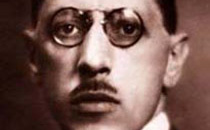
Igor Stravinsky was brought up in St Petersburg, where his father was principal bass at the Mariinsky Opera. Having shown musical talent as a child, but little firm evidence that he might be the 20th century’s paramount composer in the making, Stravinsky enrolled as a law student. In 1903, however, he also started taking private lessons with Rimsky-Korsakov. The outcome was an early orchestral style displaying, in Scherzo fantastique and Fireworks (both 1908), a shimmering virtuosity that attracted the interest of Sergey Diaghilev, impresario of the Ballets Russes.
Needing a new work for his company’s 1910 Paris season, late in 1909 Diaghilev approached an apprehensive Stravinsky, who nevertheless managed to meet the deadline. The Firebird’s premiere brought the young composer instant fame. Petrushka (1911) then announced fully the crisp rhythms, pungent harmonies and ultra-vivid orchestral colours of his mature style. And by the time The Rite of Spring’s 1913 premiere triggered the most famous audience riot in the history of ballet, its creator had developed from a minor Russian talent to one of the most brilliant and advanced composers of his time.
Marooned in Switzerland during the First World War, Stravinsky concentrated on works for smaller forces – notably the music-theatre pieces Renard (1916) and The Soldier’s Tale (1918) and the sung ballet Les noces (1914–17, orch. 1923). After the Russian Revolution Stravinsky based himself in France. Pulcinella (1920), another ballet with voices written for Diaghilev’s company, drew deftly on Neapolitan keyboard music attributed to Pergolesi. The ensuing period of Stravinsky’s neo-Classical engagement with the music of the past, though widely denounced as revisionist, was in its own way as exploratory as what had come before. Major statements included Oedipus rex (1927), the choral Symphony of Psalms (1930) and Perséphone (1934), a fusion of melodrama, ballet and cantata.
After his daughter, wife and mother had all died within a few months of one another, Stravinsky moved to America in 1939, settling in Hollywood with Vera Sudeikina, the Russian painter with whom he had led a double life for many years (they married in 1940). A full-length opera, The Rake’s Progress, was completed in 1951. Closer-than-before encounters with the serial works of Schoenberg and Webern – at the behest of Stravinsky’s young musical assistant, Robert Craft – then brought a temporary creative crisis, followed by a superb sequence of late works whose impacted, Webern-influenced syntax seemed at the time to contradict Stravinsky’s earlier style: they include Canticum sacrum (1955), Agon (1953–7), Threni (1958) and Abraham and Isaac (1963). But the differences are less great than the affinities. The technical hallmark of Stravinsky’s last masterpiece, Requiem Canticles (1966) is its composer’s peerlessly inventive way of working with small, self-contained musical cells – as in The Firebird, written over half a century earlier.
Profile © BBC/Malcolm Hayes
Read a biography of Tchaikovsky
Back to index page



 Biographical A to Z

