 | 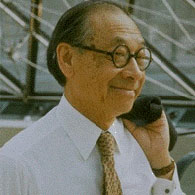 John Tusa interviews I.M.Pei John Tusa interviews I.M.Pei
Broadcast: December 03
JOHN TUSA: Millions of people a year pass through a building designed by the Chinese-American architect I.M. Pei - leoh Ming Pei to give him his full name. When they enter the Louvre in Paris they will do so through what they undoubtedly know as I.M. Pei's Pyramid - that subtly uncentred, culturally independent intervention among the grand frontages of the museum. If ever there were an iconic building, it's surely The Pyramid. In Washington, thousands going to the National Gallery enter through I.M. Pei's East Building - a monumental and coherent assemblage of triangles clad in pink stone, gazing without apology up at the Capitol, and rubbing shoulders in a neighbourly way with its reserved, classically inspired and older cousins, such as the Supreme Court and the Federal Reserve. And the list goes on, as you might expect from a man of eighty-five, whose various partnerships have put up corporate and public buildings running into their thousands. I.M. Pei was born in China. He went to study architecture in Harvard, but was marooned there by the Second World War. His first job after university was as a house architect for the legendary property tycoon William Zeckendorf. From him Pei learned how to weigh up a site for all its potential, and he put up some more than respectable buildings. But Pei needed to move on to what you might call real architecture, and to live down the reputation of being an architect for a developer. His first breakthrough was the National Center For Atmospheric Research in Colorado - a cross between a fortress and a monastery, in the foothills of the mountains. And the next decade was transformational. By 1978 his international reputation was sealed by the East Building at the National Gallery in Washington, but inbetween he and his practice seemed threatened by the constant rows over the Kennedy Library in Washington, and the scandal over the John Hancock Tower in Boston, from which thousands of windows fell out. But with the building of the Pyramid at the Louvre in 1989, I.M. Pei's reputation was secure and public in a way given to only a few architects at any one time.
His work is marked by rigour, logic, fine materials, a humane rendering of modernism, a detailed perfection of execution, and above all, by a concern for the people who use his spaces. For my money - and I've been there many times - the East Building of Washington's National Gallery is one of the most sensuous buildings I've ever been in. But critics say that his work isn't driven by new theory, that he's created no new school, and that essentially he represents an elegant end of the road to the school of modernism defined more than three generations earlier. However, the enduring nature of Pei's shapes, images, and his solutions, would seem to argue against the critics.
You were seventeen when you left China to come to Harvard. How much of the Chinese is there in your feelings about architecture?
I.M. PEI: Unconsciously I would say there must be something there, but I consciously speaking I don't see any at all. I came, I studied architecture in America, so my technical background's completely western. But my seventeen years, the formative years of one's life, and I can't say that the Chineseness in me is not there.
JOHN TUSA: Some say that there's a sense of space, a feeling of space, of how people move through buildings, of the use of gardens, that that is part of a Chinese sensibility.
I.M. PEI: I have a great love for nature. That must have started somewhere down back home I think, because my family own one of the better known gardens in Soochow, so I played there and I lived there and so I must have absorbed something there. So I continue to have a great interest in nature. That may be something that will continue to influence me in my work.
JOHN TUSA: Now at Harvard of course you studied with Walter Gropius. What really did he teach you?
I.M. PEI: Gropius was a great teacher. I wouldn't say he was a great artistic influence in the architectural sense, but I think he taught one using discipline in thinking, and I think that was something that I feel very much sort of indebted to his method, let's say, of teaching. It's a discipline. Look for logic. There must be an answer for something - it cannot be just whimsical. Anyway I think I probably finally stepped out of that, and I find that that is probably something that one has to do after you free yourself from the so-called discipline of Gropius.
JOHN TUSA: But that was an essential discipline which you had to learn and be taught to start with?
I.M. PEI: I think one has to have that discipline, but to free oneself from it is also equally important, and I like to think that I have.
JOHN TUSA: At the time, when you were in your twenties, at Harvard, you assumed that what you were learning was going to be taken back to China didn't you?
I.M. PEI: Oh yes I came to the United States really to study, and I really hadn't planned on staying more than four or five years, and then go home. Of course the war interrupted all that and made it impossible for me to do that, so I stayed in America, and in some ways quite fortunate for me, because those following years were cultural revolution and all that sort of thing, that makes it very difficult for one to grow or to extend one's interests.
JOHN TUSA: Well you would have been lucky to survive wouldn't you?
I.M. PEI: Oh, yes indeed I was, I think so yes.
JOHN TUSA: But even before that, did you have some sense of how the modernist architecture you were being taught would fit back in China? You must have had some sort of mission as a person learning modern architecture, and how it could serve your nation.
I.M. PEI: I think so, I think it's sort of more technology than anything else. Because there was then already the beginning of something. I saw buildings coming up in Shanghai for instance, getting taller and taller, and as a young boy shall I say that you can't help but be impressed with that, this is something must be interesting that makes it so. I want to learn about it.
JOHN TUSA: How did you emerge from the Graduate School of Architecture at Harvard? Were you by then an out and out Bauhaus person?
I.M. PEI: I don't think so. Looking back at it, as I said, I learned about Bauhaus method of teaching. I had some difficulty with it from time to time. For instance as an example, I was asked by Gropius at one time: "So you have some different opinion concerning my method of teaching, and Bauhaus method. Would you want to do something to prove your point?" And I said yes I would choose the subjects. I chose to design a museum for Shanghai. As an example, all the museums in the West that I've seen are all temples - pillars, huge spaces - that simply won't fit with Chinese objects - paintings, ivory, porcelain. Totally different scale. So there must be something that makes a difference, so if I were to design a museum for that Chinese art it wouldn't be the same, because it shouldn't be the same. So that's the point I wanted to make.
JOHN TUSA: And I think also, while you were at Harvard you met or worked with Marcel Breuer?
I.M. PEI: Mm hm. Breuer humanises architecture - I like that. And he put people and life very much in the forefront of any creative process, and that is a little different from what I learn about the Bauhaus method.
JOHN TUSA: That sounds fairly close to what you did for the rest of your life.
I.M. PEI: That's why we attracted each other. And he was very much interested in me - I was then a young man - and he always sort of asked me. And he was a bachelor for many years. He'd say "Why don't you come and let's have dinner together and talk", and it was very unusual for a young student that I was to be asked by a professor to do that. So we became actually lifelong friends as a result of that. I found him really a wonderful teacher.
JOHN TUSA: So do you think it was because of that relationship that your interest in making buildings where people feel at home, that that was one of the things which came from Breuer?
I.M. PEI: I think Breuer started me thinking about it - let's put it this way. Of course I developed my own ways afterwards. His architecture and mine are not very similar, but nevertheless we do have a common interest in that point, that is people and life. We travelled, I remember, at one time, my wife and I and his wife sailed in Greece together, and we promised each other we would not talk about architecture. But we did drink some wine but we said no architecture, and we agreed to that. But after we got on board, we just talked about life, and that's architecture. You cannot really separate the two. And that was a wonderful experience for me, and we were on board together for seventeen days and that's all we talked about - people, and how they live.
JOHN TUSA: Now there you are, you end up at the graduate school. You're then a teacher at Harvard with this reputation behind you and with all these Bauhaus connections, and then your first real job, or you get this approach from this amazing man, William Zeckendorf, known for being a man who does a huge amount of urban development including a large number of garages. Now what was it like when you first met Zeckendorf?
I.M. PEI: Well, at that time I really didn't know what to go, where to go, what to do, because China was not to be for me to return. My father told me that. My father by the way at that time was very active - not in government but in the finances of the government - and he advised me not to return. So there I was, already married, I wanted to do something, I wanted to plot a future. I couldn't. China was to be my future, and he said don't yet come back, so I had to find something to do. So when William Zeckendorf sent for me, and asked me if I would like to come and work for him, I hesitated for quite some time, as in those days you know an architect is not supposed to work for a real estate developer, you're not supposed to be, this is not supposed to be an activity that one should get into. It's all money, business, and we're supposed to be dealing with art of architecture. But I finally decided to do so because I wanted to learn about real estate - I thought that that's very important to an architect. And I made the right choice. I did go, I did go to him.
JOHN TUSA: In a way I would have thought that a property developer who says to an architect - or a young architect - what I really want to do is to have architectural values in my property development, I'd have thought that was an incredibly dangerous thing to go into, because in a way all property developers say I want to have high architectural values, and then they decide they can never afford them!
I.M. PEI: Well, in some ways I think William Zeckendorf might have regretted then. But we had a wonderful time together. You see, he was a very unusual developer. In some ways I feel that he was less interested in money, and more interested in doing exciting things for his ego. I think he was a very egoistic person, and he wanted to build the biggest building, the tallest building, the biggest this the biggest that, but he didn't know how to do it. But somehow he felt that he needed some help, and I was fortunate to come into the picture at that time.
JOHN TUSA: Yes I think that when you were building the Mile High Center in Denver, and you said you wanted to put in a plaza in front of it, and Zeckendorf just looked at it and said, "Why waste all that space?"
I.M. PEI: Yes! Yes I know he did, he said exactly that.
JOHN TUSA: And what did you say?
I.M. PEI: Well I said that there are several ways of looking at a plaza. I said a plaza is for people. If you can attract people to come to your place, surely it should enhance the real estate value of that place. He thought about it, he said, "Well maybe so. Let's try". I mean he was very open-minded, he was. He said let's try. And at that time I think it was rather unusual for a businessman to waste real estate, but actually it wasn't really wasted because by not having to build up the whole piece of land, we were able to persuade the City to let us build a little taller, to make up for the loss of use. And so it's a sort of a trade-off. But it turned out to be something that he understood, and he accepted it.
JOHN TUSA: And you clearly understood it. I mean did you enjoy that sort of bargaining and trading off?
I.M. PEI: Ah, very much so. I sort of enjoyed it like a game. He had a lot of partners in his ventures such as this, and one of the partners was really a Denverite - someone who lives in Colorado - and he didn't agree with it at all, and I had to persuade him, and gave him the same explanation. He didn't take to it at all, he was not in agreement, where Zeckendorf accepted it, he understood it. As a consequence - I don't know whether you that know that - since then many of the New York developments since that time have instituted a rule to permit people to use air rights for land turned to public use. So you can build taller buildings if you wish. Not all of them were wisely done but that became something that became much more, very popular in the sixties.
JOHN TUSA: And that is directly as a result of your experience in Denver?
I.M. PEI: I don't know whether it was so or not, but I think certainly Zeckendorf must have talked about it a great deal.
JOHN TUSA: What apart from that, in the wheeling and dealing and things, what do you feel that you really learned from Zeckendorf?
I.M. PEI: I learned from him about land, how to look at a piece of land and determine its value, how to develop it. For instance, when he walked around a piece of property with me - he frequently did that with me - he would say, "Now where are people coming from? - number one - and what do they do when they come to that particular corner intersection?" And this is always involving circulation, and that is something I learned. And so as a consequence of that relationship I look at a piece of land very differently from others, from other architects.
JOHN TUSA: And you would not have been taught that at Harvard?
I.M. PEI: In school no, not at all. And he looked at it with the eye of a realistic developer, and the value of that piece of land, is it on a corner, or is it on one side, is it on the south side or the north side? Where the subway, where's the subway station? Where the bus stops. Those are the ways he looked, and I was never taught that in school, no.
JOHN TUSA: But then in the end after a number of years you just felt that you had to move on, you had to get back to the business of design.
I.M. PEI: Yes 1960 was a very important year in my life because I thought about it, I said I've learned a lot from Mr Zeckendorf, and I have done something for him. I felt that I really, hadn't really short-changed him during those very very generous years that he gave me. And I thought that if I continued to work with him I wouldn't be able to develop myself properly, because by then I was doing a lot of low cost housing, a lot of urban redevelopment - exciting work, important work, but not the kind of work I really wanted to. I wanted to build concert halls, I wanted to do museums, I wanted to build public buildings, but as a house architect of a developer you just simply don't get that kind of opportunity.
JOHN TUSA: Even so, with the amount of money you must have been earning and everything like that, breaking away must have been a risk.
I.M. PEI: It was a great risk. I had to take seventy-five people out with me, without the promise of a commission. I had a staff then, dependent very much on Zeckendorf's work, and they were all very happy working with Zeckendorf, just like I was. And then when I said that if I have to leave the organisation I must begin to look for work so that I can keep the office going. And fortunately my work for Zeckendorf did not terminate all at once - there was sort of a continuation. So he agreed, he said, "Yes I think you are probably right about it, but in the meantime I still have work for you to do".
JOHN TUSA: So that gave you the necessary cushion?
I.M. PEI: That gave me the necessary cushion to continue on.
JOHN TUSA: In fact it was only then a year before this extraordinary man Walter Roberts, an astronomy professor in Boulder, Colorado, asked you to build a research centre for him six thousand feet up in the Rockies. You must have known that that was a challenge of a completely different kind - just the sort of challenge you say that you're looking for.
I.M. PEI: Absolutely, that's the beginning of my professional life. Without that project I don't think I would have been able to make the next jump, let's put it this way. Walter Roberts was a very exceptional man, like Zeckendorf, but entirely different. Zeckendorf's a developer, a businessman - a visionary, but a businessman. Walter Roberts was also a visionary, but a scientist. And they can't be more different. The reason I was attracted to him, and I think to a certain extent he was attracted to me, is because of my love of nature. This site was on the foothills of the Rocky Mountains, and you have this huge mountain behind you, and you are to build a building there. A building's only this small, and the mountain's incredible. We talked about that a lot, as to how to deal with it, how to put a building on a site of that kind, and this was where my interest in nature came in to help me.
JOHN TUSA: The first solution you offered him he just threw out and said that's wrong didn't he?
I.M. PEI: Not entirely. He threw out for an entirely different reason. It's just that he said that this is not the way I would like to see my scientists working. In other words I was doing a very very logical kind of, a very efficient kind of a plan. My solution for nature, building a building in nature, still stands. That was never objected to. It's just that the building was too efficient. He said, "I don't want an efficient building, I want an inefficient building". Can you imagine? Having worked for Zeckendorf for ten years, you know, that's all I'd been doing. And having been trained by Gropius, and all of a sudden this scientist said no I don't want an efficient building. "I'll tell you why," he said, "you know, scientists like to meet each other in corridors, and talk and talk and talk, and then when they finish talking they want to be away from people, he doesn't want to meet people, then he wants to be isolated." In other words, don't give me long corridors with rooms one, two, three, four, give me a building that people can meet and talk - chance meeting is very important - and to be isolated when he wants to. So it's a completely new set of rules - for me anyway. And so from that point on I was delighted, I said that's exactly what I would like to try.
JOHN TUSA: But also it's a very monumental building.
I.M. PEI: Not monumental, it's a strong building.
JOHN TUSA: Yes all right.
I.M. PEI: Because when you build a building at the foothills of the Rocky Mountains, you cannot do a fragile building - it has to building that can stand up to that kind of a scale. It shouldn't be like a fortress, because it has to be human, but at the same time it must be strong enough to be there. And I found the best way to solve that problem is not to fight nature, but to join with it. At that time, another building, similar site condition, was built in Colorado Springs, for the Air Force Academy, and I went to see it. It's already finished, almost finished, before I started. It was a very very modern building, resting on stilts, sort of detached from the landscape. It's another way of dealing with the problem - completely detached from the landscape so you can almost feel like the building could be moved around, because if you cannot fight nature you just want to be apart from it - that approach. But my approach is a little different, I want to join with nature, so I used a stone, come out of the mountains and built this building with stone. It's very important to do that because the colour of that backdrop is a pinkish colour stone, it's a granite. When I use that stone - in a new way of course, not lay it, you know, stone on stone, no not at all, but pour into concrete - the colour of that building turned out to match the colour of the mountains. As I said to my Dr Roberts, I said "If you made a million years, it would look the same - it would be the same colour". Of course that's an exaggeration, but that way the building blends with the nature. I learned that from American Indians. They build that way, they fit so well. Why? Because they're part of nature. The buildings almost blend into nature.
JOHN TUSA: Let's move to a very different environment, and that was more or less I think your next major project which was the Presidential Library, the Kennedy Presidential Library in Boston, and that was a much less happy experience wasn't it, where they kept on changing their mind, they changed the sites, you had to change the designs. What really went wrong?
I.M. PEI: One thing I learn - I've been in practice now for half a century or more, and the most important ingredient for an architect to do a good building is to have a good client. I think a client counts for as much as fifty per cent. I would give that much credit to my client. If I have a successful building, I say look at my client - he was the reason, he is the reason. The Kennedy Library, sadly speaking, has lost my client. I was chosen by Mrs Kennedy, and we had a wonderful relationship together, talking about it. In fact we chose our site together, which was to be at Harvard University. Then what happened of course is that she re-married, and I lost her, so somebody else took over.
JOHN TUSA: Did the University become the client?
I.M. PEI: No. No, Robert Kennedy became the client. Then he was assassinated, so I lost him. Robert Kennedy by the way would have made a good client - I really felt comfortable with Robert Kennedy. So the family was totally, there was just one tragedy after another. And in the end, not only I had no client to work with, also there's little money left, after years and years and years. And also don't forget 1968 was a very very unhappy year, as you probably know - you were a student probably at that time.
JOHN TUSA: No!
I.M. PEI: No? Well students were so unhappy with the world in general, maybe because of Vietnam, so Kennedy, who was once a hero of all, not only the young people, became really a subject of criticism. So therefore that makes it even more difficult. Even Jack Kennedy himself, President Kennedy himself, was no longer revered as he was once.
JOHN TUSA: Did you ever think of walking away from the project, just because the client and the information you were getting were so poor?
I.M. PEI: I really thought about it a lot. I knew back in the seventies that this building was not going to be a good building. First we don't have a site, and unlikely that we're going to get a good site. And we probably don't have the means to do a good building. Money is still important you know. And then lastly, the most important of all, I don't find a client that I could work with. Yes, I was very despondent.
JOHN TUSA: And of course at that time there was this other near disaster for your practice when the huge skyscraper for the John Hancock Company in Boston, suddenly the windows started falling out, and I think you say that, I mean it nearly brought your practice down didn't it?
I.M. PEI: That was almost the end of my practice, it was. Yes that was another unfortunate event. John Hancock was an insurance company, and they're very careful about protecting themselves. And what happened, as soon as a piece of glass broke they put in a piece of plywood, and painted it black. They didn't have to paint it black, but they painted it black to warn people, so they don't have the liability you see.
JOHN TUSA: So it had this huge curtain wall studded with bits of black painted plywood?
I.M. PEI: Black panels. It was very very… oh, I would say that was the worst period of my life as an architect, practising. And no clients would ever come to us any more seriously. The only clients I was able to attract since then were really from universities, strangely enough. They were the ones that saved me.
JOHN TUSA: Maybe they thought the possibility of commercial failure made you respectable.
I.M. PEI: I don't think so! I think they were probably sympathetic with my problem. They understood it better than others, and yes, and ah, National Gallery saved me too.
JOHN TUSA: Before we get onto that I'd like to talk about how you work, because you're clearly all sorts of things - you're an organiser, you're a deal-maker, you're a wheeler-dealer, but first and foremost I assume that you're a designer. Is that the best bit of the business for you?
I.M. PEI: You call me a wheeler-dealer?
JOHN TUSA: It's what you said.
I.M. PEI: I've never been called that. I don't think so - I don't think I qualify with that.
JOHN TUSA: let's talk about you as a designer.
I.M. PEI: I like to think so. I like to think that's my principal interest, and I hope eventually we consider to be my contribution.
JOHN TUSA: How do you go about it? Where does the idea for a building first start?
I.M. PEI: Life. I keep coming back to that - life. Life of people. Then after life is nature. Those are the two ingredients, aside from an important client with enough budget to do the sort of thing you want to do. You have to understand how this building's going to be used. Who are the people going to inhabit the building? Why? What will make them happy in the building? That's number one - you have to think of that. Of course, aesthetics - good design is part of it, contributes to it. I like to think that a person that comes to a building, designed by me or by any architect, if he's happy or she is happy about it, there's something right about it. So therefore you have to think about what makes him or her happy to be in the building. That's life.
JOHN TUSA: That all makes sense. And then you come to the external shape. All those things may work inside the building, and sooner or later you have to say, so what's it going to look like.
I.M. PEI: The form. The form is as important as function. You've probably heard this. I'm not entirely… That's one time when I and Mr Gropius may be at odds, is then. To me form doesn't always follow function. Form has a life of its own, and at times it may be the motivating force in design. When you're dealing with form, as a sculptor, you feel that you are quite free in attempting to mould and shape things you want to do, but in architecture it's much more difficult, because it has to have a function. So from time to time you may want to make function follow your form, if you happen to find a form that pleases you. So I'm not that pure, as a modernist, in that form must follow function. Frequently my function fits into my form, and I'm not embarrassed about it. I think this is frequently necessary to do, to combine the two, so that a work of architecture is pleasing, not only to be working in it but also to look at.
JOHN TUSA: And at some stage along this road a visual shape, a sense of form, emerges. I mean that must be a very exciting moment, a very rewarding moment where you think ah the building is going to look like this.
I.M. PEI: I don't think it comes that quickly, no. I like to think that I consider form to be very important, but the form has to be related to the site. Not all beautiful forms fit in all sites. Some forms simply don't fit. For instance the form I selected for the National Atmospheric Center, in Boulder, the form fits that particular site - at least in my mind.
JOHN TUSA: Have you ever so fallen in love with a form for a particular building that you found it began to distort the possibilities of how the building was internally organised, that you said I really see this is as a building, as a great piece of sculpture, as an icon, I want it to look like this even if it doesn't work internally?
I.M. PEI: No, I don't think I'd go that far.
JOHN TUSA: Are you good at throwing ideas out? I mean rejecting them?
I.M. PEI: Yes, yes. Oh, if I start with only form-making, I would be a sculptor, I wouldn't be an architect. For an architect you have to put all these things together before you invent a form. You have to take many things into consideration at one time. But form is not unimportant - in fact… but it's not the be all and end all. You don't just start with the form and fit function in willy nilly - that I don't do, and you cannot be successful if you do that.
JOHN TUSA: How good an engineer are you? I mean I ask that question because after all you've always worked with colleagues, you've always worked with a practice. I take it that the process is not that you come along with a wonderful set of ideas and then you hand it to the practice to make it work?
I.M. PEI: Oh here again I don't do good that way.
JOHN TUSA: No I assume you don't!
I.M. PEI: I am very much at home with engineering, very much at home. I understand the engineering's approach. So I usually - I always, not usually, I bring the engineers in early, very early. As soon as I have some idea as to what I thought this particular project, the direction should go, I would bring them in, and talk about it, before I have any notion at all as to how the building eventually will shape up. And they frequently influence me by stating their own ideas about how they view things. I don't always accept it of course - that's my right to do so - but I bring them in quite early.
JOHN TUSA: But you're not a dictator, you can't be a dictator?
I.M. PEI: Oh, you cannot as an architect, no - Mr Wright notwithstanding!
JOHN TUSA: You've said that one of the key qualities for an architect is you must be able to draw in your own mind. If you can't see space, you can't be an architect
I.M. PEI: I think, almost think that that's a proper statement of my views. I used to draw a lot - that's how I was brought up as an architect - but after a while I stopped drawing. I still draw but I like to conceive a form and space in my mind, but fix in my mind at the same time all kinds of functional requirements that I require. It's too complicated. And then you begin to conceive space and form afterwards, and that's the process I use, and I've used it for forty, fifty years now.
JOHN TUSA: And what is it like physically to you? It's been said that when you're in the process of really trying to solve the problems of a building, it's a process of huge agitation, and that your wife thinks that you're absolute hell to live with at that time.
I.M. PEI: No not really! Well, I keep her awake, yes, because I do my work at night, unfortunately. It's a very bad habit. When I'm in bed, that's where I do a lot of thinking - not reading, I don't turn on the light - because it's so quiet. And that was a bad habit. I formed that habit early in life when I had the energy to cope with it, because it means you lose a lot of sleep! But my wife was very disturbed by that, and I still do it but less so.
JOHN TUSA: And when did you put the ideas down? Would you wait until the morning before you said I must now put these things down on paper, just to grasp what they are?
I.M. PEI: There were times when I was younger I would get up in the middle of the night and go to the bathroom, turn on the light and scribble a few ideas, and test it out and see if it works. If it doesn't work I go back to bed and think again. No, I'm gradually, I'm doing that a lot less - fortunately for my wife.
JOHN TUSA: Has a shape for a building, a form, ever come to you in the night or in a dream?
I.M. PEI: I can't say 'no', but nor can I say 'definitely'. There were times that I, because if you think about something intensely for a long period of time it sometimes appear in a form somewhat like dreams, but not exactly. It's hard to say. Sometimes I solve problems that way.
JOHN TUSA: Now one of the buildings, which of course is the one that you're most identified with and has a very very strong sense of shape, is the East Building of the National Gallery of Washington, which I've mentioned, with these very strong geometrical angles to them. And I think that it is the case that you produced the basic form for this more or less on the back of an envelope - you had this site, which is a trapezoid site, and then you drew a line through it to make two major triangles, and that was essentially the concept of the building we have today.
I.M. PEI: Yes, firstly you have to start with the site. The site is a triangle. It's not an equilateral triangle, so therefore we have a problem of facing a new classic neighbour, a sister building, which is the West Building, which is a perfectly symmetrical site - east/west and north/south - and here we are, we have to join, we have to become part of the ensemble. So therefore the axis must start with the old building, and then when you go to your irregular site you have to find the one triangle that fits that, and then the left over it becomes the other triangle. And that's how it started - it's really to find an axial relationship with the sister building, and then what's left over is another triangle
JOHN TUSA: Fortunately!
I.M. PEI: Fortunately - worked out very well for another part of the function for the museum, which is the museum administration.
JOHN TUSA: So it's an intellectual solution actually, but with very very profound aesthetic consequences?
I.M. PEI: Well it's a solution that one either accepts or not. I felt, and I still do, that the new building, even though we built, was it forty years later, has to relate to the old building. Having started to begin with that then everything else falls in line afterwards - fortunately. Not always the case.
JOHN TUSA: Now when it came to the Pyramid in the Louvre, how did you go about deciding where the big pyramid and the smaller pyramid, where they would be positioned in relation to the classical buildings?
I.M. PEI: The Pyramid is not important - I'm sorry to say that. It's a symbol only. The most important piece of work in the Louvre is the re-organisation of the entire museum - that is the important thing, not the Pyramid. You see the museum never function. There was a palace. Actually the palace was built since twelfth century actually, from twelfth century until Napoleon III, with a series of sort of additions, one palace after another.
JOHN TUSA: But you're saying the pyramid enabled you to solve the problem of the organisation of the museum?
I.M. PEI: Or rather the organisation of the museum requires a centre, and the centre is where the pyramid's placed.
JOHN TUSA: But why a pyramid as the centre?
I.M. PEI: Ah, that's another choice that came later, but to locate that centre, the new centre of gravity, is the most important step, and the reason the centre was chosen there comes out of function down below. You see the Louvre actually is built along the Seine - that's how it was started - and then Napoleon I, he began to make it parallel to Rue de Rivoli, and it makes a strange angle. So all of that composition, there are three major pavilions, as you know - Denon, Richelieu and Sully, and those three became the three points, and by connecting those three points I located the centre, and that centre enabled me to reach all three pavilions in the shortest distance, and that means the Louvre du Museum became three museums, not one.
JOHN TUSA: Yeah but you see just now you said that the pyramid was a symbol, and what you've just said is that clearly it isn't a symbol, it's a solution.
I.M. PEI: Well having located the centre, then they said this is where you enter.
JOHN TUSA: Yes but again why...
I.M. PEI: So why the pyramid, why do you enter into a pyramid...
JOHN TUSA: Yes quite.
I.M. PEI: ...and not into a hemisphere?
JOHN TUSA: Yes.
I.M. PEI: That is just that you have to take into consideration the Louvre itself. Louvre itself, first of all, is built of beautiful colour stone. It's a golden colour stone, and all the roofs are pitch. And because of the pitch, the angle that fits the best is a pyramid. The pyramid echoes the pitch of the roof. And then another thing is that it's the least obstructive of form and shape. If you put a cube there, you hide most of the Louvre. Hemisphere no less. A cone is probably the best, but cone is not a good form.
JOHN TUSA: Well the result of all this is something which is a world icon, very popular, very successful, and, I was struck in reading things, very often patronised by some of the critics isn't it? I mean one of them said it's a kind of upmarket cultural airport. Do you mind that sort of criticism?
I.M. PEI: Oh I've been subjected to worse criticisms than that one! No, no, of course how can you not expect criticism? I would not have accepted a project if I was worried about criticism. Certainly you have it. Whatever I do, because first of all I'm not French...
JOHN TUSA: You're not sensitive, no. Why should you be?
I.M. PEI: I'm from America and that's also not very good!
JOHN TUSA: Yes.
I.M. PEI: But no, no, I wasn't worried about criticism, I was worried about finding the right solution.
JOHN TUSA: One remark about you that rings truest to me is that in the end what you've done is to humanise modernism. Would you accept that as a description?
I.M. PEI: Well if modernism needs humanising, if you say that. I'm not so sure that's… For instance would you consider Frank Lloyd Wright a modern architect? He humanised architecture, modernism. Perhaps you say maybe that Bauhaus did to a certain extent create the impression of dehumanising architecture. If that is what they say about me I consider that to be a very high compliment.
JOHN TUSA: And are you worried when people say, as they do from time to time, well of course Pei is elegant, Pei is a supreme master of surface and detail etc., but he's never done anything deeply original?
I.M. PEI: What is originality? That's the question there. To be original is not the most important thing is it? I mean to design something you have to know that this is the best you can do for that particular circumstance, not always the most original. It's the most appropriate, the most fitting, and eventually, hopefully, the most beautiful. No I'm not too worried about that criticism at all.
JOHN TUSA: I.M. Pei, thank you very much.
| |








 Night Waves Debate: "This house believes that Prince Charles has been good for architecture"
 submit your walk






