| | | | POGUE MAHONE - THE STORY OF THE POGUES
Available on demand.
Presented by Mark Radcliffe
| |
 | |
 | | Hear the programme again on demand here! |
| For one brief, beery, gap-toothed moment, back in the bleakness of the second term of Thatcherism, it really did seem like there was a new folk revival. Improbably - during a period dominated by shoe-staring indie pop and stadium rock - somewhere on the dark streets of London, an ex-public school boy was leading this bunch of musical hooligans out of the beer-sodden back rooms and into the charts!
Shane MacGowan - for it was he - weaved The Pogues from low dives into legend. In the greedy, red-braced '80s - a time before world music and new acoustic music, when folk music was at its most unpopular - The Pogues boldly reintroduced the age-old 'Trad. Arr.' tag on record labels, dusted down The Dubliners and took them into the Top 10 again!
They even got into The Face - and almost made folk fashionable for a while. Predictably though, The Pogues' chainsaw energy divided the folk fraternity: enthusiasts welcoming the shot in the arm they had given the music, while detractors denigrated their musical ability and bemoaned the stereotypical image of falling-down-drunk Paddies.
Pogue Mahone (Gaelic for 'kiss my arse!') seemed to come from nowhere, although Shane MacGowan had previously seen service in the post-punk outfit the Nipple Erectors. But it was in 1982 that the seeds were sown, when Shane first collided with ex-Millwall Chainsaw Spider Stacey, and the pair set off together to play a set of Irish rebel songs at Richard Strange's New Romantic heaven, Cabaret Futura. Soon The Pogues were hurling themselves around London, fusing punk energy, traditional music and Shane's original songs into a single heady brew.
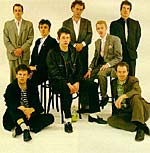 Above: The Pogues in 1987
|
Inevitably The Pogues were drawn toward that maverick orphanage, Stiff Records, which in August, 1984 released their debut single, Dark Streets Of London; two months later, came their debut album Red Roses For Me. But it was the band's striking second album, released the following year, that established The Pogues.
The title - Rum, Sodomy & The Lash - came courtesy of Winston Churchill, and space was found inside for Eric Bogle's magnificent The Band Played Waltzing Matilda, the traditional Jesse James and The Gentleman Soldier. Producer Elvis Costello took particular delight in The Pogues' trashing of Ewan MacColl's Dirty Old Town - he had never forgiven MacColl for falling asleep at one of his shows during his own folk club days! But perhaps most remarkable of all were Shane's originals - notably the poignant Pair Of Brown Eyes and the raucous Sally MacLennane, which together marked the emergence of a songwriter of authentic brilliance.
By now, The Pogues were officially the band to watch. Support slots for Bob Dylan and U2 followed, and a close friendship with Tom Waits. Incessant touring, and boozing took their toll, but 1988's If I Should Fall From Grace With God remains The Pogues' masterpiece - Shane's writing was at its peak, notably on Turkish Song Of The Damned and Broad Majestic Shannon. New Pogue (and ex-Radiator From Space) Philip Chevron brought in the atmospheric Thousands Are Sailing, while the band's folk credibility received a boost when Terry Woods (ex-Sweeney's Men, Steeleye Span founder member, Gay & Terry Woods and The Woods Band) was recruited. The period also marked The Pogues' commercial peak: Fairytale Of New York, featuring Shane duetting with Kirsty MacColl, was only kept off the 1987 Christmas No.1 slot by the Pet Shop Boys' It's A Sin.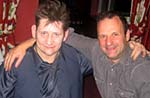 Above: Shane with Mark Radcliffe
|
Inevitably, the follow-up was going to be problematical. Peace & Love had its moments, but 1990's Hell's Ditch was wayward - and by then, Shane's infamous fondness for hard drinking and other excesses was becoming a problem. To fulfil live commitments Clash frontman Joe Strummer was brought in to substitute for Shane, and in 1991, Shane finally quit. The band persevered with 1993's under-rated Waiting For Herb, but subsequently split.
All eyes remained on Shane, and his 1995 debut with The Popes, The Snake, didn't disappoint. He managed a second Popes album, The Crock Of Gold in 1997, and, against all the odds, still performs despite well-documented drink problems and spells in a clinic, despite the suspicion that some of the audience are attracted by ghoulish curiosity.
On a good night though, back before their bassist Cait O'Riordan became Mrs Elvis Costello, The Pogues were a fiery force - exuberant punk energy harnessed to fine traditional influences. And, in their wake, folk leaped on another step.
Colin Irwin
| |
| | |