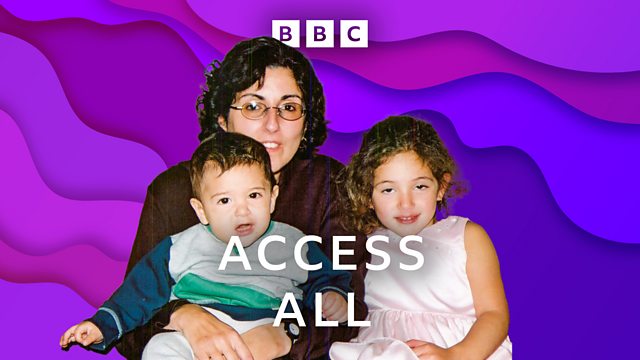
Sarah lost her voice to MND, 25 years later she’s got it back
An astonishingly feel good story about AI.
When Sarah Ezekiel was 34 and pregnant with her second child she was diagnosed with Motor Neurone Disease (MND). She lost the use of her hands and all “intelligible speech” within months, and her marriage broke down.
Twenty-five years later, a family VHS tape filmed in the 1990s, resurfaced. Amongst the blaring TV and people talking in the background was eight seconds of Sarah chatting - barely audible at best.
Despite the unlikelihood of rescuing anything from it, assistive tech company Smartbox set to work. Simon Poole looped and cleaned the scratchy audio with a variety of tools until the cockney accent and lisp , Sarah used to hate, returned in all their glory. Sarah can now use her own voice with her eye gaze technology.
For her now grown-up children, Aviva and Eric, it was the first time they had ever heard their mother’s voice.
Presenter: Emma Tracey
Sound design: Dave O’Neill
Producers: Emily Selvadurai and Beth Rose
Editor: Damon Rose
Featured
.
Transcript
20th August 2025
bbc.co.uk/accessall
Access All – Ep 172
Presented by Emma Tracey
EMMA- Today we’re telling a story about technology and identity. Tech means a lot in the lives of us disabled people, and it can solve many of the difficulties we have. It changes over time and it gets better and better.
Can you introduce yourself for me?
SARAH- I’m Sarah Ezekiel and was diagnosed with MND when I was 34 and pregnant with my second child in April 2000.
EMMA- Hello. Welcome to Access All. And it’s a bit of a different show this week. The voice you just heard there is Sarah Ezekiel, if you didn’t catch it. Actually more correctly it is a speech synthesiser that she’s been using which is a few years old now. It’s a bit generic and a bit monotone. Sarah has motor neurone disease and lost speech and the use of her hands pretty soon after diagnosis. I’m in her house in Hendon in London and I’m asking her about when she became disabled 25 years ago while she was pregnant with her second child:
SARAH- My symptoms were slurred speech and weakness in my left arm. I was in denial, thinking I’d be fine after I gave birth. In fact after Eric was born I deteriorated rapidly and was soon severely disabled and lost intelligible speech. I was very depressed and terrified of disability and death. My marriage ended in 2003 and I was given 24-hour care for myself and our children. It was difficult to watch strangers care for my kids, but I’m grateful for the help I received and being able to watch them grow up. The worst part was I couldn’t use my computer, and only got assistive technology five years after diagnosis. I felt very isolated and was struggling to communicate with my carers too. It was a very difficult time, but things did improve greatly when I could use a computer.
EMMA- Unable to move or speak, computers changed her life. The voice you heard there was her most recent synthetic voice, and is not the voice she uses now. Technology has moved on, now she sounds much more human, more like herself in fact.
It’s a very posh voice you have there, Sarah. That’s your old synthetic voice. Give me a blast of your new voice.
SARAH- Hello, this is my voice, which was made possible by Smartbox and ElevenLabs. It’s a kind of miracle really.
EMMA- Wow, that just sounds really different. The first one sounds a bit Joanna Lumley, and this one sounds incredibly different.
Right, let’s just stop for a second and I’ll let you know what’s going on here. When you’re about to lose your voice nowadays you’re encouraged to record it and bank it for future use, and that’s because AI can take that recording and turn it into a fully featured computerised version of your speaking voice. Then you can use it to say whatever you want via a computer controlled maybe by eye movements or chin movements. You need a pretty big chunk of your voice recorded to create that AI voice, and when Sarah lost her voice a quarter of a century ago we didn’t tend to record our voices like that; there were no voice messages, we didn’t have smartphones. So, when the offer came up to make an AI version of Sarah’s original speaking voice the family had to dredge up some audio from 25 years ago, and all they could find was a tiny bit of low quality audio of Sarah chatting from a home video from the 1990s.
How did it feel when you heard that voice for the first time?
SARAH- After such a long time I couldn’t really remember my voice before MND. When I first heard it again I felt like crying and it was very emotional.
EMMA- Oh gosh, I can imagine. It’s such a different voice and clearly it sounds quite a lot like your original speaking voice, which is just so brilliant.
MUSIC-
PAULINE- My name is Pauline Marks, and I’m head of national support services at the Motor Neurone Disease Association.
EMMA- What is motor neurone disease, Pauline? Lots of us will have heard about it via Rob Burrow, the ice bucket challenge, that sort of thing. But can you tell us a little bit about exactly what it is?
PAULINE- Of course. So, motor neurone disease, or MND as some people refer to it as, is a fatal rapidly progressing neurological condition, and it affects more than 5,000 adults in the UK at any time. So, the disease causes messages from the nerves, so the motor neurones in the brain and spinal cord that control movement, to gradually stop reaching the muscles. And what that means is that they gradual weaken, stiffen and waste. What can happen, the result is that people become locked in a failing body; they’re unable to move, talk and eventually breathe. Some people might experience changes in thinking and behaviour in rarer forms of motor neurone disease, but it doesn’t usually affect the senses, so things such as hearing, touch and sight.
EMMA- Sarah has two children. Eric was in her tummy when she got her MND diagnosis 25 years ago, and Aviva is a couple of years older. I met them both and first I asked Eric, after a lifetime of having a rather robotic sounding mum, what was it like hearing her actual speaking voice?
ERIC- So, when I first heard my mum’s original voice it was almost like any other afternoon, it had just sort of come through. And I didn’t quite believe it at first, I was quite sceptical because I had no idea what mum sounded like. So, it was only when I saw how pleased and excited mum was that I was really happy and I was like, we’re clearly on to something here. And it’s made a very big difference so I was very happy, very excited.
EMMA- And Aviva, what emotions went through your mind when you heard the voice?
AVIVA- The first time, it’s taken me a while to process it, but really hearing it in the house has – especially today, I’m not home as much – but hearing it in the house it has made me really happy and quite emotional. It’s really made her present in the space. Like, mum isn’t just a disabled person in the corner with a robot that doesn’t relate to her. She’s here, we can hear her, we can feel who you are as a person. And you take up space in a more personable way, it’s really lovely. It still surprises me.
EMMA- Is it what you expected?
AVIVA- No [laughs].
EMMA- What did you expect?
AVIVA- Well, [laughs] I guess like me, but I don’t know what I sound like, so.
EMMA- You’ve got two children, Eric and Aviva, what did they think when they heard this new voice?
SARAH- My kids couldn’t remember my voice, and I think they were thrilled to hear the real me. Maybe a bit surprised too.
EMMA- How close is it to your original speaking voice, do you think?
SARAH- I don’t really remember my voice and only have a video where I say one line. I think it’s pretty good, although I wonder if I would sound older now.
EMMA- There’s no harm in being a bit Peter Pan I reckon when it comes to a new voice. Why not?
This version of Sarah’s voice was made using tech from startup AI company ElevenLabs based in New York City. But how did the brief bit of audio they found of Sarah get turned into a computerised voice which could say anything she typed into it with her eyes? I spoke with Simon Poole. He’s the chief technical officer at assistive technology company, Smartbox, and he made it all work with eye-gaze for Sarah. He opened up his laptop and showed me.
What’s happening here, Simon?
SIMON- So, what I have here is an old home video that Sarah sent me. When we told her about the technology that would allow her to create a replica of her voice we asked her if she had any old footage of her voice from before she lost it, which was over 20 years ago. The only thing she had was this home video of her changing her baby’s nappy. Eight seconds of her talking with a TV on in the background.
EMMA- Wow. Can we hear it?
SIMON- Yeah, sure. Let me play it. See if you can hear what she’s saying:
SARAH- [Muffled speech] she wasn’t getting enough milk and she was miserable.
EMMA- I don’t know about you but I can barely make anything about here.
SARAH- I thought, you know, I gave her a bottle one night and she was so much happier.
SIMON- That’s all we got.
EMMA- Let’s rewind that and listen again.
SARAH- She wasn’t getting enough milk at all and she was miserable so, um, I thought, I’ll go for a bottle one night, and she was so much happier.
EMMA- I think I heard, you know, I gave her a bottle one night.
SIMON- Yeah, she said a little bit before that. let me play the first bit again. It’s really hard to hear:
SARAH- She wasn’t getting enough milk at all and she was miserable.
EMMA- Oh, it’s the breastfeeding conversation.
SIMON- Yeah.
EMMA- She was saying…oh my goodness.
SIMON- Yeah, we’ve all been there [laughs].
EMMA- So, she’s just talking about how Aviva wasn’t getting enough milk and she gave her a bottle one night and she was so much happier.
SIMON- Exactly, yeah.
EMMA- Gosh, it’s kind of like a key sentence. That’s amazing.
SIMON- Yeah. So, when Sarah sent me this video my heart sank because I thought there’s no way we’re going to be able to create a voice using audio that is that bad. But ElevenLabs have an AI tool called the Voice Isolator, and what this does, because it knows what voices sound like, it’s able to extract a voice from a noisy background, no matter how bad the audio is.
EMMA- Let’s go back a bit though, Simon. Tell me what the technology does and how it was used to make Sarah’s voice?
SIMON- Essentially you have synthetic voices generated by a computer, and there’s a new technology available with the new generation of AI which can create a voice from a recording of your existing voice.
EMMA- So, you did that, you got the recording. Then this was eight seconds of a background of a video. How does it pull that forward and then what did you do with it then?
SIMON- There’s two different AI tools in action here. So, one of them was able to isolate a voice sample from an existing audio clip. And the second one is able to then create a replica voice that you can use to speak anything with the sound of that voice. So, I want to play you the cleaned up version. You’ve heard the version where it’s really, really hard to see what’s being said. And this is really the latest in AI audio cleanup technology, which made it sound like this:
SARAH- [Cockney accent] she wasn’t getting enough milk because she looked miserable. And I thought, you know, I gave her a bottle one night and she was so much happier.
EMMA- Ooh, it’s a bit weird, isn’t it?
SIMON- Yeah.
EMMA- It’s clear but it’s also missing some of the key sounds in the sentence. So, how did you take that and make a full voice with all of those different vocal sounds that we need, the s’s and, do you know what I mean, all the different intonations and everything?
SIMON- Yeah, I get that, because you’ve only got a very limited clip, and really you want a good hour of somebody’s voice to create a really high quality recording. But what the AI technology does is it knows what typical voices sound like. They’re built from hundreds or thousands of original voices that the AI has been trained on, so it’s listened to those voices and how they sound, saying all sorts of different phrases. So, then from a very small sample it can then guess what that voice would sound like if it was saying other words based on how most people speak.
MUSIC-
EMMA- Sarah, what does it mean for you and other people you’ve heard from like you, who have motor neurone disease, to speak with a voice that sounds like their and your original speaking voice?
SARAH- I feel like myself again. And I don’t sound like a robot. My Facebook friend Esther, who has MND, heard about my voice and had hers made. She’s really happy. And we didn’t even have to pay, which is amazing. My carers and friends love my voice, which is really nice.
EMMA- I mean, everyone’s voice is so much part of their identity, isn’t it? But you’ve had your mechanical voice for so long, probably different ones and better and better over time, but you’ve had that mechanical voice for such a long time, do you miss it?
SARAH- I do kind of miss my synthetic voice and turn my voice off sometimes. I was very posh and people didn’t know I was cockney with a slight lisp. I feel a bit more exposed because I didn’t really like my voice before, and wondered if people looked down at me because I was from the East End. I don’t care about that now and I’m glad to be back.
EMMA- Oh, that’s so amazing. All the emotions and all the different feelings.
MUSIC-
EMMA- Now that you’ve heard what your mum’s voice sounds like what were your thoughts around her voice and your voice and the similarities?
AVIVA- So, when we were looking through home videos I noticed that, I was probably about four, I had a little cockney accent when I was singing a song in the video, which is really cute [laughs]. And yeah, I was talking to myself in my car as you do, [laughs] and I was just saying something and oh, I sounded like mum there. It’s been really nice to connect to mum in that way because yeah, without the physicality figuring out how we’re similar is quite nuanced and something I’ve been thinking about my whole life, so it’s really nice to connect in that way.
EMMA- I can hear, Sarah, that you love that.
SARAH- I think you really sound like me.
EMMA- Finding a bit of Sarah speaking on video tape and turning it into a voice she can use has helped Sarah to recapture her identity. It’s her in there, a woman with a bit of a cockney accent. Dr Susan Oman is a senior lecturer in data AI and society at the University of Sheffield. We showed her some videos of Sarah.
SUSAN- I have to say I don’t often get asked to do interviews about a positive use of AI [laughs].
EMMA- Okay. What are you usually asked?
SUSAN- Well, normally, especially with things like voices and even replicating an actual individual’s voice, the stories we might hear in the news are of those scam phone calls where someone’s son or daughter has been replicated and they’re calling them to ask for money. Or I’ve been asked to comment a lot recently on an MP that’s created an artificial version of his voice to communicate with his local constituents, which the people who live in his local area aren’t really a fan of it turns out. So, often it’s very negative implications from these technologies rather than the positive ones. So, this is a rather lovely turn of events for me, Emma [laughs].
EMMA- Yeah. And it actually reminded me of another aspect of the story, Susan, which is Sarah’s son said that before the new voice Sarah would be trying to ring organisations and companies and they wouldn’t engage with her because the voice wasn’t natural enough for them to believe she was a person. And her son had to do it for her, which lessened her autonomy and stuff. So, they were hoping that it will help with stuff like that as well.
SUSAN- It must do, yeah it must do. But then if it’s good enough to do that then does that mean it can get through those banking encryption technologies?
EMMA- Well, maybe I’ll ask Sarah to try that for me [laughter].
SUSAN- It’s about you as an individual and your connection with who you are. So, for example, accent is really important; it betrays your class, it betrays your origin, it kind of betrays a little bit about who you are. If that doesn’t feel like you then you don’t feel like you. I suppose the other side of it is how people relate to you. If you are speaking to people in a voice that sounds mechanical that voice is in and of itself quite alienating, it’s quite robotic, or perhaps it does sound like another person. But essentially that person isn’t the person you’re speaking to; it might be replicating someone else, such as Joanna Lumley, as you mentioned. I do think what we’re talking about here is an individual’s relationship with themselves and who they feel like, as well as the relationship they have with the people around them.
EMMA- It’s interesting that you talked about identity earlier. Sarah said that her friends and her carers love the voice. You saw the piece with her son. Sarah’s daughter actually said that because growing up Sarah didn’t have physicality she struggled to find things that they had in common that had been passed down from Sarah to her daughter, and now that the daughter has heard Sarah’s new voice her daughter, Aviva, says that it actually shows her that Sarah’s voice is a bit like her voice.
SUSAN- Ah.
EMMA- And that actually their voices are similar. And that meant so much to Aviva. Is that something you find in your work, that connection and the importance of that?
SUSAN- I mean, definitely the connection between families. I have never studied a story quite like this before where someone, a technology like this has made this kind of impact in their life. But what I would say is the restoring of something lost between people in the same family or other kinds of relationships is incredibly important.
EMMA- Yes.
SUSAN- But that’s a really lovely aspect of this story.
MUSIC-
EMMA- Aviva, as a small child when did you realise that your mum did have something going on, that she was ill?
AVIVA- Yeah, I just have this memory, I must have been quite young, but just asking her to prepare some strawberries, and she wasn’t able to cut them, she had to ask someone to cut the strawberries for her.
EMMA- And Eric you said you don’t remember her not having motor neurone disease?
ERIC- No, so mum was diagnosed in April 2000 and I was born in June. And I think that her deterioration was quite rapid following that and that period of time. So, my memories are always mum being paralysed. It’s quite moving hearing what Aviva just said about the strawberries, I hadn’t heard that before.
EMMA- When you compare your family to your friends’ and their parents how did your family do things differently? How did you guys do things in your house?
AVIVA- We had a carer in the afternoons after school to look after me and Eric. My friends’ mums would often give me a lift home from school, and they’d always ask how mum is, and I’d always say yeah, she’s okay. They’d be like, she’s amazing, I went yeah. So, I felt really looked after by all my schoolfriends’ mums in the area, which was really nice. And that felt quite different.
EMMA- And Eric, what about interacting with your mum, like doing stuff together was different because you had carers at home, but what kinds of different ways did you guys bond and have the chats and that kind of thing?
ERIC- So, having chats I would say in the way that other people do with their parents has always been quite different, but we have great chats. I sit next to her, she will use her computer and hearing her new voice is really helpful with that because a lot more emotion comes across.
AVIVA- I’d always miss the fact that we couldn’t have phone calls when I was at uni. But texting each other provided a way to communicate. And I realised that we have a similar sense of humour, and I’ve learnt a lot. Like, I wasn’t sure how I was similar to my mum because of the lack of physicality, but through the texting and the humour and the style it felt familiar.
ERIC- Well, whenever my phone pings I have to check to see if it’s a text from mum or not, because if not I’ll end up with three or four messages quite soon afterwards.
AVIVA- Yeah, it’s always a pleasure to text mum. It always feels like that can be…I’ll never be being rude, I’m just like, I’m messaging my mum and that’s the priority. That’s always the best thing, being able to chat.
ERIC- Because it’s such a key part of how we communicate when mum texts me I want to answer quickly.
MUSIC-
EMMA- Technology isn’t just there to create a voice for Sarah, it has many other uses too. It allows her to work with the MND Association, to paint again, and recently she put on a show where she turned her experiences of being without technology, then becoming a technology user, and then getting her original speaking voice back again into a stage show using drag, AI and animation.
[Clip]
SARAH- When I lost intelligible speech I felt like I’d lost my identity. Though I can still speak most people can’t understand a word I’m saying. Thank goodness for high- and low-tech technology. If I was living with MND in 1925 I’d be totally screwed. Before MND I was a right proper cockney and spoke really quickly.
[End of clip]
EMMA- Sarah, you’re also an artist and you produced a recent stage show. Tell me a bit about your art and what part having motor neurone disease has played in your work?
SARAH- I studied art and history of art for A-level. I went to art college, but I think I was too immature at 18 and wasn’t ready for it. I dropped out and became a PA, mainly in publishing. I was still creative after dropping out of art college and did evening classes in life drawing and sculpture. Other artists and nature inspire me. I love flowers and painting them. When I lost the use of my hands from MND I really thought I’d never create again. Eye-gaze technology changed that and I started using art software to paint in 2012. I was so happy, and even though it was painstaking and tiring I loved painting again. I started exhibiting my work and sold it online. I used the proceeds of my sales to buy eye-gaze technology for other people with MND because funding wasn’t available then.
[Clip]
SARAH- I just wish I could sing again. And maybe AI will make that possible in the future. But we’re in the magical world of theatre where I can do whatever I want. I’ve always loved music from a very young age and I’m always singing in my head. What would the world be without music?
[End of clip]
EMMA- You’re an absolute legend, honestly, buying eye-gaze technology for other people, volunteering, working on your art, raising your children. I’m properly impressed, and if I can do half of what you do I’d be delighted with myself. Sarah, is there anything else that you want to tell me, either about your plans for the future or something maybe that you want to say to people with motor neurone disease?
SARAH- I’m now working on the Co-Creative MiND project funded by the Wellcome Trust. We are working to enable people with MND to create by writing, film, theatre, animation and much more. They don’t have to be artists. And I’m really excited about this project which is until 2030. Creativity gives me so much pleasure and I forget about the difficulties of living with MND. I really hope that the MiND project will do the same for other people living with this awful disease and allow them to explore their inner worlds.
[Clip]
SARAH- The real Sarah Ezekiel is back again. AI can be used for good, so people who diss it can sod off [audience laughter].
[End of clip]
EMMA- Thank you very much for listening to this week’s episode of Access All. Please do get in touch with me. You can email [email protected]. And please do subscribe to us on BBC Sounds. See you next time. Bye.
Podcast
Get the latest episodes of the Access All podcast the moment a new episode goes live!
Podcast
![]()
Access All: Disability News and Mental Health
Weekly podcast about mental health, wellbeing and disabled people.

Related Content