Germany at the Centre of EU Migration Crisis
Chris Bowlby explores how Germany found itself at the centre of Europe's migration crisis, and learns how the country has received successive waves of refugees since the 1940s.
In the European migration crisis, Germany stands at the centre. Angela Merkel encouraged hundreds of thousands to move there in recent months, calling for a 'welcome culture' to show itself among her fellow citizens. It was meant to show that the Germans - partly because of their dark 20th Century history - were uniquely prepared to respond to the refugee's plight.
And Germany's recent history does offer a fascinating lens through which to understand the current crisis. Chris Bowlby visits the Friedland transit camp, now housing Syrians but which has received successive waves of refugees since the 1940s, beginning with some of the millions of ethnic Germans driven west by the Red Army. We hear how Germany absorbed these multi-millions, and then millions more 'guest workers' from Turkey and elsewhere. Has this changed the country, redefining what it is to be German? In Cologne, Chris explores how these unresolved tensions are resurfacing today, as the country debates how far it can continue to receive refugees in such numbers, and how they will integrate into today's Germany
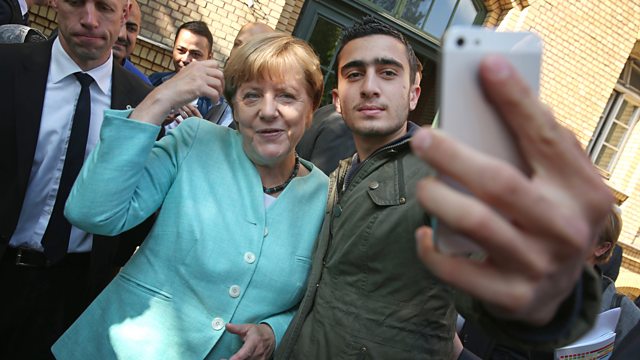
(Photo: German Chancellor Angela Merkel poses for a selfie with a migrant from Syria after visiting the AWO Refugium Askanierring migrant shelter in Berlin. Credit: Getty Images)
Last on

Broadcasts
- Thu 18 Feb 201600:32GMTBBC World Service except News Internet
- Thu 18 Feb 201603:32GMTBBC World Service Americas and the Caribbean
- Thu 18 Feb 201605:32GMTBBC World Service Online, East Asia, South Asia, Europe and the Middle East & UK DAB/Freeview only
- Thu 18 Feb 201607:32GMTBBC World Service Australasia
- Thu 18 Feb 201618:32GMTBBC World Service Australasia
- Thu 18 Feb 201619:32GMTBBC World Service except Australasia & News Internet
- Mon 22 Feb 201602:06GMTBBC World Service Australasia
- Mon 22 Feb 201606:06GMTBBC World Service East Asia
Download this programme

Subscribe to this programme or download individual episodes
