Understanding the size of bacteria
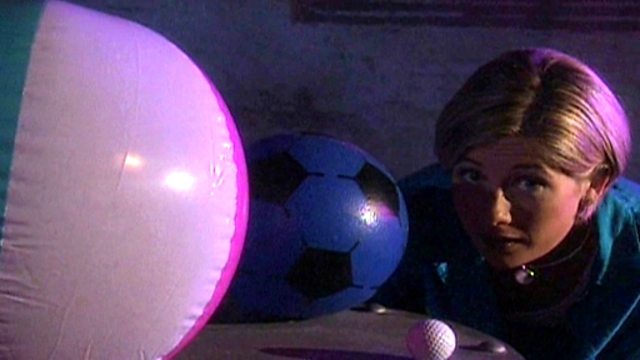
Simple objects are scaled up in size and used to illustrate just how tiny bacteria can be. An ordinary needle has been scaled up by a factor of 5,000. The giant needle is 250 metres long. This comparison is used with bacteria. The viewer is asked to think how big a single bacterial cell would be if it was also magnified 5,000 times. Would it be the size of a beach ball, a football, a golf ball or a garden pea? It would be the size of a pea. Bacteria are just one group of microbes. If algae were magnified 5,000 times they would be the size of a golf ball, while another single-celled organism, an amoeba, would be the size of a beach ball.
Duration:
This clip is from

More clips from Micro Organisms
![]()
Microorganisms (clip compilation)
Duration: 00:43
![]()
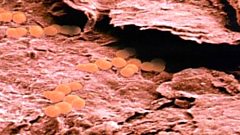
The bacteria that lives on skin
Duration: 00:53
![]()
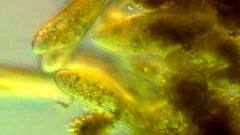
Microorganisms at work in a sewage farm
Duration: 00:47
![]()
Interdependence and adaptation (clip compilation)
Duration: 00:50

More clips from Science Clips
![]()
Weightlessness in space—Forces in Action
Duration: 01:21
![]()
Gravity on Earth, Jupiter and Pluto—Forces in Action
Duration: 01:22
![]()
The Moon and its orbit around Earth—Earth, Sun and Moon
Duration: 01:27
![]()
The Moon—Earth, Sun and Moon
Duration: 01:12