THE DEBATE THAT CHANGED AN ELECTION
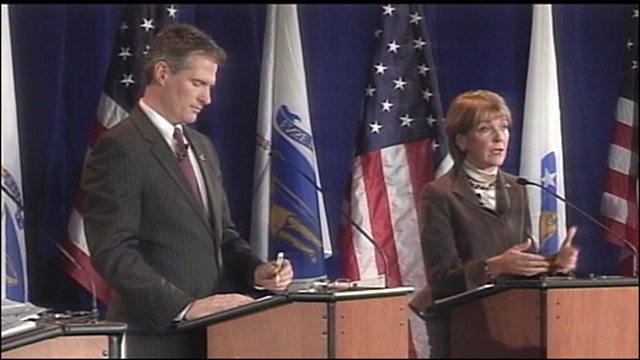
Scott Brown's performance in a TV debate with Democratic rival Martha Coakley helped him secure election to the US Senate in January 2010.
It was a stunning victory, capturing a Massachussets seat which had been synonymous with the Kennedys and held by the Democrats for 50 years
By Jay Mukoro
It’s not often remarked upon that John F. Kennedy had already proven himself in the TV debating arena, and well before his legendary encounter with Richard Nixon in Chicago, on 26 September 1960. Eight years earlier, a young JFK had first shown his debating flare, in front of the cameras, when capturing a Massachusetts senate seat from Henry Cabot Lodge in 1952. The late Erik Barnouw, a media historian, and best know for his work on American radio and television broadcasting, wrote that Kennedy ‘impressed viewers with the brevity and conciseness of his replies, engaging wit, and apparent grasp of local issues’.
Spool forward fifty years from the first Presidential debate, and on a cold winter night last January, at the University of Massachusetts in Boston, we wanted to understand and get the inside story, on what it’s like to be a candidate taking part in a TV Debate. Scott Brown gave us exclusive behind the scenes access, in the lead-up to the debate; from the morning walk through, to last minute negotiations about the set, to his reflections immediately after the debate in his green room.
In recent decades, the Senate seat Brown was vying for had either been occupied by a Kennedy -John F Kennedy, his younger brother Edward Kennedy, or a family confidant. In short it was common –and not just amongst Democrats, to not only view Massachusetts as staunchly Democrat, but this particular seat as synonymous with the Kennedys’. But when Professor David Gergen, the debate’s moderator said as much during the debate, Scott Brown bristled, and said in response: ‘With all due respect, it’s not the Kennedys’ seat. It’s not the Democrats’ seat. It’s the people’s seat.’ Brown’s pointed response set the tone for a spirited hour long televised debate, as he repeatedly clashed with his Democrat and main rival, Martha Coakley - over taxes, terrorism and healthcare issues.
Coakley went into the debate with as much as a 15 point lead, according to one poll in the Boston Globe. As the debate progressed it became clear that one of Scott Brown’s key strategies was to deploy a line or motto that could yield some post debate momentum. So when Martha Coakley attempted to suggest that a Brown victory would be tantamount to a continuation of the Bush/Cheney policies of the last administration, he was quick to point out: ‘…I’m Scott Brown - I live in Wrentham, and I drive a truck, and you’re not running against them, you’re running against me.” This implied ‘I’m a man of the people’ conveyed a sense of ordinariness, and Brown proved how a prepared line, of the likes of Republican hero Ronald Reagan’s ‘there you go again’, can have a huge impact on the viewing/voting audience, and be a game changer in an election.
It can be argued that Scott Brown used the reach of a televised debate, and the momentum he gained from it, to help secure a totally unexpected victory, which stunned the Democrats, in Washington as much as it did in Boston. But beyond the historic impact of Brown’s triumph was a bitter irony, as Ted Kennedy had been a long-time champion of healthcare reform and Obama’s reforms – which the Republican victory for a moment, threatened to derail.
Back in 1952, as Alan Schroeder author of "Presidential Debates: 50 Years of High-Risk TV” has noted in his book, Kennedy’s ‘unadorned style of delivery [fitted] well into the viewer’s living rooms’ across Massachusetts. Nearly 60 years later, and half a century on from JFK’s appearance in America’s first Presidential debate, Scott Brown’s down to earth manner and his projection as an independent minded Republican, fitted well with Massachusetts voters tuning into the TV debate in Boston in 2010 ( though admittedly minus the wit, verbal dexterity, and aplomb of John Fitzgerald Kennedy).
It remains to be seen what our leaders’ have digested from the ‘50 Years of High-Risk TV’, which have been the staple of American elections.