Throat Lozenges
Paddy McGuinness visits a medicine factory in Nottingham that’s helping to tackle the nation’s colds and flu, producing 230 million tablets and lozenges every single week.
Paddy McGuinness explores the secrets of the Reckitt medicine factory in Nottingham to reveal how it makes 230 million tablets and lozenges every single week. Paddy is following the production process of two products – Strepsils honey and lemon lozenges, and Nurofen ibuprofen tablets.
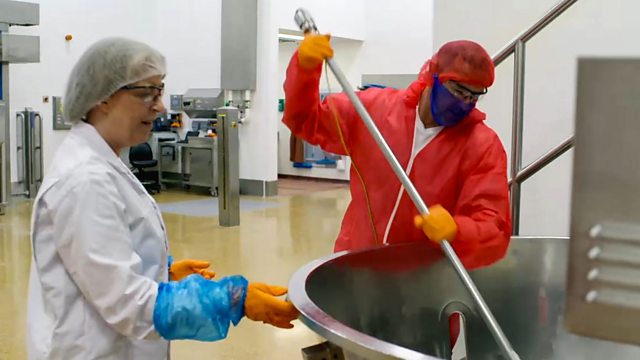
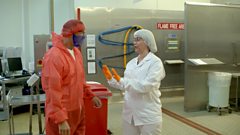
As soon as he arrives, Paddy is handed a large amount of clothing, including a fully protective bodysuit, a hairnet and even a face covering. As it’s a pharmaceutical facility, they take things very seriously.
Fully kitted out, he’s ready to get going and meets lozenge supply lead Richard Tagg, who’s overseeing the unloading and testing of a key lozenge ingredient, honey, in a special air-locked room. Paddy is surprised to learn that honey is used just for flavour, and the active ingredients that will actually soothe a sore throat are added later.
The next stage is the mixing area of the factory, again air-locked to prevent contamination. Here, the honey is combined with liquid sucrose and liquid glucose, creating the base mixture for the lozenge.
Adding the all-important active ingredients comes next, and for that, Paddy heads to the dispensary, where he meets technical director Dr Genna Buckley. No airlock door here, but before he can relax too much, Genna informs him that there are even stricter health and safety rules at play. The dispensary is an Atex-rated zone, containing flammable liquids and fine, dry powders. Anything that creates an electrical charge might cause an explosion! So, Paddy empties his pockets of all manner of electrical equipment, including microphones, walkie-talkies and several mobile telephones. There is one problem: cameras aren’t allowed into the danger zone, so the crew have to put the long lenses on and shoot the scene from afar, given the strict health and safety codes that have to be followed. Genna shows Paddy how two key active ingredients are added to help kill viruses in the throat, along with lemon oil and peppermint oil, which accentuate the lemony flavour.
At the start of the main production line, Paddy meets back up with Richard and watches the freshly mixed lozenge mix pour out onto a moving belt in one continuous, yellow stream. The hot mix is slowly cooled down and passes through a series of machines that transform it into a long sausage shape called a rope. The next stage of production is the moulding machine, which changes the rope into the familiar lozenge shapes at a rate of 8,300 every minute.
With the lozenges made, Paddy turns his attention to Nurofen, learning how various powders are mixed together before being pressed under very high pressure to form tablets. After that, they are coated with a sugar syrup to help the medicine go down better and packed into blister packs.
Back on the lozenge line, Paddy meets area team leader Marc Watkins to learn how his lozenges are also packed into blister packs, which helps to keep them fresh. The packs are then slid into cardboard boxes and piled into cartons ready to leave the factory.
In the dispatch area, Paddy learns that each lorry leaving the factory contains a whopping 4.5 million lozenges and 7.8 million tablets. That’s a lot of grateful patients!
Elsewhere in the episode, Cherry visits a team from the University of Oxford to learn the fascinating science behind how bees regurgitate nectar from their stomachs to make delicious honey. And she heads to Cumbria to discover how traditional thermometers are produced.
Meanwhile, historian Ruth Goodman discovers the murky world of the Victorian pharmacy that sold far more dodgy ingredients than medicines, sometimes with deadly consequences.
Last on

More episodes
Previous
Clip
Credits
| Role | Contributor |
|---|---|
| Presenter | Paddy McGuinness |
| Presenter | Cherry Healey |
| Presenter | Ruth Goodman |
| Production Manager | Laura Johnstone |
| Executive Producer | Lucy Carter |
| Executive Producer | Michael Rees |
| Production Company | Voltage TV |

Learn more about the history of the factory and how it has evolved with an interactive from The Open University.
The fascinating stories behind the production of some of our favourite products.
