Global Visions
Matthew Sweet explores the idea of a 'polycrisis' of progress across the spheres of technology, economic expansion, climate and the global political order.
Matthew Sweet explores the idea of a 'polycrisis' of progress across the intertwined spheres of technology, economic expansion, climate and the global political order.
In the spheres of technology, industry, economic growth and geopolitics the notion of human progress seems to have gone into reverse. There are widespread fears that new and incomprehensible technologies will turn against us. The industrial revolutions that enabled prosperity and comfort are now fuelling our ecological self-destruction. And just when we need global institutions to help regulate technological tyranny and combat climate disaster, the postwar architecture of the UN, international law and human rights seem increasingly marginalised in a world order that itself seems to be devolving.
For centuries, technology and scientific development, economic expansion and global governance were all seen as markers of progress - the Enlightenment’s promise of endless, forward improvement. But across all these fields this narrative now seems to be in crisis.
The idea of progress is so hardwired into our culture and psychology, it's not an easy idea to give up. But is the idea of endless progress itself now part of the problem? And progress for whom? It’s a relatively new idea - older periods in human history imagined the passing of time in cyclical or seasonal terms far more attuned to sustainability and the natural world. Given our current age of ‘polycrisis’ – the interconnection of global technology, climate catastrophe and geopolitical disorder - do we need to rethink how to think the future beyond the concept of linear time, endless expansion and progress?
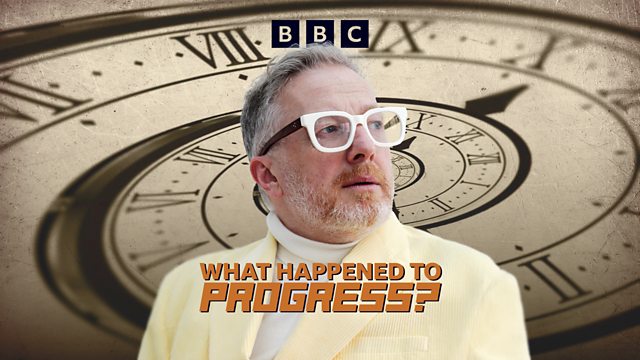
Author, historian and broadcaster Matthew Sweet asks what happened to progress – has it stopped? Are we going backwards? How have our ideas about progress themselves changed? With the help of thinkers, historians, writers and activists, Matthew asks if the concept can be re-imagined to give us newfound agency, shared humanity and most of all, hope.
In this final episode, Matthew explores a key vision of moral and political progress - the idea of a global, rules-based order to promote peace, cooperation and a shared humanity. Mapped out by the German philosopher Immanuel Kant in the late 18th century as the highest form of moral progress in politics, Kant's vision fuelled the 20th century architecture of global governance - the League of Nations, and after World War 2 the United Nations, the Universal Declaration of Human Rights, the WHO and other bodies. This project, speaking as it did for the whole of 'humankind', was not without its critics - then or now. But as the world's most powerful nations turn their back on global institutions and openly flout international law, is this idea of political progress going into reverse, undoing the postwar settlement and returning us to a state of lawlessness?
Contributors this episode include political philosopher Francis Fukuyama, military historian Margaret MacMillan, psychoanalyst Adam Phillips, barrister and human rights activist Shami Chakrabarti, historian David Edgerton, barrister Ulele Burnham, political theorist Lea Ypi, author Adam Greenfield, former High Representative of the Union for Foreign Affairs and Security Policy Cathy Ashton and director of the Climate Majority Project, Rupert Read.
Producer: Eliane Glaser and Simon Hollis
A Brook Lapping production for BBC Radio 4
Last on

Broadcasts
- Mon 12 Jan 202611:00BBC Radio 4
- Sun 18 Jan 202617:10BBC Radio 4
