Destination Moon
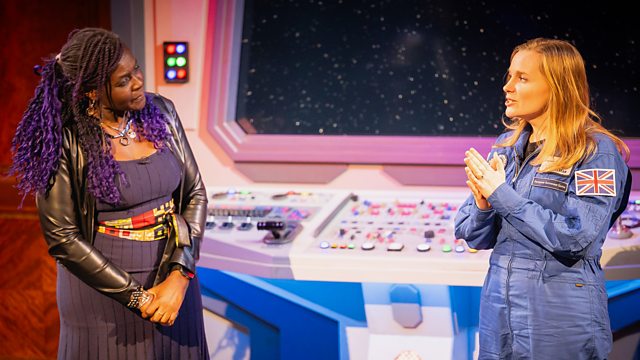
Dame Dr Maggie Aderin-Pocock begins her search for extraterrestrial life with an exploration of our nearest neighbour, and her favourite space rock, the moon.
Scientists in 2025 detected the 'strongest hint yet' of biological activity outside our solar system on exoplanet K2-18b, sparking growing excitement about the real possibility of extraterrestrial life. In this series of lectures, Dame Dr Maggie Aderin-Pocock sets out on a journey to find it. In lecture 1, self-confessed ‘lunartic’ Maggie begins by exploring our fascination with our closest neighbour, the moon.
Maggie first became obsessed with the moon as a child, when she would watch it with her dad, and aged 14, she even built a telescope of her own. Four hundred years earlier, Galileo first assembled glass lenses and made a telescope, which Maggie and audience volunteers will help to recreate. He too pointed it at the moon, astonishing the world with his drawings and inspiring a raft of theories about the type of alien life that might be living there. The moon wouldn’t be confirmed as lifeless until humans actually set foot on it in 1969.
Maggie explores the history of our own species in space, joined by the UK’s latest crew of European Space Agency astronauts - Rosemary Coogan, John McFall and Meganne Cristian. From the early Apollo missions to the planned Artemis Moon landing in 2027, the astronauts join children from the audience in a series of demos that illustrate the challenges of human space travel and the reality of colonies on the moon and beyond.
Maggie uses this lunar viewpoint to look back on our own planet and ask some fundamental questions about life. Cosmic mineralogist Prof Sara Russell from the Natural History Museum studies space rocks and demonstrates what they can tell us about where life’s precursors came from and how life on earth may have got started. We then meet some of the most weird and wonderful creatures that have evolved here on our planet, like the scaly foot snails that live at hydrothermal vents deep in the ocean, at temperatures of over 350°C. What are the limits for life on another world, and what might it look like?
Finding other planets that might host life will require us to ‘see the invisible’. Maggie and her volunteers demonstrate, using UV torches and infrared cameras, how today’s modern telescopes allow us to do just that.
Finally, Maggie examines what it means to be a 'goldilocks planet' - not too hot, not too cold - just right for life. In a full audience participation demo, we question if there is another habitable world out there and what it would need to be like. What are we searching for in our quest to find an extraterrestrial species?
This is the 200th anniversary year of the Christmas Lectures. They are the most prestigious event in the Royal Institution calendar, dating from 1825, when Michael Faraday founded the series for children. They have become the world’s longest-running science television series and promise to inspire children and adults alike each year through explosive demonstrations and interactive experiments with the live theatre audience.
Last on

More episodes
Previous
You are at the first episode
Clip
![]()
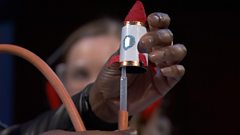
Hydrogen rocket launch
Duration: 01:25
Credits
| Role | Contributor |
|---|---|
| Presenter | Maggie Aderin |
| Executive Producer | David Dugan |
| Series Producer | Lucy Haken |
| Director | David Coleman |
| Production Manager | Felicity Chapple |
| Production Company | Windfall Films Ltd |
Featured in...
![]()
Exploring the Cosmos
A collection of programmes exploring the mysteries of stars, Space and distant planets.

Now it's time to launch your own space mission
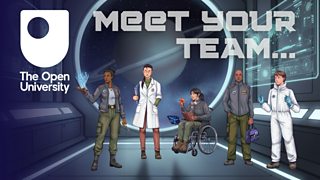
Discover the teams that bring space science to life with The Open University.
