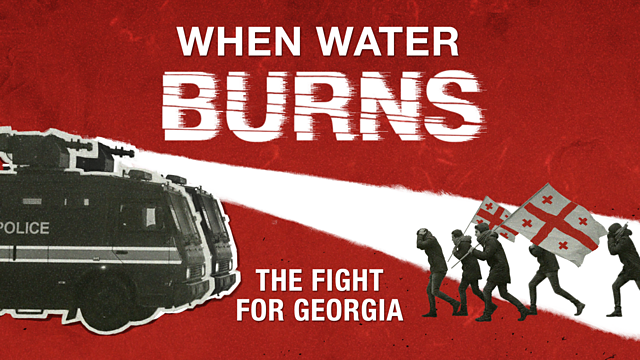
When Water Burns: The Fight for Georgia
“It didn’t only get you wet, it also burned your skin”
BBC Eye uncovers evidence suggesting Georgian police used water cannons laced with a chemical weapon against protesters last year.
“It didn’t only get you wet, it also burned your skin”
A year-long investigation by the BBC has uncovered evidence that police in Georgia used a World War One chemical weapon in water cannons against its own citizens during protests in Tbilisi last year. It’s believed to be camite (CA or bromobenzylcyanide), an obsolete chemical weapon first deployed by the French forces late in 1918 against the German army.
The Georgian authorities described the allegations as ‘absurd’ saying that the police had acted legally.
Paediatrician and anti-government activist Dr Konstantine Chakhunashvili told the BBC that even small sprinkles from the water cannons burned his skin and that it took days to wash off the substance. He said that the experience led to his decision to run a medical study on nearly 350 other protesters who had also been exposed to riot control agents and water cannons.
The study concluded that nearly half of the participants reported some long-term effects - defined as beyond 30 days - such as coughing and shortness of breath. He also noticed changes in the heart and lungs in some cases.
The BBC Eye team spoke with high-level whistleblowers formerly of the Georgian riot police who helped determine the likely identity of the chemical agents used – information which the Government has so far refused to reveal. A former Head of Weaponry at the riot police told the BBC he was asked to test a mixture of two chemicals in the water cannons whilst in post and described it as 10 times stronger than regular tear gas – it made it hard to breathe and caused some of his colleagues to vomit.
The BBC shared its evidence with toxicology and chemical weapons experts who believe that the compound used is likely to be Camite (CA or bromobenzylcyanide) - an obsolete riot control agent, first deployed as a chemical weapon by French forces against the Germans at the end of World War One. It was later used by American police but then dropped due to its strength and persistence.
The UN Special Rapporteur on Torture Dr Alice Jill Edwards says that based on the BBC’s evidence, this could be classed an ‘experimental weapon’ and its use would be in violation of human rights law.
The ruling party, the Georgian Dream, described the allegation that unknown chemicals had been added to the water cannons as ‘deeply frivolous’ and ‘absurd’.
It said that law enforcement had acted ‘within the bounds of the law and constitution’ when responding to the ‘illegal actions of brutal criminals’.
More episodes
Previous
You are at the first episode
Featured in...
![]()
BBC Investigates
These ground-breaking investigations reveal the real stories beyond the breaking news.