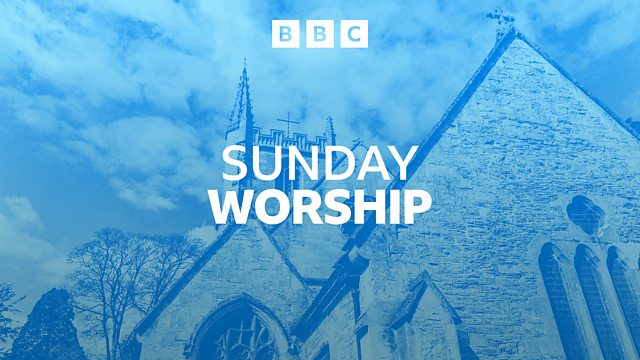
St Aloysius' Church, Glasgow
With Fr Adrian Porter SJ and the Schola Cantorum of St Aloysius' College, Glasgow.
With Fr Adrian Porter SJ and the Schola Cantorum of St Aloysius' College, Glasgow.
Readings: Amos 8:4-7
Luke 16:10-13
Dear Lord And Father Of Mankind (Tune: Repton)
Before The World Began (John L Bell/Graham Maule)
Ubi Caritas (Gjeilo)
Our Father (Roberts)
Praise To The Holiest In The Height (Tune: Billing)
Organ Voluntary: March from The Occasional Oratorio (Handel)
Director of Music: Ann Archibald
Organist: Ronan McQuade
Last on

Script
FR
ADRIAN PORTER SJ: Welcome &
Introduction
Good
morning. My name is Fr Adrian Porter and
I am here in the Jesuit Church and College of St Aloysius in Glasgow.
We gather, as Christians all over the world do on this day, to read the Scriptures, to reflect on God’s word and to offer our prayer and praise in word and song. We hope to bring some solace and calm, and some time to think in the midst of the world’s tensions and turmoil.
MUSIC: HYMN – DEAR LORD AND FATHER OF MANKIND (Tune: REPTON)
ADRIAN: Preparing to listen to the Word of God & Opening Prayer
I’m
joined today by the Schola Cantorum of St Aloysius’ College directed by Ann
Archibald and accompanied by Ronan McQuade.
Now, as we prepare to listen to the word of God in the Scriptures, we are
conscious of our own unworthiness to stand before the living God who is all
good. And yet we know that he is all
merciful. And so we ask the Lord’s
forgiveness for our sins.
MUSIC: KYRIE(Keith Roberts Mass of St Aloysius)
MARY
O’DUFFIN: Opening Prayer
Let us pray.
Lord, God,
in your wisdom you created us,
by your providence you rule us:
penetrate our inmost being with your holy light,
so that our way of life
may always be one of faithful service to you.
Through Christ our Lord. Amen.
ADRIAN:Introduction to Scripture readings
Our Old
Testament reading is read for us by the Principal of St Aloysius’ College,
Séamus Scorgie.
SÉAMUS
SCORGIE: Old
Testament Reading (Amos 8:4-7)
A
reading from the book of the prophet Amos.
Hear
this, you who trample on the needy
and bring the poor of the land to an end,
saying, “When will the new moon be over, that we may sell grain?
And the Sabbath, that we may offer wheat for sale,
that we may make the ephah small and the shekel great
and deal deceitfully with false balances,
that we may buy the poor for silver
and the needy for a pair of sandals
and sell the chaff of the wheat?”
The Lord has sworn by the pride of Jacob:
“Surely I will never forget any of their deeds.”
This is the word of the Lord. Thanks be to God.
ALL: Thanks be to God
ADRIAN The Psalm which the church pairs with this reading could not be more of a contrast.
Amos has directed our attention to the sordid dealings of those who trample the needy and bring the poor of the land to an end.
We feel embarrassment and contempt for our fellow men and women who behave in such a way with scant regard for the least fortunate, buying them off for the price of a pair of sandals.
Psalm 113 is one of the hallelujah Psalms sung before the Jewish Festival of Passover.
It is a song of praise sung by the whole community, calling attention to the God who though high above all the nations and even above the heavens, stoops down and looks with compassion on the lowly and poor, lifting them up, raising them, setting them up in the company of princes. How different are God's ways from our human ways!
Alleluia. O servants of the Lord. Praise
the name of the Lord.
May the
name of the Lord be blest both now and forevermore.
From the
rising of the sun to its setting, praised be the name of the Lord.
High above all nations is the Lord, above the heavens his glory.
Who is
like the Lord our God, who dwells on high, who lowers himself to look down upon
heaven and earth?
From the
dust he lifts up the lowly.
From the
ash heap he raises the poor to set them in the company of princes,
Yes,
with the princes of his people.
To the
childless wife, he gives a home as a joyful mother of children.
MUSIC: PSALM: BEFORE THE WORLD BEGAN (John Bell/Graham Maule)
READER -
MAISIE Gospel Reading (Luke
16:10-13)
A
reading from the holy gospel according to Luke.
Jesus said to his disciples,
“One who
is faithful in a very little is also
faithful in much,
and one
who is dishonest in a very little is also dishonest in much.
If then
you have not been faithful in the unrighteous wealth,
who will
entrust to you the true riches?
And if
you have not been faithful in that which is another’s,
who will
give you that which is your own?
No
servant can serve two masters,
for
either he will hate the one and love the other,
or he
will be devoted to the one and despise the other.
You
cannot serve God and money.”
The word
of the Lord.
ALL: Thanks be to God.
ADRIAN Reflection
When I am asked to conduct the funeral of someone I do not know, I face the challenge every priest and minister faces: to say something about the deceased – neither pretending the familiarity of a lifelong friendship nor giving the impression you haven’t a clue about their loved one. I ask the family for a few thoughts – what would immediately come to mind if they were asked to describe them to someone who didn’t know them; and the response is always about the kindnesses they showed, the love they lavished, the tribulations they overcame, and never about the wealth or prestige they accumulated. And it is often warts and all, occasioning affectionate laughter, the knots and muddles and missteps regretted which are there in every lived life. The prophet Isaiah sums it up well when he says, “like a weaver you roll up my life to cut it off from the loom” (Isaiah 38:12) – I know that the tapestry I have woven of my life is likely to be more a child’s primary school art project than the masterpiece of Bayeux!
Funerals are, perhaps, one of those relatively few naturally-occurring occasions which force us to take a different and longer perspective on things: sub specie aeternitatis, from the eternal point of view. Maybe we are too busy and preoccupied with the business and busy-ness of living to do so at any other time. Astronauts often described the experience of looking back at planet earth from space as awe-inspiring, transcendental and humbling – a realization of the fragility and interconnectedness of transient human life; it was an experience they wished everyone could have as it would change the way we live our lives. Jesus tries to get his disciples to take this radically different perspective in the gospel we just heard.
The context here is Luke’s telling of the great pilgrimage Jesus makes from Galilee in the north, heading towards Jerusalem and, inexorably, to the fulfilment of his mission in his death. As he goes, great crowds gather and accompany him along the road, intrigued by this man, challenged by his preaching, and amazed by his miracle-working. The dialogue reported by Luke switches back and forth between exchanges with the whole crowd or individuals within it and much more intimate conversations with his disciples. For this inner band of those chosen from the beginning of his ministry, Jesus sharpens the focus and heightens the demand – this is ‘hard teaching’ which sorts sheep from goats, those who are like rich soil and willing to engage, and those in whom the seed falls on rocky ground.
What Jesus calls “unrighteous wealth” is, of course, the very necessary currency and exchange of our daily lives: money, doing the shopping, food, relationships, family, catching the bus, pleasantries, working for a living, paying the bills. We are perhaps more than a little discomforted by the abruptness of Jesus’ description of it, “unrighteous wealth” – surely it is unavoidable? But, perhaps despite the puzzled faces of his disciples, Jesus drives home his point – not only is this wealth “unrighteous”, our attachment to it means that we have not been faithful even in “that which is another’s”. Everything we have is, in effect, borrowed – we can’t take it with us – “Fool, this very night your soul will be demanded of you” (Luke 12:20) – or as the prophet Job observes, “naked I came from my mother’s womb, and naked I will return.” (Job 1:21)
If we meet Jesus’ challenge as his disciples and delve deeper into this idea of “unrighteous wealth”, which we all possess and in which we deal every day, we arrive at a worrying realization that, almost inevitably, this “unrighteous wealth” is, to a greater or lesser extent, come by through dishonesty and exploitation. How so?
The
Church leads us into this deeper reflection by pairing today’s gospel with a
passage from the Old Testament prophet Amos. Amos lived in the eighth century BC and spoke out against the scandal of
the growing disparity between the wealthy and the poor in the northern Kingdom
of Israel. Times are not much changed,
for, according to research published by the Rowntree Foundation, in the UK
today the top 1% of the population holds 23% of wealth and the bottom 50% of
the population owns less than 5% and the gap is widening.
(Joseph Rowntree Foundation, Changing
the Narrative on Wealth Inequality 2025).
Amos indicts those “who trample on the needy and bring the poor of this land to an end”; who know every trick and ruse to “make the ephah small and the shekel great”; who “deal deceitfully” by “selling the chaff [and not the grain] of the wheat.”
We may not deal in ephahs and shekels, and we may baulk at the idea that we trample anyone, but honest reflection suggests we have their equivalents: We [– and I include myself in this -] tend to hold tight to what is ours and measure out with a degree of miserliness what we could give with great generosity; we often exploit the relationships we have with others for our own benefit rather than what is truly best for them; we use our energy, our talents, our time, our resources mostly for our own comfort; we consume the resources of the earth without too much thought for the scarceness of those resources and the impact on those, a world away, who are most affected by climate change and poverty.
And yet
amidst all this, God remains faithful to us, for in the gift of his Son, Jesus
Christ, “Life found its source; death found its end; light found in him its
course, darkness its friend, for neither death nor doubt nor darkness can put
out the glow of God, the shout: 'I am for you.'
MUSIC: PSALM: BEFORE THE WORLD BEGAN (John Bell/Graham Maule)
ADRIAN
What I increasingly realize is that it is all too easy to barge my way through life, insensitive to the needs and struggles of others, sharp-elbowing them aside, and allowing myself to be obsessed with what is mine and “fair” from my own narrow perspective.
Only after this soul-searching reflection, do I recognize what Jesus has been saying all along – that this is about “dishonesty”. And even though I know, or perhaps just have an inkling, that what Jesus is saying is spot-on, I choose to put my head in the sand and carry on as usual. My excuse is that everyone else is doing it. There’s comfort in the herd . . . until I personally, and alone, am called to account for my life, today and at the final judgement.
Jesus challenges his listeners to consider “that which is your own” – the treasures we heap up in heaven, true riches, deposited for eternity. I am reminded of a New Yorker cartoon which shows a rich man at the pearly gates having received St Peter’s assessment of his life’s worth: He says, “They’ve properly given me an A in business, an A in money, and an A in power, but somehow an F in life.” Perhaps then his eyes were opened to times when his desire for wealth and power had made him blind to those he had deceived and damaged along the way.
God has entrusted us with true riches. Indeed, showered them upon us, day by day: in the very fact that I live, and move, and have my being; in the warmth of sunshine and freshness of showers and the manifold glories of nature; in the astonishing achievements of human creativity; in the best of human nature; in the child’s fascination with what I have long discovered and discarded as banal; and yet we pass them by. How often do we who live close to amazing sights in our cities or in the countryside not visit them because there will always be time – until there isn’t.
In ancient times, the People of God who escaped Pharoah, and wandered forty years in the desert, complained there was no food and the Lord “rained down bread from the heavens” (Deuteronomy 16:4) and they called it Manna, delicate, powdery, as fine as hoarfrost, white, like the taste of wafers made with honey. But soon familiarity bred contempt and they wailed “Who will give us meat to eat?” (Numbers 11) and God gives them quails in abundance; but still they are not satisfied. While it is true the world can seem a very grim place at the moment, the true riches given by God will always outnumber, outshine, outpace the sadnesses and miseries and tragedies if only we have eyes to see and ears to hear.
And this doesn’t mean we are to be superficially happy religious eccentrics, crassly smiling in the face of truly appalling things. It means we share in the suffering of the world, we ask mercy for our own and others acts and omissions, but we hold tight to the presence and activity of the God who loves us, even to the giving up of his only Son, and offer hope where there is despair, faith where there is doubt, and where there is hatred, love.
Our world is so in need of these treasures today. And I am so in need of them too. As we listen to God’s word today in these Scriptures, let us open our hearts and, setting aside for a moment the “unrighteous wealth” of this world, be again devoted to the Master who is devoted to us. For only then will we find true riches.
MUSIC: UBI CARITAS (Gjeilo)
MARY & JACK – Bidding Prayers
MARY:
God is love: he who dwells in love dwells in God, and God in him. In Jesus Christ we see how God loves us. Let us renew our faith in his love.
MUSIC: KYRIE(Keith Roberts Mass of St Aloysius)
You have
given us life and light this morning: let us give thanks for such great gifts.
ALL: Lord, hear our prayer.
JACK:
You are
the sole master of the future: keep us from despair and the fear of what is to
come.
ALL: Lord, hear our prayer.
MARY:
Love has
no ambition to seek anything for itself: strengthen our will to give up
selfishness today.
ALL: Lord, hear our prayer.
JACK:
May the
governments of nations and the leaders of the peoples act with justice and
integrity for peace and the common good.
ALL: Lord, hear our prayer.
MARY:
May your
love in us overcome all things: let there be no limit to our faith, our hope,
and our endurance.
ALL: Lord, hear our prayer.
JACK:
Let us
pray to the Father in the words that Jesus taught us …
MUSIC: OUR FATHER (from Roberts Mass of St Aloysius)
ADRIAN: Closing Prayer (St Anselm d.1109) & Blessing
We pray in words written by St Anselm almost 1,000 years ago.
Jesus,
like a mother you gather your people to you;
you are
gentle with us as a mother with her children.
Despair
turns to hope through your sweet goodness;
through
your gentleness we find comfort in fear.
Your
warmth gives life to the dead,
your
touch makes sinners righteous.
Lord
Jesus, in your mercy heal us;
in your
love and tenderness remake us;
in your
compassion bring grace and forgiveness;
for the
beauty of heaven may your love prepare us.
ALL: Amen
May the
Lord bless you and keep you. ALL: Amen
May he
let his face shine upon you and show you his mercy. ALL: Amen
May he
turn his countenance towards you and give you his peace. ALL: Amen
And may
the blessing of almighty God, the Father and the Son and the Holy Spirit, come
down on you and remain with you for ever. ALL: Amen
Go in the peace of Christ.
ALL: Thanks be to God.
MUSIC: HYMN – PRAISE TO THE HOLIEST IN THE HEIGHT (Tune: BILLING)
MUSIC: ORGAN - MARCH FROM THE OCCASIONAL ORATORIO (HANDEL)
Broadcast
- Sun 21 Sep 202508:10BBC Radio 4
Lent Talks

Six people reflect on the story of Jesus' ministry and Passion from their own perspectives
No fanfare marked Accession Day...
In the Queen, sovereignty is a reality in a life, says the Dean of Westminster.
The Tokyo Olympics – Stretching Every Sinew

Athletes' reflections on faith and competing in the Olympics.
"We do not lose heart."
Marking the centenary of HRH Prince Philip's birth, a reflection from St George's Chapel.
St David's Big Life Hack
What do we know about St David, who told his monks to sweat the small stuff?
Two girls on a train
How a bystander's intervention helped stop a young woman from being trafficked.
Sunday Worship: Dr Rowan Williams
How our nation can rise to the huge challenges it faces, post-Covid-19.
