Powerful Voices
A service from Bangor, North Wales, led by Rev James Tout, with music, readings, conversations and prayers from members of the National Youth Choir of Wales.
The National Youth Choir of Wales join together annually for their summer residency. This year, the choir is based at the University of Bangor, in the North West corner of Wales. Its members, drawn from across Wales, and aged between 16-22, relish the opportunity to unite their voices through song.
We often turn to singing as a heightened form of communication, bursting into song at moments of celebration, and even moments of great sorrow. The scriptures themselves are full of song: psalmists invite us to make a joyful noise and to sing praise, and Biblical figures respond in song at moments of great intensity and power. Rev James Tout and members of the National Youth Choir of Wales explore the potential in our own voices, both sung and spoken, as well as the power that can be unlocked by listening and responding, often to the most humble of voices.
Luke 1. 46-55 / Tell Out My Soul (T. Dudley-Smith, W. Greatorex)
Luke 18. 15-17
How Shall I Sing that Majesty (Coe Fen), K. Naylor, arr. Alistair Warwick
Children, go where I send thee, arr. Roderick Williams
Even When He is Silent, Kim André Arnesen
Beloved, let us love, Meirion Wynn Jones
Pantyfedwen (Tydi a wnaeth y wyrth / You did this mighty deed), M. E. Evans, arr. Tim Rhys-Evans
The National Youth Choir of Wales
Conductor: Tim Rhys-Evans
Pianist: Nicky Rose
Organist: Joe Cooper
Last on

More episodes
Script:
Bore da a chroeso. Good morning and welcome to Sunday Worship. I’m the Reverend James Tout, Chaplain to the Archbishop of Wales, and today’s worship comes from Bangor, North West Wales. Bangor is the oldest city in Wales, home also to its longest high street, where to one side we see the majestic mountains of Eryri National Park, and the other the seemingly harmless but tricky waters of the Menai Strait separating Ynys Môn from the mainland. This is the place where Saint Deiniol in 525, founded his community and monastery; the fence of hazel around it, the original bangor. The Diocese of Bangor is the oldest see in Britain. Here, for almost a millennium and a half worshipers have lifted their voice in songs of praise to God.
And I’m here, on campus, outside Neuadd Pritchard Jones – the University’s main hall – where the National Youth Choir of Wales are busy rehearsing as part of their annual residential course. And in today’s service, we hear their voices, both sung and spoken, and reflect on what it means to make a joyful sound together.
We often burst into song as a powerful form of communication, in celebration, in protest, in praise. It’s that power that our first hymn refers to, “How Shall I Sing that Majesty”, in which the hymnist can only turn to music and song as he strives to join the heavenly chorus to sing of the majesty of God.
Hymn 1: How Shall I Sing That Majesty
Bidding Prayer – Rev James Tout
Let us make a joyful noise to the Lord, breaking forth into song and singing his praises. Lord, we praise you with joyful instruments, with harps, trumpets, pipes and voice we make melody, for you are our King and our God. Amen.
The sounds of vocal warm up exercises fades up.
We hear the choristers share their singing experiences, and consider the power of singing together.
The vocal warm up exercises end.
The Power of Song – Rev James Tout
The word voice appears in the Bible around 400 times by itself before you add any of its synonyms…then, we’re up to over 9000, so we can safely say that finding and using one’s voice is important. It’s not only spoken voice that is found in scripture, there is a whole host of song in the Bible too; we only need to glimpse into the book of Psalms to see countless sung expressions of people's deepest feelings, not only in times of sadness and fear, but in times of exuberant joy and happiness. We find numerous stories about voice and its power. But we also find some stories where individuals and even groups are so overwhelmed, awestruck and amazed that their most primal instinct is to burst into song.
There’s the song of Moses and Miriam after God has parted the Red Sea where we hear Miriam lead the chorus “Sing to the Lord, for He is highly exalted”.
There’s the song of Ruth to Naomi “Where you go, I will go; where you lodge, I will lodge; your people shall be my people, and your God my God”. Despite the death of Ruth’s husband, Naomi’s son, it's a song that speaks of faithfulness, love, friendship and sacrifice.
There’s Simeon’s song of praise when he’s presented with the baby Jesus in the temple: “for my eyes have seen your salvation”. He instantly recognises the baby as the Messiah and bursts into song.
But, perhaps one of the best-known songs in all of scripture is that of Mary, the mother of Jesus, not long after she has received the news that she is pregnant. She herself was likely a young person, maybe the same age as some of the young people in the choir today; navigating a difficult world which would have seen her pregnancy as scandal. Despite all of this, because of God’s goodness, the emotion is overwhelming, and she bursts into song.
Hymn 2: Tell Out My Soul, Luke 1. 46-55
First Reflection - James
In this song, Mary meets with her relative Elizabeth who is also pregnant, with John the Baptist. When they meet Elizabeth feels the child leap for joy in her womb and cries out loudly in praise. Mary responds in her song of praise of God, of God’s power, of God’s sovereignty, of God’s goodness and of God’s faithfulness. As we’ve heard, every time we find songs in scripture it represents something profound and special, it’s as if the only way that these individuals can express their deepest feelings is to burst out into song. It says something about singing as being a direct and pure form of saying what one truly means, in ways that simple prose simply cannot.
There are parallels here for us in our lives, I’m sure. I wonder how many of us have a ‘theme tune’ or maybe a ‘special song’ for certain feelings, songs that transport us to places when we hear or sing them; they have an uncanny power to help us shape and form our indescribable emotions into poetic form. We only need to look around us and we see this everywhere; the hymns we sing in Church can often better articulate what we’re trying to say or feel than the most eloquent of sermons; the songs we sing at sporting events galvanise a sense of community and team but also the mood when the team is winning or losing.
The physical and mental benefits of singing are well documented, and we’ve heard in the young people’s responses glimpses of the benefits it brings them; it all points to the power that music has to help us shape our deepest thoughts and feelings.
Mary and Elizabeth are only able to do these incredible things, to say yes to God and bring into the world St John the Baptist and Jesus because they heard and responded to God’s call on them. Despite the conditions not being ideal for either of them, they heard, listened, and responded faithfully to what God was asking of them.
Listening can be such a hard thing to do, we often hear things, but do we really listen? Our young people have much to say to us, but listening to what they have to say can be challenging, difficult, uncomfortable; but usually profound, prophetic, and worthwhile.Guitar strumming fades up, along with laughter and chatter.
I’ve popped out to the Powis Hall at Bangor University, and I’m joined by four of the younger members of the choir, Luke, Poppy, Emma and Owain, to talk about how they use their voice.
Discussion with young people about issues important to them, and how they aspire to use their voices – James and Choir Members
Song 3: Children, go where I send thee
Introduction to reading – Rev James Tout
These young singers have certainly learned to use their voices creatively, to make a joyful sound, and also have plenty to say for themselves too, if only we would listen. It’s nothing new either, Jesus tells us quite clearly the importance of young people, in the Gospel according to Saints Matthew, Mark and Luke we have the story of Jesus blessing the children:
Reading 2: Luke 18. 15-17 – Choir Member
People were bringing even infants to him that he might touch them; and when the disciples saw it, they sternly ordered them not to do it. But Jesus called for them and said, ‘Let the little children come to me, and do not stop them; for it is to such as these that the kingdom of God belongs. Truly I tell you, whoever does not receive the kingdom of God as a little child will never enter it.’
Second Reflection – Revd James Tout
In this short account, we can see that the disciples are getting annoyed by all these children that are being brought to Jesus, they’re a nuisance, a distraction from the work at hand. Jesus clears the situation up quickly – he instructs them to let them come to him because it is these that the kingdom belongs to. It places them squarely in the picture, they’re important, they’re not only the future but very really the present also.
So just as in those times we can learn to listen to our young people today. The members of the Choir have demonstrated to us very clearly that they care, they have powerful voices, all they want is to be listened to and be part of the process.
I was a High School Head of Science and Associate Assistant Headteacher. Whenever I was interviewing people for roles one thing I always made sure happened was that they spent some time with a group of young people so that they could ask their questions. They were always the most perceptive, the most curious, the most discerning; and sure enough, they were always right about who was best suited to the role. Many of us will know the feeling of facing these difficult questions, if only I had a penny for the number of times I was asked in my Chemistry lessons how I could be a Science Teacher and a Priest, I’d be a very rich man indeed. How could I possibly believe in God and the scientific detail of our amazing world? Or the inevitable deep questions from my Son about the meaning of life, why do bad things happen to good people, or simply why he can’t have chocolate for breakfast every day.
So often when we listen to something or someone there is a need to respond. It is up to us then, to find the humility to which Jesus refers, to become more like children ourselves, and to listen to our young people so that they may feel truly heard.
Hymn 4: Even When He is Silent
Third Reflection 3 - Revd James Tout
We’ve heard of the power of song and singing in heightening a message and in finding our voices, the power and prophetic nature of listening to our young people. But, sometimes when we use our voice, when we have something to say that needs to be heard, when we think we have been listened to, sometimes we’re faced with a deathly silence. That silence that can make us feel utterly voiceless and unheard. The motet, “Even When He is Silent”, sets a text found on a wall at a concentration camp: “I believe in the sun even when it’s not shining. I believe in love even when I feel it not. I believe in God even when He is Silent.”
It’s the silence that wears us down, it’s the silence that can make us give up completely.But, even in the deepest of silences, like the deepest, most shocking silence that the motet conveys where human life was treated as worthless, where their voices seemingly mattered not…even within this deafening silence, there, even there, the writer found hope with God. They found that no matter what, they were known and loved by God. This is truly extraordinary and helps us to find some sense that silence is not always nothingness.
Using our voices helps us foster relationships, create deep and meaningful connections, explain ourselves, to share our burdens with family, friends, and colleagues, to show our own willingness to listen too. We can do this with God too, through our prayer life, and we’re told that he will listen. Jesus prayed to his Heavenly Father often, maintaining that relationship, not only in good times but in difficult times too.
Often when we pray, one of the outcomes is the need to act, or an invitation to respond in some way. This can be in acts of kindness, charity, generosity; and sometimes the response is one that isn’t too hard or tasking. Other times the response is hard and demanding, uncomfortable and burdensome, but deep down we know is the right thing to do.
God has a funny way of evoking these responses, and we only need to listen to what our young people have said to us already, they’re passionate about taking action, for standing up for what they believe in, in responding to the world they see around them.
We may not hear an auditory voice, it may simply be uncomfortable silence, but it is unmistakably God’s call to action. And there can be power in the silence, too.
Prayers – Revd James Tout and Choir Members
We come now to our time of prayer. Let us pray.
Almighty God, your Son has promised us that, when we meet in his name and pray according to his mind, he will be among us and hear our prayer. In your love and mercy, fulfil our desires and give us your greatest gift, which is to know you, and your Son, Jesus Christ our Lord.
Lord, we use our voice to pray for people of every race and in every kind of need: make your ways known on earth, your saving power among the nations.
Lord, we use our voice to pray for your Church throughout the world; guide and govern us by your Holy Spirit, that all may be led into the way of truth, and hold the Faith in unity of spirit, in the bond of peace, and in righteousness of life.
Lord, we use our voice to pray for all who are in danger, worry or any kind of trouble; for those who are sick, lonely or in need and for those who serve and care for them, for the victims of hunger, fear, injustice or oppression.
Lord, we use our voice to pray for those suffering as a result of national disaster. We remember especially at this time, the people of Libya and Morocco.
Just as our Lord Jesus Christ taught us, we pray with confidence to the Father:
Our Father, who art in heaven, hallowed be thy name. Thy kingdom come. Thy will be done on earth as it is in heaven. Give us this day our daily bread, and forgive us our trespasses, as we forgive those who trespass against us; and lead us not into temptation, but deliver us from evil. For thine is the kingdom, the power, and the glory, for ever and ever. Amen.
We’ve taken a journey today through thousands of years of powerful voices – from prophets and saints of old, to the young people of today. We’ve heard of moments in people's lives when they have been so overwhelmed with joy and wonder that all they have been able to do is sing out in praise. We’ve heard moments in people’s lives when they have been so desperate, and crushed by sheer silence that their words set to music still have a profound effect today. We’ve heard of the need to listen and listen well, to the voices of our young people and how they want us to act to what they see in the world.
And our final hymn today speaks of using one’s voice to proclaim, in uncontainable praise, God’s mighty deeds and praise him with all creation. Pantyfedwen, that great Welsh hymn in which we hear the words “Mae’r haleliwia yn fy enaid i, a rhoddaf Iesu, fy mawrhad i ti.” Which translates to “The hallelujah has possessed my soul, To you, O! Christ, I give my praises all”
Hymn 5: Pantyfedwen
Blessing
The blessing of God almighty, the Father, the Son and the Holy Spirit be among you, and remain with you this day, and always. Amen.
Hymn 5: Pantyfedwen continues
Organ Playout: Dubois Toccata in G
Broadcast
- Sun 17 Sep 202308:10BBC Radio 4
Lent Talks

Six people reflect on the story of Jesus' ministry and Passion from their own perspectives
No fanfare marked Accession Day...
In the Queen, sovereignty is a reality in a life, says the Dean of Westminster.
The Tokyo Olympics – Stretching Every Sinew

Athletes' reflections on faith and competing in the Olympics.
"We do not lose heart."
Marking the centenary of HRH Prince Philip's birth, a reflection from St George's Chapel.
St David's Big Life Hack
What do we know about St David, who told his monks to sweat the small stuff?
Two girls on a train

How a bystander's intervention helped stop a young woman from being trafficked.
Sunday Worship: Dr Rowan Williams
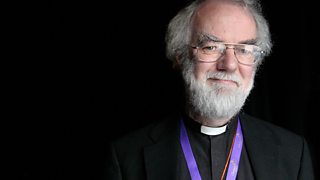
How our nation can rise to the huge challenges it faces, post-Covid-19.
