St David 900 celebrations
It’s 900 years since St David was recognised as the patron saint of Wales by Pope Callixtus II. Presented from Jerusalem by the Dean of St David's, Sarah Rowland-Jones.
This year marks 900 years since St David’s place at the centre of Welsh identity was given international recognition by Pope Callixtus II, who also affirmed St. David's Cathedral as a significant pilgrimage destination.
David’s life and the stories which came to be told about him were from the very beginning shaped by an international dimension: David was given his status because of a relationship with Rome; he acquired his spiritual purpose because of a relationship with Jerusalem; his birth and upbringing involved a relationship with Brittany; while his spiritual leadership involved relationship with the whole island of Britain.
For this St David’s Day, the Dean of St Davids, the Very Revd Dr Sarah Rowland Jones, considers Wales' patron saint’s life and message from the perspective of Jerusalem, the city David would have considered the centre of the world, and to which he is said to have made pilgrimage in the 6th century.
Sarah leads a service from the ancient Holy Land locations which formed David’s view of the world; and invites reflections from three contemporary Welsh pilgrims visiting sites of significance for the story of St David: in Rome, Fr Matthew Roche Saunders, Catholic priest from Aberystwyth; in Brittany, Canon Edwin Counsell, of St Illtud’s, where David is believed to have studied; and in Jerusalem, contemporary Welsh writer in residence at St George’s College, Rhidian Brook. The service also includes a contribution from the present day Patriarch of Jerusalem, His Beatitude Theophilus III.
Music by the following artists, recorded on location by the BBC:
Sound of Wales
St David's Cathedral Choir
Choir of the Venerale English College, Rome
Officina Corale
Producer: Dominic Jewel.
Last on

Script:
SRJ: Welcome
Good morning and welcome to SW. I’m SRJ, the Dean of St Davids. I’m in Jerusalem – that city of honey coloured stone, a busy, bustling place of many peoples, languages and cultures.
MUSIC STARTS THEN DIPS UNDER NEXT SPEECH
MUSIC 1: Here Is Love – verse 1 (Welsh) – Sound Of Wales
SRJ (Welcome cont.)
If you had come here in about the year 550 AD, you might have seen a strange figure – a pale-skinned Celt from Europe’s far north western shores, a monk, simply dressed, drinking only water; austere and yet with a kind eye.
And it would have been Dewi Sant, St David, now patron saint of Wales, who, it is said, came here with companions St Teilo and St Padarn – and while he was here, the Patriarch made him Archbishop of the Britons.
Though some people did travel so widely in those times, we have no way of knowing for sure; but we do know that 900 years ago this year, in Rome, Pope Callixtus II publicly acknowledged David’s importance, declaring that two pilgrimages to St Davids were of equal value to one to Rome. This cemented his position at the centre of Western identity and character, and reinforced Wales’ place on the global stage.
MUSIC UP
MUSIC 2: Here Is Love – verse 2 (English) – Sound Of Wales
SRJ (Welcome cont.)
David’s identity is international: David’s status reflected the relationship with Rome; his spiritual significance is reinforced through his relationship with Jerusalem; his birth and upbringing involved a relationship with Brittany; while his Christian leadership, with the whole island of Britain.
In this service we’ll explore locations connected with David’s life and story, and hear not only from me in Jerusalem, but also from other contemporary pilgrims following in his footsteps, and we’ll worship as David did. We will hold in our hearts and minds his final words to his followers: Be joyful, keep the faith, and do the little things that you have seen and heard from me.
MUSIC 3: Guide Me O Thou Great Redeemer – St David’s Cathedral Choir
ATMOS: Gethsemane
SRJ: Opening Prayer
I’m standing in an old garden on the slopes of the Mount of Olives overlooking the old city of Jerusalem. This garden is full of ancient olive trees – they’re gnarled and bending over, clearly hundreds and hundreds of years old, some beyond a thousand; some might even have been here, tiny shoots, in the time of Jesus. In David’s time pilgrimage to the holy land was already well established, ad when they came to Jerusalem those pilgrims would have begun their reflections on Jesus’ walk through Holy week and Easter here, in the garden of Gethsemane, where Jesus prayed on the night before he was crucified.
We’ll pray, using collect – the special prayer - for St David’s Day:God our Father, you gave Saint David to the people of Wales to uphold the faith:encouraged by his example, may we all joyfully hold fast to the things which lead to eternal life; this we ask through Jesus Christ our Lord. Amen
One contemporary Welsh pilgrim following in the footsteps of St David is the writer and broadcaster, Rhidian Brook. He’s a resident here at St George’s College in Jerusalem, where, after many months, he is still trying to make sense of this complex and confounding city. He spoke to us from the library at St Georges.
Rhidian: Pilgrim reflection part 1
From where I stand, there is a God’s-eye view of the city, and today Jerusalem is living up to its name. The City of Peace is calm, its hum is dialled down, the air seems saturated with prayer. The sun is doing that trick with the light on the ramparts, and Jerusalem is golden. For now.
Splendid and terrible things have happened here and still do. If the walls could speak, they’d have plenty to say: “We’ve seen everything you can imagine. Innocents massacred, empires overthrown, prophets prophesying. Pilgrims from every land, including Wales. There’s nothing new under our sun.”
Six months here and I’m still scratching the surface of this honeyed limestone. Arriving with a bag full of opinions and preconceptions, it turns out this place can’t be reduced to a two-sided argument, three faiths, or a quartered city – it is an infinite polygon.
Reading 1: Jeremiah 1 4-9 (Jerusalem voice)
Now the word of the Lord came to me, saying, ‘Before I formed you in the womb I knew you, and before you were born I consecrated you; I appointed you a prophet to the nations.’ Then I said, ‘Ah, Lord God! Truly I do not know how to speak, for I am only a boy.’ But the Lord said to me, ‘Do not say, “I am only a boy”; for you shall go to all to whom I send you, and you shall speak whatever I command you. Do not be afraid of them, for I am with you to deliver you, says the Lord.’ Then the Lord put out his hand and touched my mouth, and the Lord said to me, ‘now I have put my words into your mouth.’
MUSIC FADES UP UNDER READNG
MUSIC 4: Father’s Song (verse 1) Matt Redman Sound of Wales
MUSIC FADES UNDER LINK
SRJ: Link
Today in Rome, Fr Matthew Roche Saunders is a Catholic priest from Aberystwyth.
ATMOS: St Peter’s Square, Bells
Fr Matt: Pilgrim reflection part 1
Standing on the cobbled streets of St Peter’s Square in Rome, I’m conscious of the millions of people who’ve smoothed underfoot these stones of the Eternal City before me. Many of them pilgrims, seeking God here; many others tourists, observers perhaps, looking in from the outside at this curious city so steeped in Catholic past and present. But every one of them has returned home with some interior sense of this place.
Prayer (Rome voice)
Father in heaven as we follow in the pilgrim footsteps of St David, and encounter so many others who have drawn in before us this road of trust in you, we pray for a share in his simplicity: may we sense you near us; and for a share in his joy: may your light shine through us each day.
Fr Matt: Pilgrim reflection part 2
St David himself wasn’t one of those who walked the streets of Rome, though one of his successors did: Bernard, first Norman Bishop of St Davids, journeyed here in the eleventh century to petition the Pope to recognise David as a saint, and to appeal that St Davids be recognised as an archdiocese. This latter request – which ultimately fell on deaf ears – would certainly have swollen Bernard’s influence in the medieval Welsh church. Perhaps it also drew to wider attention the manuscript of the Life of David, the account by the monk Rhygyfarch which probably helped to persuade the pope and is still our main source for David’s life.
We can’t assume to know why Bernard did this, especially so many centuries later. It’s possible to imagine Bernard being just as interested in worldly acclaim for himself as in saintly recognition for his national patron, and returning home disappointed. But it’s equally true that had Bernard not been so forthright, we may never have had 900 years of papal recognition of David’s sanctity.
MUSIC 5: Chant – Choir of English Seminary, Rome
SRJ: Link
The Choir of the English Seminary in Rome. Canon Edwin Counsell is the rector of Llantwit Major.
ATMOS: St Divy Church
Edwin: pilgrim reflection part 1
My pilgrimage in search of David has brought me from my home town on the south Wales coast, where the church I care for has roots that trace back to a Celtic monastic college, where tradition tells that David was a student, learning at the feet of Illtud, his teacher.And here in St Divy, a few miles from Brest in north western France… the ancient parish church tells the story of St David through a timeline of murals, stained glass and carvings, and artists from successive eras have used their most vibrant colours to tell of David, St Divy’s dynamic preaching and resolute defence of his faith.
Yet the art work and tradition tells a story that’s familiar to my Welsh eyes and ears – there are even male voice choirs, thought to be the sole preserve of Wales, that turn out to be just as strong in Breton culture. And the regional anthem here is sung with as much pride and passion as Hen Wlad Fy Nhadau – the Welsh national anthem – yet bewilderingly, to the very same tune.
MUSIC 6: Mouezh Paotred Breizh – Bro Gozh Ma Zadou (verse 1) – Choir EXCERPT
MUSIC FADES UNDER LINK
Edwin: Pilgrim reflection part 2
Now, it might be Lent, but rugby is one thing that neither Wales nor France will be giving up in the next few weeks. They say brains and brawn… mind and muscle, co-exist in the boiler-room of a rugby international, but perhaps those same attributes, along with a common life and purpose, marked out the pilgrims of Celtic times, who faced storms of weather and theology, as they traversed the seaways between Wales, Cornwall and Brittany, 15 centuries ago.
And in our reading from chapter 16 of Matthew’s Gospel, Jesus speaks to his disciples, in no uncertain terms, about what it takes to be a disciple.
Reading 3: Matthew 16 24-27 (00:40) (Brittany voice)
Then Jesus told his disciples, ‘If any want to become my followers, let them deny themselves and take up their cross and follow me. For those who want to save their life will lose it, and those who lose their life for my sake will find it. For what will it profit them if they gain the whole world but forfeit their life? Or what will they give in return for their life?‘For the Son of Man is to come with his angels in the glory of his Father, and then he will repay everyone for what has been done.
MUSIC FADES UP UNDER
MUSIC 7: Father’s Song (continuation and end)
ATMOS: Gethsemane
SRJ: Link
Contemporary Welsh worship collective the Sound of Wales – who recorded at the chapel in Pontypridd which another Welsh icon, Tom Jones, attended as a boy.
Place matters – whether David visited Jerusalem or not, this city where Jesus Christ was crucified and rose again was at the heart of David’s spiritual world; and it continues to shape the way we understand ourselves, understand others, and understand God. Let’s hear more from Rhidian.
Rhidian: Pilgrim reflection part 2
When it is peaceful, it feels miraculous. Everyone wants a piece of the City of Peace. Negotiating its tangled weave of relationships and doing a dance of three faiths takes perseverance and patience. One person’s celebration is another’s irritation; one man’s temple is another’s tomb. For this is the most contested real estate on earth.
For many, Jerusalem is not just a real place, it’s an ideal. A barometer of what is possible for humanity. When people pray for it, they’re praying for the world, as though the two are synonymous. This is the place where eternity touches materiality. God is given a geography. A house. A postcode. It’s just that people can’t agree on who has the title deeds or in which house He lives. And on such things the fragile peace turns.
SRJ: Uber reflection part 1
ATMOS: Garden tomb
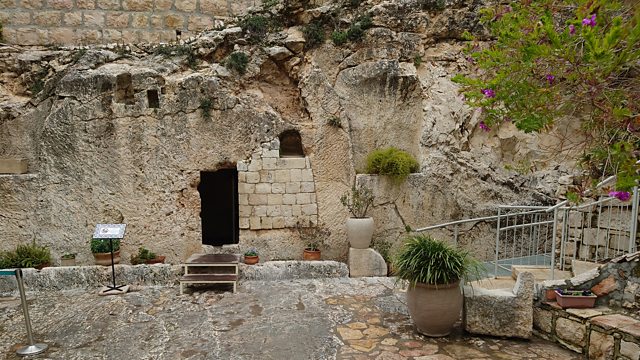
We’ve moved from Gethsemane, and Jesus’ anguished prayer the night before his crucifixion, to the Garden Tomb, where pilgrims for over a century have come to ponder the rock-hewn tomb, and meditate on how Jesus’ body was laid in such a place – and how, early on Easter Sunday morning, the women came and found the tomb empty.
It's an inviting place to sit and pause and reflect. Birds sing in palms and terebinth trees. Shrubs, flowers and herbs cluster in gravelly beds beneath the honey-coloured walls.Pilgrims have long walked in the footsteps of the saints, holy men and women through the ages. As we have heard from our contemporary Welsh visitors to Rome and Brittany, the faith of the saints and the witness of their lives can still encourage us today to follow the one they also worshipped. This outer journeying can shape our inner journeying, and we can find our identity being moulded by where we go, and the people we meet and the practices we choose to follow along the way.
Jerusalem takes all this to another level. Here pilgrims are directly confronted by the reality of God incarnate in Jesus Christ – the divine almighty sharing in human flesh and blood, in our mortality. The historic facts of his life, death and resurrection are powerfully rooted in the spiritual geography of this land. I find it blows my mind! It can sometimes feel as though 2000 years are telescoped into a single eternal present moment: heaven has come to earth, and stretches out the hand of welcome for us to take. Are we ready to surrender ourselves, once again, ever more deeply, or perhaps for the first time, into the hand of the living God? It was said that when Dewi came here, he met the Patriarch of Jerusalem, who made him Archbishop of the Britons, and sent him home with gifts of an altar, a bell, and a staff to help him continue on the path God set before him. Well, following the story of David, I met the current Patriarch of Jerusalem, His Beatitude Theophilus the Third.
INTERVIEW: His Beatitude Theophilus III
Concludes with short prayer
MUSIC 8: Il Signore È il Mio Pastore (D. M. Turoldo) Officina Corale
SRJ: Uber reflection part 2
We began our service by reflecting on Dewi’s identity, with its many, often international, facets. We understand ourselves better through our relationships with others, and with God – all these help us find our place within the world today.
While Wales might be a tiny nation, David still gives us a place on the international stage: the very first pilgrims I met on arriving in Jerusalem told me how much they love St Davids Cathedral!
And whether or not Dewi came here, his compatriots did. St Jerome in the fourth century complained at the number of pilgrims coming to Jerusalem, including from the British Isles. Pilgrimage wasn’t necessary, he said, writing ‘Access to the courts of heaven is as easy from Britain as it is from Jerusalem for “The kingdom of God is within you”.’Let’s hear more from Rhidian.
Rhidian: part 3
Stopping at the Mount of Olives before entering Jerusalem and meeting his death, Jesus gazed upon the city and wept: ‘if only you knew the things that made for peace.’ Peace is something the vast majority of people here want. But, as the golden walls of Jerusalem will tell you, and two thousand years of pilgrims have discovered, its peace is not built on a foundation of rock, but on a foundation of sacrifice.
Meanwhile, the people get on with living. The women at The Damascus Gate lay out their wares, the Shawarma man fires up his grill. The Israeli boy-soldiers eat ice cream, guns dangling from hips. Rents get paid. Love gets made. Every day the extra mile is walked, cheeks are turned, shekels given. Grievances flair but most are diffused as they must be when your enemy is also your neighbour.
SRJ: Link
Here’s Edwin again.
Edwin: part 3
It seems to me that the whole Celtic Christian community, be it in Wales, Cornwall or here in Brittany, simply took up its cross, and carried it with courage and determination, be it in the face of heresy or Atlantic storms – and, as we take up the cross on the journey of our lives, just like the saints of old, we walk in the footsteps of Jesus Christ himself.
SRJ: Link
Father Matthew.
Fr Matt: part 3
I experience Rome as a place where God and mankind meet. I’ve not long left the Sistine Chapel, and noticed that Michelangelo picked up this point in his famous fresco The Creation of Adam, painted on the chapel’s ceiling. We see the finger of God stretched out towards Adam’s, who symbolises each one of us. Adam’s finger is not stretched, but relaxed, as if he’s still deciding whether or not to connect, and to receive the divine life God is wanting to pour into him. I come back from my own pilgrimage – and so perhaps did Bernard – with a deeper desire to receive God’s life in me.
SRJ: Uber Reflection part 3
This is perhaps the ultimate lesson from all we’ve considered. Wherever we go, wherever we find ourselves, God will be with us. Whoever we are, God will help us as God helped Dewi, to be joyful, to keep the faith, and to do the little things he sets before us.
Dewi teaching can be our moral compass at home and in the world, and be a light to guide our path whether we travel far and wide, or whether we rest at home.
The choir now sing ‘A Responsory for St David’. This is an arrangement by our former Music Director and Organist, Timothy Noon, of a Latin medieval hymn of praise about St David. This only came to light in the 1960s – a reminder of the long-standing influence of David’s words – A little bread, a drop of water was David’s refreshment.
MUSIC 9: Penpont Antiphonal (St David’s Cathedral Choir)
SRJ: Link
We’re in St George’s, the Anglican Cathedral here in Jerusalem, in a quiet oasis not far from the Old City.
The Very Revd Canon Richard Sewell is the Dean of St George’s College, the study centre attached to the Cathedral.
Richard: Prayer for the world, Lord’s Prayer
O Lord our God, You are the source of justice and of peace.
The Holy city of Jerusalem is the City of Peace, which has so rarely known the benefits of peace.
Yet the peoples of this city yearn for peace.
All the world yearns for peace, and yet Lord, in our strength and efforts, this eludes us. In places of division and warfare, stay the hands of those who cause conflict, and comfort the victims of violence.
Give to each one of us, O God, that deep peace in our hearts which is ours in Christ, that our words and ways will be for peace. This we ask in the name of Jesus Christ, the Prince of Peace. Amen.
And as our saviour Christ has taught us, we now pray:
Our father, who art in heaven
Hallowed be thy name
Thy kingdom come, thy will be done
On earth as it is in heaven
Give us this day our daily bread
And forgive us our trespasses, as we forgive those who trespass against us
And lead us not into temptation, but deliver us from evil
For thine is the kingdom, the power and the glory
For ever and ever, Amen.
MUSIC 10: Here Is Love – first verse (Welsh) – Sound Of Wales
THEN MUSIC BED UNDER BLESSING
SRJ: Blessing
Almighty God, awaken in us the zeal of your servant Davidthat, in singleness of heart, we may follow you in joy, in faithfulness, and in doing the little things you set before us, Amen.And the blessing of God almighty, Father, Son and Holy Spirit,be among you, and remain with you always. Amen
MUSIC 11: Here Is Love – last verse – Sound Of Wales
PRES ANNO:
The Sound of Wales bringing to a close this week’s Sunday Worship, a service for St David’s Day led by the Very Reverend Sarah Rowland Jones, Dean of St Davids, and produced by Dominic Jewel. You can find out more about St David’s anniversary, and his international links, via our website.
Broadcast
- Sun 26 Feb 202308:10BBC Radio 4
Lent Talks

Six people reflect on the story of Jesus' ministry and Passion from their own perspectives
No fanfare marked Accession Day...
In the Queen, sovereignty is a reality in a life, says the Dean of Westminster.
The Tokyo Olympics – Stretching Every Sinew

Athletes' reflections on faith and competing in the Olympics.
"We do not lose heart."
Marking the centenary of HRH Prince Philip's birth, a reflection from St George's Chapel.
St David's Big Life Hack
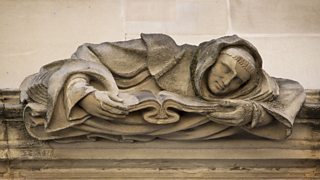
What do we know about St David, who told his monks to sweat the small stuff?
Two girls on a train
How a bystander's intervention helped stop a young woman from being trafficked.
Sunday Worship: Dr Rowan Williams
How our nation can rise to the huge challenges it faces, post-Covid-19.
