Lest we forget...
Live from the West London Synagogue, bringing to memory the atrocities of the Nazis, and the genocides of Armenia, Rwanda, Bosnia, and the present day persecution of the Uyghurs.
Friday was Holocaust Memorial Day, the day for everyone to remember the millions of people murdered in the Holocaust under Nazi Persecution, and in the genocides which followed. This meditation, live from the West London Synagogue, as well as bringing to memory the atrocities of the Nazis, also marks the genocides of Armenia, Rwanda, Bosnia, and the present day persecution of the Uyghurs, China having been accused of committing crimes against humanity possibly amounting to genocide. Candles will be lit for all these by prominent members of the Jewish community and honoured guests, the last candle being for LGBT+ victims of the Holocaust. The meditation will be led by Rabbi David Mitchell, with an address by The Reverend Canon James Hawkey, Canon Theologian of Westminster Abbey. The Choir of West London Synagogue will present music from the much celebrated 19th century Cantorial Tradition, and the meditation will also include a Uyghur folksong.
Director of Music: Richard Hills; Producer: Philip Billson.
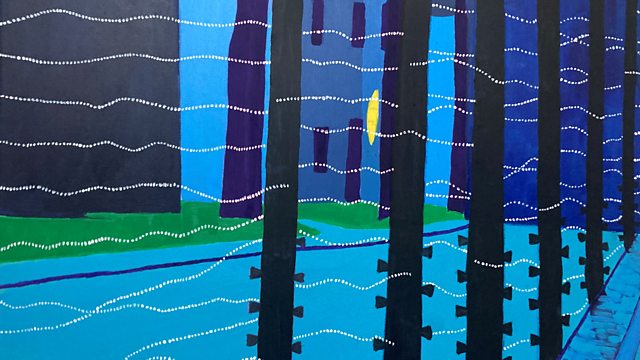
Website image: The Night. Permission for use given by the artist Guy Jones.
Last on

More episodes
Previous
Programme script
Please note:
This script cannot exactly reflect the transmission. It may include editorial
notes prepared by the producer, and minor spelling and other errors.
It may contain gaps to be filled in at the time so that prayers may reflect the needs of the world, and changes may also be made at the last minute for timing reasons, or to reflect current events.
Announcement from Continuity: BBC Radio 4. Time now for Sunday Worship marking this season of Holocaust Memorial, with an address by the Canon Theologian of Westminster Abbey. The meditation, which comes live from West London Synagogue, begins as the Synagogue choir sings a psalm setting from the Hebrew Bible.
Enosh Kechatsir - "As for Man, his days are like grass" [Louis Lewandowski, 1821-1894]
Rabbi David:
Frail mortal, his days are like the grass, He blossoms like a flower in the field.
But the breeze passes over it, and it is gone.
Psalm 103, with its beautiful images of nature, reminds us that we are all finite. The Holocaust, with its unprecedented, industrial murder of so many millions, stands in stark contrast. The victims of the Holocaust did not fade like the grass and the flowers, they were brutally annihilated into dust and ashes. Afterwards, the world said: ‘never again,’ but those words have, again and again, proven hollow.
I’m Rabbi David Mitchell and leading this meditation with me is Rabbi Helen Freeman. Back in 1840, the founders of the West London Synagogue of British Jews challenged this congregation to serve as a beacon of light. This morning, as we mark National Holocaust Memorial weekend, we will light six candles, six beacons to remember the Holocaust, and other genocides. In so doing, let us rededicate ourselves to the pledge: ‘Never again!’
I invite Marie van Der Zyl, President of the Board of Deputies of British Jews, and a member of this congregation, to light our first candle.
Marie van der Zyl: “I light this candle in memory of the six million Jews murdered in the Holocaust.”
Rabbi David: “Another member of this congregation, Dame Maureen Lipman will offer our first reading:”
Dame Maureen Lipman:
Zdenka Fantilova was a Holocaust survivor who clung on to life through Terezin, Auschwitz, Bergen-Belsen and several other concentration camps. She was a member of this congregation until her death, last November, aged 100. Zdenka shared her story in a book called The Tin Ring. In Chapter 41: The Death March, Zdenka wrote about her younger sister Lydia:
Book extract
Ani Ma’amin SUNG BY WLS CHOIR
- "I believe with perfect faith in the coming of the Messiah" [attr. Azriel David Fastag, arr. Kaplan]
Rabbi Helen: “I invite His Grace, Bishop Hovakim Manukian, Primate of the Armenian Churches of the United Kingdom to light the second candle and offer a prayer:”
His Grace, Bishop Hovakim Manukian LIGHTS THE SECOND CANDLE AND SAYS:
Heavenly Father, with heavy hearts, we have come together to remember the murder of six million European Jews.
I stand before you, God Almighty, as your servant and shepherd of the Armenian people, who survived the first major Genocide in the 20th century, mere few decades before the murder of the Jewish people.
Even as we are united in our pain, we ask you, Lord, to comfort the survivors and their generations with your gifts of hope, resilience, and justice.
We beech you, Lord Almighty, to protect the lives of all who continue to be victims of inhumanity and wars. We ask you, Lord, especially, to strengthen and protect the entire population of Artsakh, Nagorno-Karabakh, who are subjected to a devastating blockade for more than a month; protect and save, O Lord, the people of Ukraine, and all victims of wars.
Increase in us, God Almighty, faith, hope, charity, and deeds of virtue, that in keeping your commandments, we may please you, both in will and deed, according to your benevolent will. Now and always, Amen.
Psalm 23: Crimond SUNG IN ENGLISH
The Lord is my Shepherd [Crimond, Jessie Seymour Irvine 1836-1887]
Rabbi David: After our next piece of music, the Reverend Dr James Hawkey, Canon Theologian of Westminster Abbey will give the address. First, I invite Souvenir Mutesi, CEO of Rwanda Sisterhood to light our third candle for Rwanda and offer a reading.
Souvenir Mutesi LIGHTS THE THIRD CANDLE AND SAYS:
Consolee Nishimwe, survived the 1994 genocide in Rwanda as a teenager. She is the author of the book ‘Tested to the Limit’ in which she narrates her personal story:
Book extract
Sahaki Sahaki (3 verses) "You may laugh at the all the dreams which I the dreamer can weave" [Folk Tune arr. Hoffman/Hills]
Reverend Canon James Hawkey FROM WESTMINSTER ABBEY
Auschwitz, Belsen, Dachau: names which represent genocide. Srebrenica, Bucha, Armenia, Rwanda, the Ninevah Plains, place names which have come to signify that which they were never meant to bear, names which represent how humanity has failed to learn the lessons taught us in the starkest possible terms. We know the names of the places, and we know the names of some of the people. We remember stories of heroism and stories of fear, of trauma which cascades down generations, and which re-casts words and names which before, perhaps, were neutral. As our former Poet Laureate Sir Andrew Motion put it, in a poem commissioned to mark the 70th anniversary of the liberation of Auschwitz:
Bare facts and staggering multitudes: what hope,
what possible hope left for language with finish?
Light. Knock. Road. Engine. Rail. Truck. Cold. Night.
Whatever these words meant they no longer mean.
There is a fundamental shattering of meaning which goes on in the violence of genocide, because ideological murder on such a scale is an attempt to destroy the image and likeness of God. Genocide is diabolical anti-creation; it is deep blasphemy.
As Rabbi Hugo Gryn, formerly of this synagogue, put it in his introduction to Ann Frank’s diary, “In the intervening years, I have often thought about how Auschwitz-Birkenau was the denial and perversion of all the Ten Commandments, which stand for what we have come to call the Judaeo-Christian spiritual tradition and morality…” And yet, in the act of remembering, we somehow allow what is at first a deeply fragile and devastating frame of reference to be expanded. In reflecting on the horror of genocide, we feel almost visceral connections with, and love for, people whom we never met. In the very act of remembering some particular stories of tragedy, brutality, courage, or kindness, we sense that there are millions of other stories no one knows. All these are somehow held today, because we know with deep intuition, that this is not what people are made for. God’s covenant given in creation is one for blessing and not for curse. We realise our sibling likeness. We sense our own responsibility for one another’s flourishing, and our shame when this goes so fundamentally wrong. Again and again, throughout the course of history, humans, individually and corporately, are faced with a choice. Do we bless one another, or do we curse?
The psychiatrist and psychotherapist Viktor Frankl, himself imprisoned in four concentration camps, reflected that in the camps, humans could either behave as “swine or saints.” The decision for either potential was a personal one. Frankl continued, “Our generation is realistic, for we have come to know man as he truly is. After all, man is that being who invented the gas chambers of Auschwitz; however, he is also that being who entered those gas chambers upright, with the Lord’s Prayer or Shema Yisrael on his lips.” This is language without finish. It is truth without end, because it is the language of the Lord’s own faithfulness to a creation as fragile as it is beautiful. Can we be co-workers with that faithfulness? Co-workers with that Covenant? At a time of war in Europe, of human rights violations across the world, and of a widening gulf between rich and poor, we should be reminded that any straightforward narrative of inexorable human progress is fantasy. The choice remains: do we bless one another, or do we curse? If we are to be co-workers with the Lord’s own faithfulness, we shall not ourselves be protected from the worst excesses of human violence, cruelty or greed, but we shall have been fully alive, and ourselves worthy of God’s remembrance.
Rabbi Helen:
“Thank you James for those moving and challenging words. Dania Hanif is Chair of Remembering Srebrenica London and Southeast region and she is going to light the fourth candle. Then Safet Vulkalic a survivor of the Bosnian genocide will read the Remembering Srebrenica prayer”.
Dania Hanif LIGHTS THE FOURTH CANDLE
Safet Vulkalic SAYS:
We pray to almighty God,
May grievance become hope
May revenge become justice
May mothers' tears become prayers
That Srebrenica never happens again
To no one, nowhere.
REPEATS IN BOSNIAN.
Shomeir Yisrael "Guardian of Israel" [Samuel Alman, 1877-1947]
Rabbi David: “In solidarity with all those Uyghur Muslims who are being repressed or imprisoned in concentration camps in China, I invite Rahima Mahmut, Director of the World Uyghur Congress, to light our fifth candle, and then to share the Uyghur folksong – Tarim - which starts with the words: Farewell, loved ones - I have left for the banks of Tarim”.
Rahima Mamut LIGHTS FIFTH CANDLE AND SINGS Tarim (2 mins)
Rabbi Helen: Andrew Stone, Chairman of this synagogue will now light the sixth candle for LGBT victims of the Holocaust. Lord Etherton, will then offer our final reading:”
Andrew Stone: LIGHTS SIXTH CANDLE
Lord Etherton:
“From Heinz Heger’s book – The Pink Triangle: The True Life-and-Death Story of Homosexuals in the Nazi Death Camps Book extract…
Hashiveinu "Turn us back to you, O Lord" [Abraham Dunajewski, 1843-1911]
Rabbi Helen: “In Judaism, we have both a prayer for the dead – Eil Malei Rachamim - and a prayer for the mourners, known as the Kaddish. We begin with Eil Malei Rachamim for the victims of the Holocaust.”
Maya Levy, WLS CANTORIAL SOLOIST, SINGS Eil Malei Rachamim
Rabbi Helen: “For the victims of every genocide we have marked, and countless others, we turn to the Mourners’ kaddish and say:”
Rabbi Helen LEADS KADDISH:
Yitgaddal v’yitkaddash sh’meih rabba (amen), b’alma di v’ra chiruteih, v’yamlich malchuteih, b’chayyeichon uv’yomeichon uv’chayyei di chol beit yisra’el, ba’agala u’vizman kariv, v’imru amen.
Y’hei sh’meih rabba m’varach,
l’alam ul’almei almaya.
Yitbarach v’yishtabbach v’yitpa’ar
v’yitromam v’yitnassei v’yit-haddar
v’yit’alleh v’yit-hallal, sh’meih di kudsha, b’rich hu, l’eilla min kol birchata v’shirata tushb’chata v’nechemata, di amiran b’alma, v’imru amen.
Y’hei sh’lama rabba min sh’maya,
v’chayyim aleinu v’al kol yisra’el,
v’imru amen.
Oseh shalom bimromav, hu ya’aseh shalom aleinu v’al kol yisra’el, v’al kol ha-Olam v’imru amen.
Rabbi Helen: “This meditation for Holocaust Memorial Day has reminded us that many communities have suffered terrible loss in the last century, and some continue to suffer. We pray that the Eternal will give them courage and hope for the future in their times of trouble, in the words of Psalm 121 ‘That G-d will preserve their going out and their coming in, from this time forth and for evermore.’”
Psalm 121 – 8. Essa Einai (Ps 121) - "I will lift up my eyes to the hills' [Charles Garland Verrinder, 1834-1904]
Fade on organ music
Closing announcement from Continuity: ‘I lift my eyes to the mountains’ a setting of Psalm 121 composed for the 19th Century choir of West London Synagogue by their first organist and choirmaster Dr Charles Verrinder. Today’s Director of Music and organist was Richard Hills and the organ was played by Richard Pinel.
[Details of all the music can be found via BBC Sounds]. The producer was Philip Billson. Sunday Worship next week visits Alive City Church with Mobo award winning Gospel group Volney Morgan and New Ye.
Broadcast
- Sun 29 Jan 202308:10BBC Radio 4
Lent Talks

Six people reflect on the story of Jesus' ministry and Passion from their own perspectives
No fanfare marked Accession Day...
In the Queen, sovereignty is a reality in a life, says the Dean of Westminster.
The Tokyo Olympics – Stretching Every Sinew
Athletes' reflections on faith and competing in the Olympics.
"We do not lose heart."
Marking the centenary of HRH Prince Philip's birth, a reflection from St George's Chapel.
St David's Big Life Hack
What do we know about St David, who told his monks to sweat the small stuff?
Two girls on a train
How a bystander's intervention helped stop a young woman from being trafficked.
Sunday Worship: Dr Rowan Williams
How our nation can rise to the huge challenges it faces, post-Covid-19.
