Amazing Grace
The Archbishop of York, Stephen Cottrell, preaches on the transforming power of grace, on the two-hundred and fiftieth anniversary of the hymn Amazing Grace.
The Archbishop of York, Stephen Cottrell, preaches on the transforming power of grace and its abiding power in our world today, on the two-hundred and fiftieth anniversary of the first public appearance of John Newton’s hymn Amazing Grace.
The service is led by Canon Rachel Mann who explores John Newton’s encounter with God’s grace and his transition from slave trader to abolitionist that followed.
Featuring a broad variety of arrangements of the famous hymn and reflections from those who’ve performed or adapted it, including Bob Chilcott, Karen Gibson, John Rutter and Will Todd.
The Readings are: 2 Peter 1: 3– 11 and John 1. 9-18
Producer: Alexa Good
Last on

More episodes
Previous
Script of Programme
Sunday Worship 250 Years of Amazing Grace
MUSIC : Amazing Grace
Performed: The Kingdom Choir
Canon Rachel Mann
Good morning and, on this first day of 2023, a Happy New Year! Welcome to this special Sunday Worship. Today, we celebrate one remarkable hymn; a hymn so resonant and powerful that it’s difficult to believe that it has not always been with us. Today, on the two-hundred and fiftieth anniversary of its first public appearance we celebrate John Newton’s Amazing Grace. Stephen Cottrell, the Archbishop of York, will preach on the transforming power of grace and its abiding power in our world today.
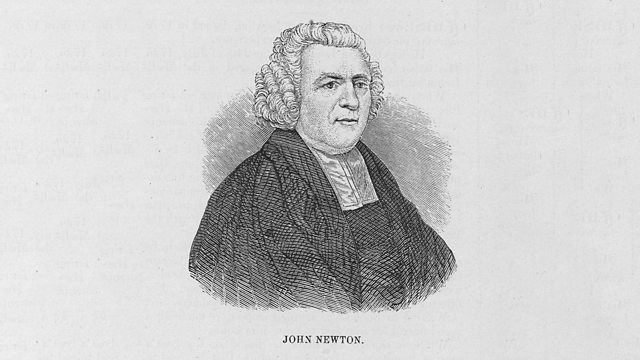
John Newton was a middle-aged curate in Olney, Buckinghamshire when he wrote Amazing Grace in 1772; he liked to write hymns to match his sermons, and Amazing Grace was written to accompany a sermon for New Year’s Day 1773. When Newton spoke of the amazingness of God’s grace, he spoke from the heart. For this was a man who, in his youth, had been a foul-mouthed, debauched sailor; later he became a slave trader in the Atlantic Slave Trade. However, the grace of God broke through Newton’s selfish, exploitative ways. Famously, it was during a violent storm off Ireland in 1748 that he cried out to God for mercy. After his survival he began his journey to faith. Through his encounter with God’s grace and the call to repent and seek justice, slowly he became an abolitionist who influenced the whole anti-slavery movement. He came to understand that the one who once was lost, could be found in God’s love.
Newton’s beloved hymn speaks beautifully into this ongoing season of Christmas. Grace holds us as we worship the Christ-Child and Jesus calls us into a fresh way of life.
That was the Kingdom Choir with their arrangement of Amazing Grace. Their musical director Karen Gibson explains it’s importance to her:
Karen Gibson: “You can almost see the writer John Newton standing a top a hill proclaiming God’s goodness to anyone who would listen. Those words are a message in and of themselves. It is the come as you are, warts and all, invitation, no matter who, what or why, and how amazing is that?”
MUSIC: Amazing Grace
Arranged: Robert Prizeman
Performed: Libera
Holy God, ever ancient, ever new,
renew us with your love.
Span the poverty
of our failures and betrayal
with the abundance of your grace. Amen
Canon Rachel Mann
Grace is a simple word. Yet its single syllable holds within it worlds of meaning. Grace is an undeserved outpouring of love and mercy on a community or an individual; it is God sharing his very self with us in such a way that no matter how cut off from him we feel or are, we can find our way back to him, our true home. In my mid-twenties I could not see how someone like me could be part of God’s family. I was sure God hated gay people like me; I was sure he could not forgive me for all the terrible things I’d said about him. How very wrong I was. I longed to know his love and one night I prayed to know Jesus. In that moment, God provided the spark of grace that that helped me know that, despite everything, I was freely loved and I was home. ‘Grace’ bridges the unbridgeable. Psalm 116 says, ‘Gracious is the Lord, and righteous; our God is merciful. The Lord protects the simple; when I was brought low, he saved me.’ Grace is that Love of God which reaches across sin and separation and redeems us.
Amazing and wonderful God,
Full of grace and mercy,
Thank you that your love
never truly abandons us;
Amen.
We hear now from John Rutter and Will Todd just two of the composers who have arranged it, and whose compositions we will hear later. We hear first from John Rutter:
John Rutter:
“26 words in the opening of that hymn, the only exception being the very first word Amazing. It seems like a contemporary word – one we’d use in the 21st century but in fact there are quite a few instances of the verb in the 1611 Bible; the Shepherds were amazed, but there are no uses of the adjective until John Newton used it in the hymn. I do think that the words and tune make a great marriage because there is an essential simplicity to both and I think that is perhaps what gives the hymn it’s universality.”
Will Todd:
“I used my jazz playing skills to do a new harmonisation of Amazing Grace. It has been performed in the private ceremony at St John’s Lafayette Square at the second inauguration of President Obama. And, we also did an orchestrated version a memorial for Grenfell Tower. I’m just really grateful that what started as a simple arrangement has been a well-known version of this tune.”
MUSIC: Amazing Grace
Arranged: Will Todd
Performed: St Martin’s Voices
Somehow, this story of John Newton’s journey from slaver to Christian to abolitionist matters when we consider why Amazing Grace speaks so resoundingly across so many dividing lines. This power for transformation is captured in Bob Chilcott’s musical setting of a text by the Guyanese-British poet John Agard, as Bob now explains:
Bob Chilcott:
John Agard frames this poem so brilliantly and powerfully and as he says at the beginning grace is not a word for which I have much use. He looks deeply into his conscious in this poem and as he says “it took a storm to save the dumb wretch in me” and his epiphany moment comes at sea in this storm. I set this poem for two male voice choirs and I made it quite an angry outburst but then at the end after this last line “lord let my souls scum be measured by a hymn” the hymn emerges from the distance.” .
MUSIC:
Newton’s Amazing Grace
Arranged: Bob Chilcott
Performed: Orphei Drangar
Canon Rachel Mann
Bishop Rose Hudson-Wilkin who will be preaching later today at Newton’s old church, St Peter and St Paul’s Olney, explains what it means to her:
Bishop Rose Hudson-Wilkin
“Amazing Grace is an iconic song within the black community, within the church, within the nation, it’s international and I guess no particular group can say that this is theirs. We live in a world where many think that it's all down to them, it's all about them and suddenly this hymn smacks us on the nose and almost wakes us up to the realisation that actually it's not about us, it is about something greater than us that has chosen to dwell with us and isn't that just amazing in its own right that this God chooses to become Incarnate and live with us an release us from the kind of life that would be mundane that would hold us down and to give us the freedom that we don't have to live a life that betrays the fact that we are made in God's image.”
MUSIC: Amazing Grace
Arranged: Stuart Wilson Fairbairn, Traditional
Performed: Royal Scots Dragoon Guards (Instrumental)
POEM: Amazing Grace - Laura Darrall
Amazing Grace
What is your sound?
You are the waves
You are the ocean spray that batters on the new born day
And raises reckless raving rays of sunrise into squinting salt-soaked eyes
You are the cries of gulls that kiss the clouds and
You are loud
.How sweet your sound
You are the thunder rolling in the bay that darkens out the night
You are the lightning strike that crackles and cracks open the creases in the
crests of the cliffs that keep us from falling
You are the dawn calling
You are the silence that sits after the sun has sunk beyond the horizon
You are the Whys and
Wheres and
Hows and
Whats
of language
You are the bandage I reach for when all I can do is
reach
Amazing Grace
How sweet Your sound
I was blind
But now can see
MUSIC: Amazing Grace
Arranged: John Rutter
Performed: The Cambridge Singers
Canon Rachel Mann
If, as we heard in Laura Darrall’s poem, Amazing Grace has inspired poets and artists, the hymn ultimately draws its power from the grace we see in the Bible. In our first reading, taken from the second letter of St Peter, we hear how God, in his divine grace, provides all that we need to live a holy life. This does not mean, however, that we are not called to make a response. Our second reading, from the first chapter of John’s gospel, reminds us that the source of grace is Jesus Christ who has been the Light of the World from before it’s foundation.
READING: 2 Peter 1: 3– 11, Read by Bishop Rose Hudson Wilkin
His divine power has given us everything we need for a godly life through our knowledge of him who called us by his own glory and goodness.4 Through these he has given us his very great and precious promises, so that through them you may participate in the divine nature, having escaped the corruption in the world caused by evil desires.
5 For this very reason, make every effort to add to your faith goodness; and to goodness, knowledge;6 and to knowledge, self-control; and to self-control, perseverance; and to perseverance, godliness; 7 and to godliness, mutual affection; and to mutual affection, love. 8 For if you possess these qualities in increasing measure, they will keep you from being ineffective and unproductive in your knowledge of our Lord Jesus Christ. 9 But whoever does not have them is near sighted and blind, forgetting that they have been cleansed from their past sins.
10 Therefore, my brothers and sisters,[a] make every effort to confirm your calling and election. For if you do these things, you will never stumble,11 and you will receive a rich welcome into the eternal kingdom of our Lord and Saviour Jesus Christ.
MUSIC: Amazing Grace
Arranged: Lee Hodridge
Performed: Mahalia Jackson
READING 2: John 1. 9-18, Read by Will Todd
9 The true light that gives light to everyone was coming into the world.10 He was in the world, and though the world was made through him, the world did not recognize him. 11 He came to that which was his own, but his own did not receive him. 12 Yet to all who did receive him, to those who believed in his name, he gave the right to become children of God— 13 children born not of natural descent, nor of human decision or a husband’s will, but born of God.
14 The Word became flesh and made his dwelling among us. We have seen his glory, the glory of the one and only Son, who came from the Father, full of grace and truth.
15 (John testified concerning him. He cried out, saying, “This is the one I spoke about when I said, ‘He who comes after me has surpassed me because he was before me.’”)16 Out of his fullness we have all received grace in place of grace already given. 17 For the law was given through Moses; grace and truth came through Jesus Christ. 18 No one has ever seen God, but the one and only Son, who is himself God and[a] is in closest relationship with the Father, has made him known.
SERMON: Archbishop of York, Stephen Cottrell
Near the end of his life, the former slave trader John Newton said to a friend, “My memory is nearly gone, but I remember two things: that I am a great sinner, and Christ is a great saviour”.
He had good reason to say it.
- John Newton had been a rebellious merchant seaman.
- Flogged with the cat-o-nine tails, press-ganged into the Royal Navy,
- Escaped, then treated like a slave in Africa.
- Desperately ill.
- Recovered; became a slave trader himself, shamelessly bartering people for goods;
- lost what religious faith he had,
- became a Freethinker, anti-God and a notorious blasphemer.
- Got a job as a Merchant Navy Captain.
- Almost died at sea.
- Transported slaves across continents.
And yet after another near-death experience, he began to ‘doubt his doubts’, started to study the Bible and gradually found faith taking root.
Much later on he actually became a Vicar.
One of my predecessors refused to ordain him because he hadn’t been to university. There were many other reasons! And yet… I can’t remember the Archbishop’s name but haven’t forgotten John Newton.
Newton wrote many essays, poems and hymns - the best-known one begins,
Amazing grace, how sweet the sound,
That saved a wretch like me.
It was the story of his life. All that time when John Newton had let go of God, God hadn’t let go of him. Amazing.
John Newton isn’t the only one to be amazed by God’s grace. The Number One British rap artist, Stormzy, sung of his own experience with these similar words -
I'm Blinded By Your Grace…
… ever since you found me
I'm blinded by your grace
You came and saved me…
This is my story too. Not as dramatic. Not so much darkness. But it was God’s grace that got me, the sudden - and at the same time slowly dawning, taking a lifetime to work out - realisation that changes everything, even how you deal with your own past, that God is no longer a vague ‘something or other over the hill and far away’, but close, real, with us and for us in Jesus Christ.
I’m blinded by your grace.
And of course you don’t deserve it. That’s what grace means - it’s God’s generosity; God’s energy, God’s searching and redeeming love.
You can’t earn it and you certainly can’t buy it.
And even if you’re looking for God, which of course some people are, the deeper truth is that God is looking for you. And God won’t stop. And there’s nowhere to hide, nor sin so foul and dark that God will turn away.
The poet Francis Thompson felt God was actually chasing him -
“I fled Him, down the nights and down the days;
I fled Him, down the arches of the years;
I fled Him, down the labyrinthine ways
Of my own mind; and in the mist of tears
I hid from Him . . .”
God’s amazing grace isn’t just for so called bad people. But drowning you’re more likely to be on the lookout for a lifeguard.
And although being good is good, there’s also the danger that we think our goodness is enough. And it never is. There’s always something we’re hiding. And we are lost in the confusion of it all.
Most of us, in fact, are a muddle. There is good and bad in us. We are lost in the confusion of it all. Either excusing ourselves, or beating ourselves up. And you can end up turning from grace, the dark shadow of your own making when you face away from the light.
The Narnia author, C S Lewis, a Cambridge professor who also wrote sophisticated science fiction, fell away from faith as a teenager, saying he was "very angry with God for not existing”.
He wrote about his road back to God in his autobiography, “Surprised by Joy”. ‘Joy’ he said, is like a signpost to those lost in the woods, pointing the way . . .
I call that grace. Amazing grace.
And Jesus really cares about those who are muddled and lost or dwelling in darkness.
That’s why he told so many stories about it.
About a shepherd and a lost sheep who contrary to all sensible conventions doesn’t play a percentages game and reckon there has to be loss as well as profit, and leaves the ninety-nine to go in search of the one who is lost.
About a father and a lost son; who doesn’t give up on his errant children; who welcomes home the one who had squandered his inheritance and pleads with the other to join the homecoming celebrations: “This son of mine was lost,” he said, “but now he is found.”
Amazing grace.
We cannot pass over or ignore the horrors of John Newton’s life, but neither should we underestimate the power of God’s grace in his redemption. It is indeed amazing grace. “I once was lost”, he wrote - taking those words of the Father to the wayward son and making them his own – “But now I'm found; was bound, but now I'm free”.
And here we are in the darkest time of the year, celebrating again the light of Christ and seeing one year turn to another. May the light and grace of Christ save us.
MUSIC: Blinded by Your Grace (Stormzy) – The Kingdom Choir
Performed: The Kingdom Choir
Album: Stand By Me
Canon Rachel Mann
Gracious God, we thank you for your faithfulness. Shape us and all your pilgrim people for the work of justice and peace. Grant your people the courage to show your loving grace.
Amazing God, fill us with that love which can transform the bleakest fear. Illuminate our paths that we may walk your way of faith, hope and love in confidence and trust. Into your kingdom guide us and ever make us your own. God of All, from love we are made and to love we shall return. May the light and warmth of your grace, transform both us and our neighbour, both enemy and friend, both powerful and weak … that we might serve your Kingdom both here and yet to come. Amen.
MUSIC: The Lord's Prayer
Arranged: Robert Stone
Performed: The Cambridge Singers
Canon Rachel Mann
After John Newton became an abolitionist he wrote a pamphlet in which he said, ‘It will always be a subject of humiliating reflection to me, that I was once an active instrument in a business at which my heart now shudders.’ He came to see that it was not until he began to be an agent of justice and grace himself that he had truly embraced the powerful realities of God’s grace … A reminder perhaps that grace works both quickly and slowly in our lives. Quickly because we can receive the Light of God’s love in an instant; slowly, because it is only over time that we begin to truly be transformed by that loving grace.
MUSIC: Amazing Grace / Nearer My God To Thee
Arranged: Joseph Shabalala
Performed: Ladysmith Black Mambazo
Broadcast
- New Year's Day 202308:10BBC Radio 4
Lent Talks

Six people reflect on the story of Jesus' ministry and Passion from their own perspectives
No fanfare marked Accession Day...
In the Queen, sovereignty is a reality in a life, says the Dean of Westminster.
The Tokyo Olympics – Stretching Every Sinew

Athletes' reflections on faith and competing in the Olympics.
"We do not lose heart."
Marking the centenary of HRH Prince Philip's birth, a reflection from St George's Chapel.
St David's Big Life Hack
What do we know about St David, who told his monks to sweat the small stuff?
Two girls on a train

How a bystander's intervention helped stop a young woman from being trafficked.
Sunday Worship: Dr Rowan Williams
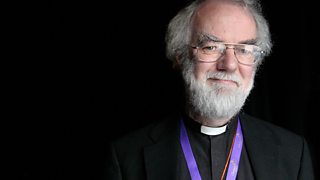
How our nation can rise to the huge challenges it faces, post-Covid-19.
