Destination: Moon
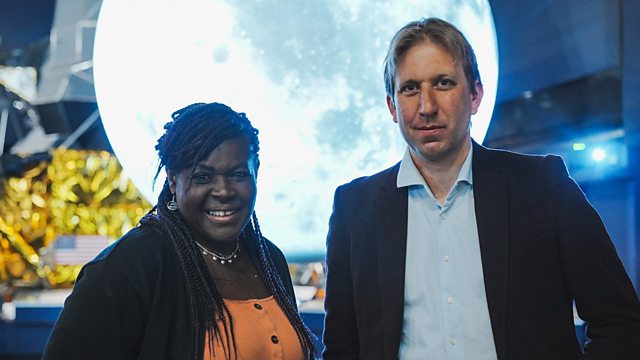
Space scientist Dr Maggie Aderin-Pocock and astrophysicist and author Chris Lintott look back at the legacy of the Apollo programme, and forward to the future of lunar exploration.
In the fiftieth year since the last astronaut stepped on the Moon’s surface, we look back at the legacy of the Apollo programme and forward to the future of lunar exploration. Maggie and Chris visit the Science Museum where Maggie discovers from space curator Doug Millard that one of the museum’s star attractions – Apollo 10’s command module – nearly did not bring back its entire crew.
Chris discovers that NASA’s latest assault on the Moon, the ‘Artemis’ programme plans to set up an orbiting moon station, and a shuttle from it to a permanent base on the Moon’s surface – and learns from NASA’s Dana Hurley that much of the technology needed for such a mission has yet to be invented. Nonetheless, the first dry run for the SLS rocket and the Orion command capsule and moon landing system will go ahead – without crew – and is planned later this year. On that first mission to orbit the moon, thirteen tiny ‘cubesats’ will be released into moon orbit to discover more about the lunar surface in anticipation of greater future human activity on the moon. These low cost satellites are providing the next generation of space scientists and engineers an opportunity to work on spacecraft for the first time.
Maggie talks to Craig Hardgrove, an associate professor from Arizona State University, who leads a relatively inexperienced team in building LunaH-Map. The pint-sized craft will scan the lunar surface for evidence of hydrogen (and therefore water) which will be enormously useful for future missions and moon bases to provide sustenance and fuel – once the technology is in place to deliver it.
Pete Lawrence is on hand for tips on how best to observe the Moon from earth and during the upcoming lunar eclipse on the 16th May, and Chris learns from Prof Sara Russell of the Natural History Museum that the Apollo missions allowed science to identify Moon asteroids here on earth, and that future missions retrieving more Moon rock might tell us even more about how the earth formed, and how life emerged.
Last on

Credits
| Role | Contributor |
|---|---|
| Presenter | Chris Lintott |
| Presenter | Maggie Aderin-Pocock |
| Presenter | Pete Lawrence |
| Production Coordinator | Carisse Perks |
| Production Manager | Kassi Murphy |
| Assistant Producer | Marina Hui |
| Executive Producer | Steve Crabtree |
| Series Producer | Peter Leonard |
Broadcasts
- Fri 18 Nov 202223:30GMTBBC News except Latin America, North America, UK & UK HD
- Sat 19 Nov 202200:30GMTBBC News North America & Latin America only
- Sat 19 Nov 202204:30GMTBBC News except Latin America, North America, UK & UK HD
- Sat 19 Nov 202211:30GMTBBC News except UK & UK HD
- Sat 19 Nov 202216:30GMTBBC News except UK & UK HD
- Mon 21 Nov 202200:30GMTBBC News Latin America & North America only
- Thu 24 Nov 202200:30GMTBBC News North America & Latin America only
- Fri 25 Nov 202208:30GMTBBC News except UK & UK HD
- Tue 29 Nov 202200:30GMTBBC News North America & Latin America only
- Wed 7 Dec 202200:30GMTBBC News Latin America & North America only
- Fri 9 Dec 202200:30GMTBBC News North America & Latin America only