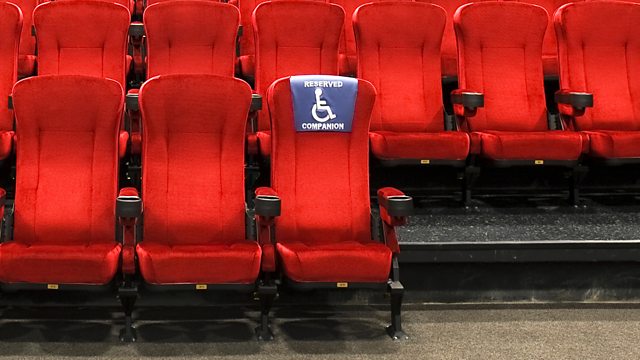
Disabled-access ticket booking, Writer Will Ashon, Artists Jane Darke and Andrew Tebbs
We investigate problems with ticketing initiatives for easier arts access, Will Ashon's The Passengers, compiling everyday voices, and new art Habitats as Heritage in Cornwall.
Disabled-access ticket booking – for concerts, comedy clubs, theatre, festivals, and more. Carolyn Atkinson reports on problems with new initiatives to make access to the arts much easier for disabled people: the big delays to the National Arts Access Card, and inconsistencies in purchasing ‘companion’ tickets.
Will Ashon is a novelist and non-fiction writer whose latest book, The Passengers, is a compilation of voices he recorded with 180 people he came across through chance and random methods – voices who share their hopes, fears and experiences that shaped their lives. Will tells Tom Sutcliffe what the combination of thoughts and tales say about Britain today.
Artists Jane Darke and Andrew Tebbs were inspired by the Marianne North Gallery at Kew - in which the walls are covered with North’s natural history paintings made on her travels around the world. They created something similar, looking at the plants insects and animals of a single small parish in Cornwall, St Eval, where Jane lives. The 100 paintings have been exhibited since June at Kresen Kernow, Cornwall’s new state-of-the-art archive centre in Redruth, and today the artists begin a residency there - with workshops, walks, talks, and films. Jane Darke, Andrew Tebbs and Chloe Phillips, of Kresen Kernow, explain this ambitious project.
Presenter: Tom Sutcliffe
Producer: Harry Parker
Last on

Front Row 2nd August 2022: Disabled-access ticket booking, writer Will Ashon, artists Jane Darke & Andrew Tebbs
Front Row: Disabled-access ticket booking, Writer Will Ashon, Artists Jane Darke and Andrew Tebbs<?xml:namespace prefix = "o" ns = "urn:schemas-microsoft-com:office:office" />
TX: 2nd August 2022
Presenter: Tom Sutcliffe
Producer: Harry Parker
THE FOLLOWING TRANSCRIPT WAS TYPED FROM A RECORDING AND NOT COPIED FROM AN ORIGINAL SCRIPT. BECAUSE OF THE RISK OF MISHEARING AND THE DIFFICULTY IN SOME CASES OF IDENTIFYING INDIVIDUAL SPEAKERS, THE BBC CANNOT VOUCH FOR ITS COMPLETE ACCURACY.
[BBC SOUNDS JINGLE]
PRESENTER (TOM SUTCLIFFE):
You’re listening to Front Row with me, Tom Sutcliffe. Hello. The writer, Will Ashon, left a surprising amount to luck in his new book, The Passengers, soliciting stories from complete strangers, and even hitching his way to some chapters. In just a moment, barring an unforeseen accident, we’re going to talk about how you structure serendipity. There are times of course when the very last thing you want is a lottery. Also in the studio is Carolyn Atkinson, with us to report on new initiatives to make access to the arts for disabled people less of a game of a chance.
REPORTER (CAROLYN ATKINSON):
It’s important because it’s discriminatory to expect someone to pay double to do something that an able bodied person does not have to pay double for.
TOM:
More on that in a moment. And down in Cornwall, they’re looking at insects. Really looking at insects.
INTERVIEWEE (JANE DARKE):
Working for two or three days, maybe sometimes a week, on a painting of a bird or an insect, we were really...
INTERVIEWEE (ANDREW TEBBS):
Finding the personalities.
JANE:
We were. [Laughs] Partly, yes. And we were doing portraits of the birds, the insects, the mammals, in the same way as we would a human animal.
TOM:
Jane Darke and Andrew Tebbs talk about their work for a new exhibition at Kresen Kernow in Redruth, home of Cornwall’s archives. First though, The Passengers, the latest book from the novelist and writer, Will Ashon. This isn’t a novel like his first two books, nor a relatively straightforward work of non-fiction like his third, Strange Labyrinth, which was a kind of psycho-geographical study of Epping Forest. The Passengers is a collage of sorts, a portrait of contemporary Britain, and contemporary anxieties, pieced together from conversations and correspondence with 179 people. And it begins with four very short chapters which amount to a kind of manifesto for itself.
EXTRACTS FROM THE BOOK:
MAN:
I want to stay and stay and never go.
WOMAN:
So that’s the thing, like you said it’s interconnected. Everything is interconnected.
WOMAN:
Life is a flux, it’s constantly moving. It’s like a river, it just carries on. It happens and moves, it changes.
MAN:
It’s beautiful to share, you know. I think we are here to share: share happiness; share love; share our things. Our things are not for ourselves, they’re better when we share them.
TOM:
The opening four pages of Will Ashon’s, The Passengers, which contributes itself to the ethic of sharing as people confess to old guilts, and reveal their doubts and hopes. And Will Ashon joins me now to talk about it. Will, how did this idea first come about? It’s an unusual book.
INTERVIEWEE (WILL ASHON):
Yeah. You mentioned Strange Labyrinth. It was when I started writing non-fiction, I had a kind of realisation that not being one of the world’s greatest brains, that rather than writing anything massively original or you know up on the mountain, I was piecing together quotes from books and from people I spoke to into a kind of collage, as you said. Obviously my background was running a hip hop label. Hip hop’s been a big part of my life, and hip hop is a collage in music. I’d always kept my fiction and my work life running the label very separate, and suddenly I found this moment where the two things kind of came together. And so that excited me. So then the book I wrote after that was about the Wu-Tang Clan, which was obviously an attempt to write about hip hop in that way. But throughout the time that I was doing that, I was wondering whether there was a way to do it without the kind of thin mortar of me joining it all together with my hilarious anecdotes about falling out of trees and things. So that was what this book was about, it was an attempt to collage without me.
TOM:
You’ve got an epigraph for the book from the Director, Agnès Varda, ‘chance has always been my best assistant’. So how much chance did you let in here?
WILL:
It varies from section to section. I mean as you mentioned, I started off, I went to see the film Faces Places with Varda speaking, at the end of September 2018, and that was the kind of starting point for the book because two weeks later I set of hitchhiking. And what I liked about that was the interviewees were picking me rather than me going out and picking them.
TOM:
So it was just a pure chance as to who came down the road.
WILL:
Yeah, exactly. Yeah, whoever stopped. Obviously what you realise quite quickly is that the people who tend to stop tend to be quite generous, kind people anyway, because they’ve stopped for some funny looking guy standing on the roadside. And so going on from that, I tried to keep an element of chance or serendipity in every decision as a whole, to try not to pick the interviewees too much myself. I mean there’s probably a few that I did but-
TOM:
You sent letters out to addresses that you didn’t know.
WILL:
Yeah.
TOM:
How did you pick the addresses?
WILL:
I used a very complicated random number system to make the postcodes. It was incredibly complicated, but it kind of worked. Then I wrote all the letters by hand, which in itself was a massive challenge because my handwriting is terrible.
TOM:
How many answers did you get back then?
WILL:
I got a few, shall we say. A few. More than I got when I sent text messages out. I think people really did think when they received a strange text message, ‘This is a scam’, [laughs] so that one wasn’t quite so successful. Yeah, and various other things as well, drawing lines on a map and then trying to find people to speak to, somewhere along those lines, things like that.
TOM:
And also when you had contributors, there was a bit of chance there. You asked them to pick a number from one to ten, did you?
WILL:
Yeah.
TOM:
And then that would be associated with a particular question. What kind of questions?
WILL:
That’s right. The questions were vague to the point of almost not really being questions at all. Things like, I think one was how does it feel? Another one was, what did it look like? And things like this.
TOM:
Good open questions though.
WILL:
Yeah. And actually part of that was about controlling my own deficiencies as an interviewer. I have a tendency to jump in and talk over people. When you transcribe 180 interviews and in every one you’re the person talking at the crucial moment, you have to find ways to hold back, as I’m sure you know.
TOM:
Well you’ve brought me on to the business of structuring all of this material. The book clearly has a structure.
WILL:
Yeah.
TOM:
It starts with the shortest, runs up to what seems to be the longest.
WILL:
Yeah.
TOM:
And then runs down again to end with the same phrase that you start with. But not repeating, obviously. You’re running slowly down in terms of length.
WILL:
Yeah, absolutely. I mean working out how to fit them all together was probably the hardest part of it. I made the stupid mistake of calculating how many variations there are of 180 sections, and I think it’s 43 digits in that number, it’s a huge, huge number. At which point I absolutely terrified myself and spent about the next month just sitting in my office crying to myself.
TOM:
There’s a tone in the book of, I mean a lot of people talk about their mental states. Partly I suppose you were doing this in the pandemic.
WILL:
Yeah.
TOM:
So people had a lot of time to think about that and also to worry about it. Did you weight it to stress and mental anxiety, or was that representative of what you got back?
WILL:
No, I think it’s representative. I didn’t weight it particularly towards that at all. I think, as you say, it was an interesting time in some ways. When the lockdowns hit, obviously I couldn’t go hitchhiking anymore, I thought it was going to be a bit of a disaster for the book. But I think actually people had, as you say, a bit more time. They were often at home. They were more willing to talk. And actually they had more to say and were thinking more about their lives and how they live their lives.
TOM:
It’s a lovely mix, because some of it is philosophical, some of it is political, and then there are just anecdotes. Contingency isn’t just part of the method of making a book, it’s a theme that runs all the way through. Let’s just hear one of the chapters or part of the chapter where that’s very clear.
BOOK ABSTRACT:
I got caught speeding on a motorbike and I was going to go to court for reasons of this very naught speed. My barrister said, “What do you do?”, and I said, “Oh, I drive white vans”. “You drive white vans? Whatever you do, you need to quit now ‘cos they’re gonna take your licence away. They hate white van men and they hate people on motorbikes. You need to go and find a job that will look good in court”. I had a friend who worked in children’s homes and he said come and have a go at this. I told my barrister and he goes, “Right, you’ve got to do it. You need to do a week and then you can call it your profession”. He made me write this horrible cringey letter about what a wonderful human I am. So I go in there, I say I was sorry, hand them the letter. One of the magistrates threw my letter on the floor, and one of them just gave me the evils throughout, but the chairman and one of the others actually read it and they go, “This is a serious business. We’re going to deliberate”. Anyway, they go in and they come back and they go, “You’ve been a very naughty boy, here’s six points and a £50 fine”. They say, “Don’t do it again, and off you go”.
And that was it. That was how I became a child care officer. I go and do the job for a week and I loved it. I really, really like the young people I look after. I’ve had some real moments of beauty. I was once in the car and we were listening to stuff on my phone and there’s some church worship music, and this girl I was with, she was like, “Oh, what is this? You loser”. It was a little bit stronger than that obviously! She starts listening to it, and then she starts singing along to it. When we get to the end of the journey, she goes, “What the heck was that?”, I was like, “I don’t know what you mean”. She goes, “Whilst I was singing that, I felt clean and beautiful”. She looked me right in the eyes – I’m already choking up – and she goes, “You know I’ve never felt clean and beautiful in my life before”.
TOM:
You must have been thrilled when you got that story, I mean it’s got everything, hasn’t it? It’s got the shock of it, the motive for taking on this important job, and then it turns around.
WILL:
Yeah. And that’s the funny thing, that actually doing these interviews the thing that I heard most often was, “Oh, I’ve got nothing to tell you, I’m really boring”. Literally everybody said it to me. And after you’ve done the first 20 or so, you can quite honestly say to people, “No, you have. You have actually got something interesting to say. Just take your time, don’t worry about it, we’ll get there”. And that was always the case, yeah.
TOM:
You had asked them for the quotidian, hadn’t you, the every day, in a lot of cases. What’s so interesting is that some of the stories aren’t boring, but they’re really interesting in the way that there’s a wonderful story where somebody sets out and he gets up in the middle of the night, and he’s got this plan to go and walk to the nearby port and watch the sun come up. And he never makes it. It’s all about fear.
WILL:
Yeah.
TOM:
It’s a very anticlimactic story, but it’s terrifically worked, I think.
WILL:
Yeah. And it’s a beautiful little story. It’s funny, some of them are very carefully edited, some of them just come out like that, and there’s no telling which ones are going to be which.
TOM:
What were you most surprised by in what you got back from people?
WILL:
I guess if I’m honest, I was most surprised by some of the intimate things that people discussed with me, which is when you’re chatting to some stranger over Zoom you don’t necessarily expect that someone’s going to open up and talk to you about personal problems. But also, the most hilarious things as well. There’s one I can’t repeat on the radio!
TOM:
No, no. But you clearly were a kind of confessor to a degree. There’s two or three stories where people reveal things that have weighed on them, and it seems almost as though they finally got it off their chest telling you. I don’t know whether you felt that?
WILL:
Yeah. I mean some of the secrets done weren’t interviews, you could either record it on my website, or people recorded them on their phones and sent them to me. So then they were talking just to themselves really. And that’s interesting as well, I think overall across the 180, for me I can notice the different textures that you get from the different ways in which the interview was conducted, whether it was in a car, or on Zoom, or what kind of question was asked.
TOM:
I loved the women who’d scratched somebody’s car and never kind of told them. Which is a very common thing, I imagine lots of people have done it. But it had left her permanently unable to watch crime dramas because she said they never got guilt right.
WILL:
Yeah. And it’s true, once you hear it you think, ‘Well yeah, that is absolutely true’, because everyone knows that horrible stomach churning feeling of guilt that you get over often the smallest things, yeah.
TOM:
It’s full of wonderful details like that. Thank you, Will Ashon.
WILL:
Thank you. [End of interview]
TOM:
His book, The Passengers, is out now.
Now we’re off to the archives, a word that generally conjures documents and dust, and the painful deciphering of ancient handwriting. Kresen Kernow in Redruth, that’s the Cornish for Cornwall Centre, overturns that image. It does have documents and maps and photographs and books, in fact it has the world’s largest collection of material related to Cornwall’s history. But as Cornwall’s state-of-the-art new archive centre occupying what used to be the Redruth Brewery, it has a lot more besides as well, including an exhibition space which is currently home to Habitats as Heritage, an exhibition of 100 paintings by the artists Jane Darke and Andrew Tebbs. Today, they began a month long residency there, one which is going to include workshops and walks and talks and films. Habitats as Heritage was inspired by the Victorian botanical artist, Marianne North, who travelled the world painting plants. Jane Darke and Andrew Tebbs have stayed closer to home, focusing their attention on what’s on their doorstep and a little beyond. Before we hear from them, Chloe Phillips who curates the exhibitions at Kresen Kernow, explains how the displays and the archives work together.
INTERVIEWEE (CHLOE PHILLIPS):
We’ve got two spaces at Kresen Kernow. Downstairs there’s three display cases. One celebrates trees and includes material dating back about 500 years, and kind of shows early almost deforestation and trees being cut down and sold. Another case features documents from our collections relating to herbs gathered as medicine, particularly during the Second World War but also the First World War. There’s reams of material like this in our collections of children gathering foxgloves, rosehips, perhaps things you wouldn’t usually think about. Then upstairs in the Treasures Gallery, that’s a dark, controlled space. Quite a sort of special space. Jane and Andrew have completed a 100 paintings of habitats from St Eval and Redruth, and that includes insects and animals and plants as well, maritime habitats, and those on the land. Accompanying that, there’s three display cases. One features artworks by local artists, and then two feature the herbaria that we have in our archives, so books with pressed seaweeds, pressed flowers. The colours in some of them are nearly 200 years old, but they look like they could have been picked and pressed this summer.
INTERVIEWEE (JANE DARKE):
My name is Jane Darke. I live on the north coast of Cornwall in a very small parish called St Eval. It’s a farming community with quite a long stretch of coastline. I trained as a painter and I study at the Royal College of Art, but I’ve become most known for making documentary films, three films broadcast on BBC4. The last one I made with Andrew about Charles Causley.
INTERVIEWEE (ANDREW TEBBS):
My name is Andrew Tebbs. I make sculpture and paint and make film. I own Tregona Chapel where we are today. It’s a former Methodist chapel with a lot of connections to the place. We didn’t want to convert into a holiday home, we wanted to try and keep it available for the community to use. It’s become the home to what we call St Eval Archive. Initially we started to interview the people that lived in the parish, people’s stories, the history of the place in stories and photographs, and that kind of moved into becoming also a collection of records of the natural history. So we now have an archive of what we call the St Eval Herbarium, a collection of the pressed flowers that we’ve collected which are specific to places in St Eval.
JANE:
That came out of some workshops that we did with local people. There’s a Bronze Age settlement within this parish which produced a type of pot which is called Trevisker, which can be found between Dartmoor and Land’s End. We thought it would be interesting just to try and make that kind of pot, so we gathered clay from streambeds and we made pots. Then another workshop was making ink from oak gall. Another workshop was pressing seaweeds. And once we got into pressing different seaweeds we thought, ‘Why don’t we make a herbarium of the plants that there are in the parish to go along with the people who are in the parish’.
ANDREW:
Talking about the pressed seaweeds, it came out of a visit you made to Kresen Kernow or the Cornwall Archives, where you saw a collection that was 200 years old in the Cornwall Archive of pressed seaweeds.
JANE:
Which is now in the exhibition at Kresen Kernow to accompany our paintings there.
CHLOE:
The project started in St Eval with the archive that Jane and Andrew run there, and they collected individual habitats, so things like wetlands and seashore from that area. And Jane and Andrew are very inspired by Marianne North, who has a big gallery at Kew Gardens.
JANE:
Marianne was a Victorian whose father was wealthy. Her father left her everything so she didn’t have to marry. It was suggested to her that because she could paint that she travel the world painting what she saw. So she went to every continent, she went to North America, South America, Australia, New Zealand, she went all over Asia. Extraordinary for a Victorian woman to have done that. She sent her paintings back, and it was the first time that anybody in this country saw those places in colour, because colour photography didn’t exist. It was quite a phenomenon that people were going in crowds to see her work. And then she had enough money to build a gallery at Kew, and all of these paintings, nearly 900, are there at Kew. It’s just this room full of blues and pinks and greens and yellows, the vibrant colours of tropical plants.
ANDREW:
Jane discovered the Marianne North collection in Kew Gardens, which was very influential in developing the idea of the project that we now have.
JANE:
It just struck me that this chapel would look wonderful filled with all of the different species, the insects, the birds, the plants, the mammals, that live in this parish. So that’s what started us on this project really. We thought that we’d represent this parish in paintings, the habitats. Each habitat is very distinct but they’re all linked together, and we picked nine habitats in St Eval parish and decided that we would do ten paintings of each. So we had ten paintings for each habitat. For Marianne, what she was looking at was so gorgeous, it was so strange, all those beautiful exotic creatures and plants. But what we were looking at was our home.
ANDREW:
We were looking at paintings that were done 150 years ago. We found it really interesting that a lot of those landscapes, a lot of those habitats, are now probably plantations, all the wildness of the places she painted have disappeared. So we wanted to sort of inspire people to look at their habitats that are closer to home on our doorstep and value them, give them value by spending time painting them.
JANE:
Working for two or three days, maybe sometimes a week on a painting of a bird or an insect, we were really...
ANDREW:
Finding the personalities.
JANE:
We were. [Laughs] Partly, yes. And we were doing portraits of the birds, the insects, the mammals, in the same way as we would a human animal.
ANDREW:
And in that way, we’re giving them value and we hope that is evident in the exhibition.
JANE:
We also thought that it would be interesting to play at being Victorian botanists. As part of the project we got a bell tent and we dressed up in Victorian costume. Andrew had a top hat, and I had a long dress. Then we went to Redruth Secondary School with forty 14 year olds. We worked with Shallal who work with artists with disabilities. We did two days at St Merryn School where we had every class from the school. And what we did was to gather either plants or we would collect insects in these pots so that they could breathe, and for a short while each person concentrated on a plant or an insect and drew it. One of the best ones we did, what was it?
ANDREW:
Murdoch Day.
JANE:
Was Murdoch Day at Kresen Kernow. There’s a group called Why Don’t You...?, which is parents and children. It was the most wonderful day. I was running around in the undergrowth with small children, and then we’d find some funny insect, “This is a fly, I don’t want a fly”, and I’d say, “Look, it’s got a yellow stomach, what is that?”, and then I’d say, “Go and give it to Andrew and he’ll look it up for you”. Then in the tent they had paints and they would paint it. They were completely absorbed, and we’ve got a lot of wonderful drawings that we’re going to be taking with us into the residency for those people to show their work. It was about getting other people involved, and also in the way that we had become absorbed in plants and birds and insects, give them a chance to do the same thing.
CHLOE:
When we started talking in partnership, we said about capturing some of the areas of Redruth as well, because that’s where we’re situated, and Redruth has a different variety of habitats to St Eval. We’re inland. It’s a former mining area. So it’s all those kind of different types of habitat that may exist. I think for me, it’s been extraordinary realising the variety and the diversity kind of on the doorstep. It’s really made me look at the environment in a different way.
JANE:
When we started walking around Redruth, what really struck us were the trees, because in St Eval they’re very...
ANDREW:
Stunted and sculpted by the wind.
JANE:
Yeah.
ANDREW:
It’s such a bleak...
JANE:
They’re just not here really.
ANDREW:
Yeah. Just hidden in the valleys, aren’t they.
JANE:
Very hidden. But Redruth is a fantastic town. We were so struck by these huge, beautiful trees. And when we talked to Chloe at Kresen Kernow, she said that’s really interesting, because they have these photographs of Redruth from 100 years ago and she’d been trying to take the same photograph now, and she couldn’t get it because of all the trees that were in the way. [Laughs] Which is really funny.
CHLOE:
The paintings look really special, they almost seem to glow off the wall. And it’s a lovely new use for our space at Kresen Kernow.
ANDREW:
We wanted to present them in a way that Marianne presented her work, so that the space in the Treasures Gallery, we made like a mini Marianne North gallery amassing them together frame-to-frame covering the entire walls, to give that sense of you know that wow factor.
JANE:
People kept saying, “Why are you doing so many?”, and I said, “You have to. We have to do 90”. In fact there are 100 because there are 10 paintings of Redruth as well. It had to be that many to really impress the extraordinary diversity of a very small parish. St Eval is only two and a half miles by three and a half miles [laughs] and all of that life that’s in those 90 paintings is here, and a whole lot more.
CHLOE:
The exhibition is up until the end of August. That’s been up since June. But actually from 2 August we have a full programme of events and activities every day that we’re open in August. Most of that has been coordinated through Jane and Andrew. There’s talks, walks, film showings, creative workshops, and there really is a really full free programme of things to do at Kresen Kernow this summer all celebrating that kind of habitats and heritage in our lovely building.
[RAVEN CALL]
ANDREW:
I could tell you about a particular painting that I did for the exhibition, which is of ravens and the raven’s nest, a frozen moment of birds wheeling around and a clifftop and a nest.
JANE:
The reason why we knew the ravens were there was because...
ANDREW:
Yeah, that nest being there for so long.
JANE:
Yeah. My father-in-law, Bob Darke, grew up here, he was born here, and he had watched that nest when he was a boy. And it’s still being used now. He died 20 years ago. He would be over 100 now.
ANDREW:
All the twigs on that nest, probably some of those twigs are from 50 or 100 years ago built up layer after layer.
JANE:
I have grandchildren. I really want them to be able to have some of the experience of wildlife that I have had in my life, and so I think heritage is inheritance as much as anything. [End of interview]
TOM:
Jane Darke, Andrew Tebbs, and Chloe Phillips of Kresen Kernow in Redruth. The Habitats as Heritage Exhibition continues there until August 27th, after which the paintings, all 100 of them, return to Tregona Chapel in St Eval.
Last year the Government’s National Disability Strategy made a promise to introduce a new national arts access card. It was intended to make it easier for disabled people to access theatres and concerts and festivals. They said they were going to do it by March of this year. They didn’t. Delivery dates like that aren’t gospel of course, they do slip a little, but this one has slipped a long, long way. The plan we now learned is for a pilot scheme to be in place by 2024. There is some good news, however, about disabled access ticket booking, and our reporter, Carolyn Atkinson, is in the studio to tell us about it. Carolyn, you’ve been investigating all things accessible for us. Let’s start with the basic question, why is there a need for a nationwide arts access card?
CAROLYN:
Well I think frustration and inconsistency sum up a lot of people’s experiences when it comes to the availability and the cost of access tickets, including what are called companion tickets which are needed by some disabled people who need a personal assistant, a PA, or a carer, to enable them to go to an event at all. Have a listen to Andrew Miller who until recently was the Government’s Disability Champion for Arts and Culture.
INTERVIEWEE (ANDREW MILLER):
One of the principle reasons for my advocating a national arts access scheme, was the lack of any consistency in venues’ approach to companion tickets and disabled access. Now as I’ve experienced through a lifetime of event attendance as a wheelchair user, I’ve been buying tickets for 40 years, it’s literally the Wild West out there for disabled consumers. In some West End theatres I’ve barely been able to view the stage and been charged top dollar for the privilege. In other theatres I’ve encountered disabled loos that can’t accommodate a standard wheelchair, let alone a Changing Places’ toilet that some disabled people need to attend events. There’s no consistency between how companion tickets are priced. So some make them half price and the disabled person goes full price, others you get a free companion and the disabled person pays a reduced rate. So it varies from venue to venue, and there’s just no standard. And I think the lack of consistency creates a barrier for disabled audience to engage. I think people want to know what they can expect.
CAROLYN:
And a quick look at Twitter backs Andrew’s point. Over the weekend I saw a tweet which said ‘why to book a disabled companion ticket do you have to call the venue? Why not email or website? Feels like a stupid barrier. Also means you have to sit on hold forever when everyone else doesn’t’. And that’s pretty much how arts lover and arts lecturer, Teresa Heath, feels. She sometimes uses a wheelchair, and then she need a companion ticket for her personal assistant to support her at a venue.
INTERVIEWEE (TERESA HEATH):
Sometimes events I’ve been to will say that there is a PA scheme, a personal assistant ticketing scheme, but it can be very difficult to get hold of anyone. At one event I went to, the so-called access helpline was also their ticketing helpline so it was completely rammed and you couldn’t get through to anybody. Recently I found information about a really, really good, it’s a really interesting festival, and I was then therefore really, really surprised to find that they didn’t have a shred of access information on their website. I mean I was looking for whether they offered PA tickets. I was looking for information as to whether I could get my wheelchair onto the site. Whether there were disabled toilets. Yeah, anything at all. And unfortunately at that point there was absolutely nothing on their website whatsoever.
CAROLYN:
So you contacted them, and what response did you get?
TERESA:
Well initially I didn’t get a response. I emailed them twice and didn’t receive anything back. I tweeted a couple of times. I Instagram’d them and didn’t get anything back. Eventually a friend of mine re-tweeted one of my tweets and they finally responded to my friend and DM’d me at that point, and basically said that the main entrance was wheelchair accessible and was there anything else that I needed to know. At that point I took the opportunity to give them quite a long list of things that I would expect to find as pretty basic provision.
CAROLYN:
And so what response have you had so far?
TERESA:
I mean I want to be really encouraging of festivals that are making an effort, and to be fair to them, they have now included a section on access on their website, and they have specified that they are running a PA scheme, so you can obtain a ticket if you need someone to push your wheelchair or whatever it is. As a former festival organiser, I want to be encouraging because I know how hard it is to put on a festival, it’s really hard work. But what’s really sad is that access is usually the first thing to be forgotten.
TOM:
By the sound of it, Teresa Heath getting some results there, but having to fight for it. What does the law say disabled people are entitled to?
CAROLYN:
Well it is a battle, and it’s all about making what are called ‘reasonable adjustments’. It’s the Equality Act that applies to theatres, concert halls, comedy clubs, cinemas, basically anyone offering a service to the public. According to the Equality and Human Rights Commission in England, Scotland and Wales, this could be things like making changes, providing information in programmes or publicity material in alternative formats. Or, I quote from their document, offering an additional ticket for free to a disabled person who needs to bring an assistant.
TOM:
There clearly is some level of good will from the theatres here, Carolyn. Some places are doing things well and offering good access and support, are they?
CAROLYN:
Absolutely. But to find out really what’s going on because of this inconsistency, I sort of decided to do a little survey. I went on to websites and found out what was happening when someone actually tries to book an access ticket. Certainly some make it clear that a free companion ticket is available if a disabled person needs a PA. UK Theatres’ President told me, the big 12 subsidised theatres all offer free companion tickets, as do many more of their members around the UK. But a quick click around random venue websites, for example Hackney Empire, Belgrade Coventry, they both offer a disabled concession and also a free carer ticket for those who need one. The Tron in Glasgow interestingly no longer does concessions, but instead it offers three price options to choose from. No-one ever has to prove eligibility for a concession, and they say a companion ticket is also free. But the Mayflower Theatre in Southampton confirmed to me that they charge half price for their companion ticket, so there a disabled person who needs a companion ends up paying one and a half times as much as a standard ticket.
TOM:
So basically every venue you go to has a different arrangement. At least those are clear, but are other theatres more ambiguous?
CAROLYN:
I would say the answer is yes, because I came across quite a few anomalies on venue websites. Front Row has actually been thanked by some of the venues for pointing them out, and some are still sort of tweaking their messages during the day. When I looked at the Bristol Old Vic website, it only said that free companion tickets were available for people with restricted mobility. So I asked them what about people who are hearing or visually impaired or neurodivergent, and of course the answer came back yes, them too. So since, they’ve updated their website and they’ve made it clear that they are available for all disabled people who need a PA.
When I clicked on ‘book tickets’ at the Mercury in Colchester, the Birmingham Rep, and the Leeds Playhouse, I was taken through to a pricing grid which basically led me to believe that companion tickets were charged for. But let me make it very clear, they’re not. Those venues have all told me that they work really, really hard to attract disabled audiences, and they all have free access schemes. They encourage people to join them, and then they say because automatically once you’re a member then the companion ticket pops up, and any other of your access needs. The Mercury has said it has its Access for All scheme, but it also points out that not everyone actually requires the free companion seat. They say barriers to the arts aren’t always to do with price. And the Birmingham Rep were keen to say that being on their access list means that they can be really sure that you are getting the right seat for you. You might say you need an end of a row seat. You might need to be near the loos. Or you might need to be in the best position to read the subtitle captions, for example.
TOM:
So one message there is to register with the access scheme. But you’re going to have to do that with every theatre that you want to go to. And proof is going to be an issue for some of those places.
CAROLYN:
That’s right. And that’s why people say the card is needed. But proof at the moment is still very controversial. Do you prove? How should you prove? There have been lots of stories of people being asked to prove their disability to the box office staff. Websites are quite often still saying things like ‘are you registered disabled?’, ‘are you on the disabled register?’. I saw a tweet about that this morning. There is no disabled register, but it still pops up on lots of websites.
Many venues I contacted say they take things in good faith. With one quick call, they put you on the access list. Others though warn on their websites they won’t tolerate abuse of the scheme, so that would suggest there has been some abuse. Then some like the Theatre Royal in Newcastle upon Tyne, they give a list of things they’ll accept as proof, so any of the disability benefits, PIP, DLA, Attendance Allowance, or a Certificate of Vision Impairment, CVI. They also say they want a passport when you apply.
TOM:
Again it’s that theme that every place you go to has a different system that you have to access.
CAROLYN:
Indeed, yeah.
TOM:
So the access card would help you get through that. That’s the idea, is it?
CAROLYN:
Well, many people would say so. And the Government actually says in its National Disability Strategy, it was published last autumn, and it said it intended to launch this card in March 2022.
TOM:
We know that didn’t happen. [Laughs]
CAROLYN:
We’re five months on. We wondered what had happened to it. I contacted Arts Council England, they’re leading on this, it’s going to be delayed for two years. They say, and again I quote, the intention is that a pilot for the access scheme will be up and running by early 2024, ahead of a full launch. Let’s go back to Andrew Miller, the ex-Disability Champion for Arts and Culture, who pushed the idea of the national arts access card.
ANDREW MILLER:
When this scheme gets rolled out, it will transform the lives of disabled audiences, making the arts and the venue sector far more accessible and radically change the access approach to all the venues who sign up to it.
CAROLYN:
But it’s massively delayed, isn’t it. What do you make of that.
ANDREW MILLER:
It’s taken a long time for this project to happen. I started advocating for it in 2018, I think. Of course there’s been the pandemic which has also slowed down everything. The initial date that I think was published in the Disability Strategy was actually a mistake at the time, I think they had put down 2022, which was very ambitious and was never going to happen. What matters to me is that this scheme is tested and is working before it’s offered to the public so it’s proved that it’s going to work.
CAROLYN:
But we do already have the Hynt card in Wales, we have the card that’s called Nimbus or CredAbility, which is accepted by many commercial venues around the country, and we’ve also got a Cinema Exhibitors’ card, which works just for cinema. Why can’t the new arts access card that you talk about just be sort of tagged onto those, if you like?
ANDREW MILLER:
It may well end up involving all of those different systems. I am not part of the process to deliver this scheme, but it could be well be that it builds on what Hynt has established in Wales, what CredAbility have done, and also what the UK cinema card does. But the essential element for me is that the card is made free to disabled users. The Hynt scheme in Wales is free to the user. That for me is a red line, and I think it has to be made available free for audiences.
TOM:
It does sound, Carolyn, as though there’s a good model in Wales there which perhaps can be expanded upon. We said at the top that there was some good news. I don’t think it’s good news that we’re moving so slowly towards it. But what is the good news?
CAROLYN:
The Holy Grail for many disabled people is being able to book online, so click and pay, job done, just like everyone else. Many venues do allow this to happen already, but of course lots still don’t. We just heard there about the CredAbility card, also known as the Nimbus card, used by companies including Ticketmaster, Merlin which run a lot of theme parks, the O2 Academies, and SSE Arenas. It assesses someone’s needs so that once they have a card, they don’t have to go through the same repeat rigmarole at each new place that they go to. Cate Gordon is from Ambassador Theatre Group, ATG, which recognises this CredAbility/Nimbus card at its venues all over the country, and she says from today they’re rolling out online booking for all disabled customers.
INTERVIEWEE (CATE GORDON):
Up until now we’ve been able to book accessible seats and essential companion tickets online in about half of our UK theatres, and starting this week we’re enabling that for more. So by the end of September it will be the vast majority of all of our UK venues, so that’s about 37 in the UK. By registering with Nimbus’s access card, customers will be able to log on to our website and book your own accessible seats, and also an essential companion ticket if you require one. So you can just log on to our website and book your tickets in the way that you want to, at the time of day that you want to, just in the same way that any non-disabled person could.
TOM:
Cate Gordon from Ambassador Theatre Group there. And thanks for Carolyn Atkinson for that report. There is an irony, isn’t there, in that the access help isn’t accessible at the moment.
CAROLYN:
Indeed.
TOM:
It needs to be more so. Thanks for listening to Front Row. I’m Tom Sutcliffe, and the Producer was Harry Parker. The Studio Manager was Andrew Garratt, and the Production Coordinator, Lizzie Harris. If you don’t want to miss the podcast ever, you can subscribe to it and then you can listen when you want to and not when we want you to.
Broadcast
- Tue 2 Aug 202219:15BBC Radio 4
BBC Arts Digital

The best of British culture live and on demand.
Inspire

A season discovering where artists find inspiration and helping listeners get creative.
Podcast
![]()
Front Row
Live magazine programme on the worlds of arts, literature, film, media and music