Radical hospitality
A service from St Illtud's Church in Llantwit Major, exploring how the rich and ancient traditions of Celtic spirituality can frame the context of a contemporary faith tradition.
Today’s episode of Sunday Worship comes from St Illtud’s Church in Llantwit Major (in Welsh, ‘Llanilltud’). Situated on the beautiful Glamorgan Heritage Coast, St Illtud’s is an ancient place of Christian witness and learning. Illtud founded his ‘College’ there in the early 6th century, and the alumni of Llanilltud reads like a ‘Who’s Who’ of Celtic saints, with Dewi Sant (Saint David himself) studying there according to tradition, while even Patrick and Bridget would have known of Llanilltud’s work and witness.
Today’s service reflects on how the roots of Celtic spirituality can frame the context of a contemporary faith tradition. The service is led by Revd Emma Street, with reflections by Canon Edwin Counsell, and contributions from members of the St Illtud’s Church community, all bearing witness to how the rich and ancient tradition of radical hospitality is as relevant now as ever in supporting service of one another.
Music includes hymns sung by members of the National Chorus of Wales, excerpts of Britten’s Third and Bach’s Fourth Cello Suites from local ‘cellist Ben Tarlton, and a window into a Celtic mediaeval sound-world from the Welsh bardic musicians, ‘Bragod’.
Last on

Script:
Welcome
Emma:
Good morning, bore da a chroeso - welcome to Sunday Worship, and to Llantwit Major on the beautiful Glamorgan Heritage Coast. I’m the Revd. Emma Street. Recent years have seen a great a flourishing of interest in Celtic Christianity and the spiritual legacy of that era, stretching back over 15 centuries. Here in St Illtud’s Church we live with constant reminders of ancient times, yet our task is to look beyond the fragments of historical detail, and realise that we are the inheritors of a rich tradition, to which we can still bear witness today.
I’m standing in the oldest part of the medieval building, which was built as a parish church in the 11th century, before a second monastic church was added alongside a century later. Today, this part of the church provides welcome and hospitality as visitors cross the threshold, as well as hosting meetings, exhibitions and regular music events. But this site also has an authentic story, reaching even further back to the early 6th century, connecting us to the time of the Celtic saints.
Those themes of tradition and heritage, faith and culture come together from a later period in Welsh history in our opening hymn “Guide me, O thou great Redeemer”. Written by William Williams, the hymn-writing hero of the 18th Century, to the tune Cwm Rhondda (Rhondda Valley), and sung by members of the BBC National Chorus of Wales.
Music 1: Hymn: Guide me O thou great redeemer
ATMOS: OUTSIDE CHURCH
Emma:
Outside St Illtud’s church, the sound of the Ogney Brook fills the air as it wends its way down to the sea, less than a mile away… across land that played host to a remarkable seat of Christian learning, 15 centuries ago. St Illtud established a monastic school here, with the fertile farmland of the Vale of Glamorgan as its backdrop, and nestling in a shallow valley running down to the sea – the gateway to the world for Illtud’s students who travelled to Cornwall, Brittany, Ireland and beyond. Illtud’s ‘college’ became a centre of learning and reflection; and the ancient alumni of that time reads like a Who’s Who of Celtic saints: The Welsh Saint Samson, Gildas and Dewi Sant (St David himself) studied here according to tradition, while even their Irish counterparts, Patrick and Bridget would have known of Llanilltud’s work and witness.
The details of the curriculum, the learning and even the buildings of Illtud’s monastic college are long gone; but the Celtic tradition that has defined this place throughout the centuries, still resonates today. This morning’s service invites us to stand in the light of an ancient tradition of generosity and welcome, without condition, and reflect upon how it shapes the Christian experience of today. We’re not seeking to re-create some ‘museum-piece’ Celtic church from the mixed up fragments of history, myth and legend; rather, it is our privilege today to bear witness to the Saints, discovering that the search for God in all things and all people, and the passionate, radical hospitality that this tradition models, is as relevant now as ever.
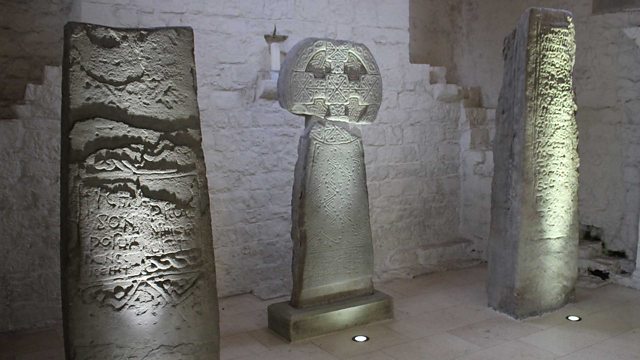
As if to trace the history of this place through the centuries, we step inside the church to the Galilee Chapel, where a stunning collection of Celtic standing stones, discovered on this site over the generations, stand like sentinels watching from those early centuries, and providing the backdrop for the Welsh Bardic musicians, ‘Bragod’, as they perform ‘St Padarn’s Staff’: a window into a Celtic mediaeval sound-world.
MUSIC STARTS UNDER, THEN WEAVES IN NEXT SECTIONS
Music 2: ‘St Padarn’s staff’ (Bragod)
GALILEE CHAPEL
Emma:
‘St Padarn’s staff’ is a reminder that the staff was one of the tools of the trade for the Celtic saints; it was a practical help as they traversed the ancient terrain, but it was also a sign of their spiritual and pastoral authority. And amongst the traditions linked to St Illtud are stories of his remarkable spiritual powers, and a later account of the Life of Illtud describes how his prayers enabled this monastic site to develop.
Reading 1: A tradition of St Illtud (Richard Parry)
“The site of Llanilltud in ancient times was a very limited area and hemmed in on every side. David, Samson, Gildas and Paul Aurelian asked Illtud to pray to the Lord that he might cause the sea to retire, so that the monastery could be enlarged. Illtud agreed and the five prayed. Illtud and his students went down to the shore at low tide, when the sea used to withdraw to the distance of a mile and more and traced a furrow with the point of his staff, beyond which he forbade the water to pass, and it has never since that time transgressed his command.”
MUSIC
Emma:
Today, the saints are tourists and Illtud’s staff perhaps is a walking pole, and Llantwit Major (which translates as “Illtud’s Great Church”) is a bustling town; yet this community still holds its remarkable past in tension with the challenges of the contemporary world. St Illtud’s Church draws together a diverse community of worshippers, pilgrims and visitors, all sharing its stillness in prayer and worship, and exploring its legacy through history and learning; and it's to the completeness of that life in Christ that we are invited today.
MUSIC
God our Father, you gave your saints to the people of Wales to uphold the faith and to be faithfuland wise stewards of your mysteries: encouraged by their example,may we joyfully hold fast to the thingswhich lead to eternal life;through Jesus Christ our Lord,to whom with you and the Holy Spiritbe all honour and glory,now and for ever. Amen.
Now we break open our scriptures, with verses from chapter 2 of St Paul’s first letter to the Thessalonians
Reading 2: 1 Thessalonians 2:9-12 (Richard Parry)
You remember our labour and toil, brothers and sisters; we worked night and day, so that we might not burden any of you while we proclaimed to you the gospel of God. You are witnesses, and God also, how pure, upright, and blameless our conduct was towards you believers. As you know, we dealt with each one of you like a father with his children, urging and encouraging you and pleading that you should lead a life worthy of God, who calls you into his own kingdom and glory.
Music 3: Hymn: “Rho im yr hedd” (Grant me peace)
MAIN CHURCH
Emma:
Members of BBC National Chorus of Wales, once again, singing the Welsh hymn “Rho im yr hedd”, “Grant me peace”.
Our preacher is Canon Edwin Counsell, the parish priest and Ministry Area Leader at Llanilltud… and we join Edwin in the main church that we use today. It was built in the 12th century, alongside the earlier parish church, to house a chapter of priests who simply prayed, day and night.
First Reflection
Edwin:
This building seems to carry the memory of those prayers, even today, with white plastered walls adorned with the ochre hues of medieval paintings, that still bear the rich legacy of those who, through the centuries, have found fellowship and faith in this place.
John Wesley visited here a few centuries later in 1777, and I’m probably standing where Wesley stood to preach. His diary entry tells of the dramatic impact this visit had on the famous evangelist.
Wesley quotation (Richard Parry)
“Friday the 25th July. About eleven, I read prayers and preached in Llantwit Major church to a very numerous congregation. I have not seen either so large or so handsome a church since I left England. It was sixty yards long… I suppose it has been abundantly the most beautiful as well as the most spacious church in Wales.”
Edwin:
I wonder, what sort of welcome did John Wesley receive here? It sounds as though it was generous; he didn’t usually preach inside Anglican churches, preferring to clamber on to the preaching cross in the churchyard, but perhaps there was something about this church that drew him over the threshold… and I’m pleased, because the door to any church is probably the most important feature of the building.
It can be a portal, a way-in to a place of prayer, healing and reconciliation… or it can be physical barrier, leaving a visitor wondering if it will creak open, revealing a sea of faces asking “who’s that stranger”!
But barriers to sacred places can be deeper, and too many people feel unworthy or burdened by the story of their lives, believing that the church, or even God, might send them away in scorn.
Radical hospitality sits at the heart of the Gospel: but that welcome to church is about more than having good signage and a coffee machine. It values every person as sacred, and speaks of a generosity of welcome in God’s name, not ‘despite’ the burdens and difficulties we carry, but simply ‘because’ of them.
St Paul wrote to the Thessalonian church just a couple of decades after the resurrection, encouraging a fledgling Christian community, as he writes, “to lead a life worthy of God”, even when they faced the distain and, perhaps, the persecution of their own community. If Paul encouraged them to find hope and faithfulness, then I reckon those same hallmarks of life lived in God, can be seen in the witness of the Celtic saints who established this place.
Their witness was of the search for God in all things and their proclamation spoke of Jesus Christ at the centre of our existence, regardless of the constant turmoil of human life.
Most of us don’t have to live with persecution today, yet we live with the burdens of this age, just like people in the time of Illtud or John Wesley, or any other point in time: and make no mistake, the last 2 years of pandemic, lockdown and separation from family, friends and normality have taken their toll.
In this church, we’ve had a focus on mental health and wellness for a while, partly born out of our own individual experiences of tragedy: and yet out of that has come a partnership with our local branch of Samaritans, and a real desire to normalise conversations about mental health.
This church building is a tactile timeline… whether that’s the chisel marks left on the windows by the medieval masons, or the Celtic stones that have left people in awe for a millennium and more;
… and I reckon those physical reminders of deeper truths have led to this being described as a ‘thin place’, as though the story and connection back to Celtic times makes the fabric separating heaven and earth seem more delicate, and gossamer-thin. Yet I wonder if the ‘thin-ness’ is found not in the place, but in the people who fill it?
We’re all ‘thin’ people, and if we’re serious about a Gospel that looks beyond that porous divide between our daily lives and an eternal God; a Gospel that speaks of God in all things and every situation; where every person finds a welcome that has no conditions, no strings attached… then the embrace we extend to others, is that of Jesus himself.
MUSIC STARTS
The contemporary bardic poem “Beyond this divide”, set for voice and crwth, a Celtic harp played with a bow, speaks of seeking God on the journey of life:
Music 4: ‘Beyond this divide’ (Bragod)
Emma:
We’re able to support many people in this community with old fashioned ‘tea and comfort’! … we can also signpost to the Samaritans, and their work to support people in anguish, that can be life changing (or, in some cases, lifesaving). But the heart of this church is the nurturing community. Professional ‘cellist Ben Tarlton grew up here, and Dai, who worships in this church, find it a place of solace.
MUSIC AND INTERVIEW INTERWEAVE
Interview with Dai Davies
Music 5: Part of Benjamin Britten’s Third Solo Cello Suite (Ben)
GALILEE CHAPEL
Emma:
We’re standing in the semi-circle of Celtic stones in the Galilee chapel as we turn to our next reading, from chapter 16 of Matthew’s Gospel, as Jesus promises his disciples the peace that flows from fellowship in God… but not before they’ve taken up the weight of the cross.
Reading 3: Matthew 16:24-27 (Richard Parry)
Then Jesus told his disciples, ‘If any want to become my followers, let them deny themselves and take up their cross and follow me. For those who want to save their life will lose it, and those who lose their life for my sake will find it. For what will it profit them if they gain the whole world but forfeit their life? Or what will they give in return for their life?‘
For the Son of Man is to come with his angels in the glory of his Father, and then he will repay everyone for what has been done.
Second Reflection
Edwin:
I’ve come to think of the Celtic standing stones as wise friends, standing silently for each successive generation, bearing witness to their ancient past.
In the year 587, St David, who tradition says was an ‘old boy’ of the Celtic monastic college at Llanilltud, spoke at the Synod of Brevi in West Wales and wowed his audience with his eloquence and sincerity of faith. He spoke out against Pelagianism, considered a dangerous heresy of the time, which proclaimed that we can live our lives freely, and choose to live righteously and find salvation... with no need of God’s grace.
Now that’s fine as far as it goes, and maybe it’s a way of life that’s familiar in the 21st century, when we can feel as though we’re in charge of our own destiny, and everything’s running to plan.
Trouble is… what happens when it all goes wrong…belly up… and we find ourselves in the throes of inner turmoil, of conflict, disagreement or even a pandemic!
I meet a lot of people in this church. I usually ask, “where have you come from today?”, because we all like to be rooted in a place that we call home.
But lockdown has reminded so many of us that trying to be emotionally self-sufficient may not really meet our needs. And I’ve noticed a real change in the visitors we receive here. Whereas people would ask about the dates of physical features of the church or enquire about guidebooks... these days, many more remark about the sense of peace that the building brings, asking if it’s OK to light candles, or where’s the best place for them to sit quietly to experience the stillness.
So now, I often ask visitors: “What do you hope to discover today?” It gets some blank looks – but others speak tentatively of God, faith and people they love. I wonder if that’s just a step away from the conversation that Jesus had with his disciples, inviting them to take up their cross, and follow him – an invitation to explore life in a new way.
Our scriptures speak of the very near presence of the cross of Christ. If we stand in the shadow of that cross, we might seem overwhelmed by its darkness… until the bright light of resurrection rises behind it; and perhaps knowing that, Matthew tells us of the clarion call of Jesus to his disciples – “take up your cross and follow me”.
I can’t help glancing at the Celtic standing stones alongside me as I speak. They were discovered around the site of the church in the last 200 years, and dated to between the 8th and 10th centuries. They tell of the activity of the community here towards the end of the ‘Celtic’ period… yet they also bear witness to the earlier tradition of Illtud and St David himself.
The carved stone at the centre is a Celtic cross, perhaps 1100 years old, with the arms of the cross representing the intersection of God and humanity in the human story. Within that core design, the craftsman has worked the complexity of the knotwork, chiselled into the stone, whose patterns show God woven into the fabric of our lives in our experiences of joy and sorrow; and then carved a circle around the intersection of the Cross: a perfect circle with no beginning nor end, that re-asserts God’s continuing love, given freely, and without condition, not just for a moment, but for eternity.
Today we bear witness to a remarkable tradition in this church, stretching back to Celtic times; through conflicts and famines, plagues and pandemics... through the era of Illtud, David, John Wesley and all those who’ve gone before.
Yet the offer of God remains the same: a revealed offer of hospitality that’s both profound and humbling in the same breath, that’s offered to Dai in his moment of critical need, or to any of us caught up in the perilous journey of our lives, shaped by our experience of the human and the divine along the way. And in that search for the stillness and presence of God, bringing calm even in the turmoil of our lives and the world, we now listen to the choir sing the famous Welsh hymn, “Calon lân”, “a pure heart”, that gives constant praise to God.
Music 6: Hymn: ‘Calon Lan’
MAIN CHURCH
Prayers
Emma:
And now to our prayers. As we give thanks for the rich tradition of the saints, handed down through the centuries, so we pray for all who seek God’s gracious love, that the Word of Christ might dwell richly in each of us, that we might be open to every prompting of the Spirit.
Lord, keep us mindful of the needs of others and may that be reflected in the welcome of our embrace and the hospitality of our lives; and as we seek answers to the questions that challenge, guide and shape our lives; we pray for those who have so little in a world of plenty … for those whose lives are blighted by the anxiety of mental illness … for those who yearn for peace.
And as the quest for peace between nations still goes on each day, may the world’s leaders work for healing and reconciliation. May they be the peace-makers who are blessed as the children of God.
Finally, we remember in our minds and in our hearts, those who are poorly, that God may strengthen them and guide the hands of those who care for them… … for those people we know and love, who may be living with the challenges of their lives each day:
Lord, in your mercy...hear our prayer.
And we pray with courage and confidence in the words of the Lord’s Prayer:
Our Father, who art in heaven, hallowed be thy name. Thy kingdom come. Thy will be done on earth as it is in heaven. Give us this day our daily bread, and forgive us our trespasses,as we forgive those who trespass against us; and lead us not into temptation, but deliver us from evil. For thine is the kingdom, the power, and the glory, for ever and ever. Amen.
The words of our final hymn acknowledge the saints and heroes of faith, who shaped this nation of Wales. Written by Timothy Rees, a former Bishop of Llandaff, and sung to the tune ‘Blaenwern’, composed by William Rowlands: “Lord, who in thy perfect wisdom, times and seasons dost arrange”.
Music 7: Hymn: ‘Lord who in thy perfect wisdom’
Concluding prayer and blessing
Edwin:
Almighty God, awaken in us the zeal of your servant Illtud and all your saints; that we may follow you in singleness of heart; through Jesus Christ our Lord. Amen.
May the Lord be with us to protect us; may he guide us and give us his strength; may he watch over us, keep us in his care and bless us with his peace.
The blessing of God almighty, the Father and the Son and the Holy Spirit come down upon you and rest upon you and on your homes; upon the people you love and those for whom you pray, today and always. Amen.
Music 8: Sarabande from Bach Cello Suite No. 4 in Eb Major (Ben Tarlton)
Broadcast
- Sun 19 Jun 202208:10BBC Radio 4
Lent Talks
Six people reflect on the story of Jesus' ministry and Passion from their own perspectives
No fanfare marked Accession Day...
In the Queen, sovereignty is a reality in a life, says the Dean of Westminster.
The Tokyo Olympics – Stretching Every Sinew
Athletes' reflections on faith and competing in the Olympics.
"We do not lose heart."
Marking the centenary of HRH Prince Philip's birth, a reflection from St George's Chapel.
St David's Big Life Hack
What do we know about St David, who told his monks to sweat the small stuff?
Two girls on a train
How a bystander's intervention helped stop a young woman from being trafficked.
Sunday Worship: Dr Rowan Williams
How our nation can rise to the huge challenges it faces, post-Covid-19.
