Music and Art in Josquin's Age: Branching Out
Donald Macleod is back at the National Gallery with Andrew Graham-Dixon to consider how Josquin and the painters of northern Europe were extending their influence.
Donald Macleod is back at the National Gallery with Andrew Graham-Dixon to consider how Josquin and the painters of Northern Europe were extending their influence.
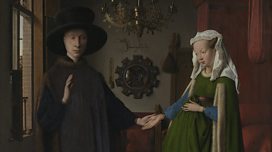
The humanist Cosimo Bartoli described Josquin as the Michelangelo of Music. A master of polyphonic choral writing, Josquin was as widely admired in his own lifetime as posthumously. While Josquin was a dominant force in music, the Franco-Flemish area with which he’s associated, also produced some remarkable painters, who, like Josquin and his fellow composers, exported their style, technical accomplishments and influence across Europe. In a series to mark the 500th anniversary of Josquin’s death, Donald Macleod visits the National Gallery in Trafalgar Square with art historian Andrew Graham-Dixon, to build a picture of Josquin’s music and the places he lived and worked, which also stimulated painters to produce equally outstanding Art. To accompany the series the paintings they discuss can be viewed on the Radio 3 website.
Considering his fame, it’s surprisingly difficult to map Josquin’s life. His birthdate was possibly 1450 or perhaps 1455 and it’s thought he was a choirboy at the collegiate church of St. Géry in Cambrai. Documents show he died in 1521, by which time he was probably in his seventies. He spent his last years as provost of the Collegiate church of Notre Dame in Condé sur l’Escaut, a town near Saint Quentin, right on the border with what’s now Belgium. In between times, Josquin may have had an association with the royal courts of King René in Aix-en-Provence and Louis XI of France, before working for the influential Sforza family in Milan and becoming the first maestro di cappella for Ercole d’Este in Ferrara.
As Josquin progresses from church musician to employment at a royal establishment, Donald Macleod and Andrew Graham-Dixon return to the National Gallery to see how painters from Northern Europe were extending their spheres of influence. The paintings they talk about are available on the Radio 3 website.
La Bernardina
Cantica Symphonia
Giuseppe Maletto, director
Guillaume se va chaufer
Capilla Flamenca
O bone et dulcissime Jesu
La Chapelle Royale
Philippe Herreweghe, director
Illibata dei virgo nutrix
The Clerks
Edward Wickham, director
Memor esto verbi tui, “Psalm 118”
Bremen Weser-Renaissance
Manfred Cordes, director
Que vous madame
Taverner Consort
Andrew Parrott, director
Petite camusette
Baises moy ma doulce’amye
Dominique Visse, counter-tenor
Ensemble Clément Janequin
Last on

![]()
Josquin and Art, from the National Gallery
Branching out, with Donald Macleod and art historian Andrew Graham Dixon.
Music Played
![]()
Josquin des Prez
La Bernardina
Ensemble: Cantica Symphonia.- GLOSSA : GCDP-31909.
- GLOSSA.
- 4.
![]()
Josquin des Prez
Guillaume se va chaufer
Ensemble: Capilla Flamenca.- NAXOS : 8.-554516.
- NAXOS.
- 15.
![]()
Josquin des Prez
O bone et dulcissime Jesu
Ensemble: La Chapelle Royale. Conductor: Philippe Herreweghe.- HARMONIA MUNDI : HMA 1951243.
- HARMONIA MUNDI.
- 5.
![]()
Josquin des Prez
Illibata dei virgo nutrix
Choir: The Clerks. Director: Edward Wickham.- GAUDEAMUS CDGAM361.
- GAUDEAMUS.
- 4.
![]()
Josquin des Prez
Memor esto verbi tui, "Psalm 118"
Ensemble: Weser-Renaissance Bremen. Conductor: Manfred Cordes.- CPO : 777588-2.
- CPO.
- 5.
![]()
Josquin des Prez
Que vous madame
Ensemble: Taverner Consort. Conductor: Andrew Parrott.- WARNER CLASSICS : 9029659823.
- WARNER CLASSICS.
- 5.
![]()
Josquin des Prez
Petite camusette
Ensemble: Clement Janequin Ensemble. Singer: Dominique Visse.- RICERCAR : RIC 423.
- RICERCAR.
- 8.
![]()
Josquin des Prez
Baises moy ma doulce'amye
Singer: Dominique Visse. Ensemble: Clement Janequin Ensemble.- RICERCAR : RIC 423.
- RICERCAR.
- 13.

Broadcast
- Tue 31 Aug 202112:00BBC Radio 3
Beethoven Unleashed – the box set
The complete set of Radio 3 Beethoven Unleashed podcasts, with Donald Macleod.
What was really wrong with Beethoven?

Georgia Mann and neurosurgeon Henry Marsh examine the composer's numerous health problems
Composers A to Z
Visit the extensive audio archive of Radio 3 programmes about Composers and their works.
Who knew? Five eye-opening stories from Composer of the Week

The production team reflects on 5 of Donald Macleod’s best stories from the last 20 years
Five reasons why we love Parry's Jerusalem
What is the strange power of Jerusalem which makes strong men weep?
A man out of time – why Parry's music and ideas were at odds with his image...
The composer of Jerusalem was very far from the conservative figure his image suggests.
Composer Help Page

Find resources and contacts for composers from within the classical music industry.
