Guide Dog DNA; Blind Mountain Biker
In Touch speaks to the scientist leading the project to sequence the DNA of 3,000 Guide Dog puppies to help breeders predict which dogs will have the most desirable characteristics
3,000 puppies are to have their DNA sequenced via sailva swabs in order to build a database that will help improve the success rate of fully established working guide dogs. The 'Born to Guide' project is being led by Dr Tom Lewis, who told us how the database will establish links between dog genetics, health and behaviour.
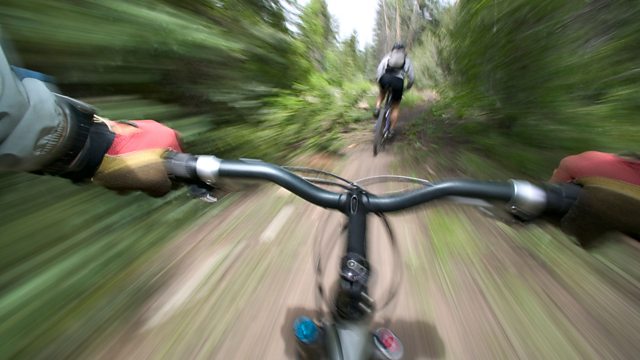
And we meet Xavier Hopkins - the visually impaired mountain biker who makes a mental map of the courses he rides, before hurtling down them at very high speeds.
Last on

In Touch transcript: 06/04/21
Downloaded from www.bbc.co.uk/radio4
THE ATTACHED TRANSCRIPT WAS TYPED FROM A RECORDING AND NOT COPIED FROM AN ORIGINAL SCRIPT. BECAUSE OF THE RISK OF MISHEARING AND THE DIFFICULTY IN SOME CASES OF IDENTIFYING INDIVIDUAL SPEAKERS, THE BBC CANNOT VOUCH FOR ITS COMPLETE ACCURACY.
IN TOUCH - Guide Dog DNA; Blind Mountain Biker
TX: 06.04.2021 2040-2100
PRESENTER: PETER WHITE
PRODUCER: SIMON HOBAN
White
Good evening. Tonight, four legs good, two wheels – well pretty good too – because tonight we search for the perfect guide dog and we meet the visually impaired mountain biker who makes a mental map of trees and other obstacles on a course before hurtling past them at top speed.
Clip
I just want to push myself as far as I can go and push – see how far a disabled athlete can go in this sport.
White
But first, producing the ideal guide dog doesn’t just happen by chance. A lot of factors have to be taken into consideration – breed, health, temperament, getting a good match between dog and owner and after all that, a fair slice of luck. Well, the Guide Dog organisation acknowledges that what is a pretty expensive operation ends up with a high failure rate – over half the dogs which start the journey don’t end up guiding. Which is why Guide Dogs is now running a project involving genome sequencing of about 3,000 puppies to discover which of them is most likely to make the grade. Well, I’ve been talking to Dr Tom Lewis, who’s head of canine genetics at Guide Dogs and who is heading the project. And I asked him – what is the failure rate at the moment?
Lewis
It’s actually a little over a half. So, of all the puppies that are bred, we identify some breeding stock which are the potential breeding stock which are the best performing dogs and of the rest it’s a little over half end up qualifying. So, we tend to – up to about 60%, 50-60% – and of those that don’t qualify, three quarters tend to be for reasons of behaviour or temperament. So, for example, being too over-excitable or too anxious or something like that. And the other 25% tend to be for reasons of health unfortunately.
White
So, just explain the science to us. How will the DNA tell you if a dog is going to be a good guide dog or not?
Lewis
Right, well, what we will be doing is we will be looking for particular patterns in the DNA that are associated with traits, characteristics, attributes, measurements that we already take from our stock, our dogs, to try and assoc – determine associations between particular patterns in the DNA and particular attributes that we either want or don’t want. And that will enable us to make much more precise breeding decisions in order to select for the best working dogs.
White
And how much is this purely a genetic scientific exercise and how much do you allow for other factors contributing to success or failure – you know, the way the dog’s treated, environmental factors, luck?
Lewis
Absolutely, those are tremendously important and it’s the old sort of nature – nature/nurture – and I think that it’s both. It’s nature via nurture. And so, just as we could breed the most perfect guide dog, we would still need to apply all the training to get them up to being that fantastic working dog. The environment is tremendously important. That said, there are some dogs, of course, that no matter how much training you provide would never be able to be guide dogs. I’ve got two spaniels and while they’re cracking dogs, they just would not be – no amount of training is going to turn them into guide dogs. So, it’s really absolutely that crucial mix of genetics and environment.
White
But this is aimed at getting the right dog to start with, so, at least, if you’ve got that then you could put the other bits in of the puzzle in place.
Lewis
Absolutely. So, it’s my job, it’s our job on the breeding team, to try and provide Guide Dogs with the best quality dogs that enter that training and that guiding school.
White
Now, as we’ve said, getting it wrong is expensive. I mean, for a start, how much does it cost to train a dog because obviously there’s plenty else you could do with this money?
Lewis
Yeah, the cost – I think the cost of a guide dog from birth up to – I think the time it’s placed – is about £60,000, I think. So, it is, absolutely, a really important thing for us to get right and to try and increase those qualification rates as much as we can. And then to ensure that once the dogs are placed in partnership with a person with sight loss that that partnership can continue for as long as possible. And so, we want to ensure that they’re in good health, that they’re enjoying their work, into retirement at quite an advanced age.
White
Can I ask you – how much is breed a factor because in the public mind, I think, that there are, quotes, “good guide dogs”, you know people see Labradors, they see German Shepherds around, how much is that perception and how much is borne out by the facts?
Lewis
I think that’s a really good question and breed is a very – something that, I think, a lot of people think they’re very sure but actually it’s quite a difficult thing to really describe. There are clearly breeds that we use currently and find more successful than others, for a number of reasons. One of the reasons I was most surprised by, of course, is size and size for that – in relation to the guide dog owner and the harness, that is all very important. So, there are – just as Labradors and German Shepherds are a particular size, they also have other traits that make them particularly suited to guiding. So, breed is very important. That having been said, it would be very interesting to be able to look at perhaps thinking about making a composite breed, breeding a composite – all the best features from the breeds that we use already into a sort of composite guide dog that actually meets all our requirements. So, it’s a really interesting question.
White
When would you expect to see tangible results from this project?
Lewis
We would hope within a few years. We will be taking the sequence from this generation of puppies, as you said 3,000, which is about two to three worth of puppies that we produce, and we will be following them extremely closely throughout their entire lives. Now a great proportion of the data that’s really useful to us will be in their early lives, when they’re growing, learning and undergoing training. So, that will come through fairly quickly. And we would hope to be able to combine that with the genomic data and analysis and research and see some results from that fairly quickly. But we will go on right through their lives, up to retirement and then beyond, and actually the data collection for this project will only finish when the last one of those puppies eventually passes on and that’s when the data set will be complete but even then the research will be able to continue.
White
It’s probably unlikely that you can genome sequence guide dog owners and yet the relationship is very important, isn’t it, are there any things that you could do to make sure the right dog ends up with the right owner?
Lewis
Absolutely and that partnership is really key and really critical. So, we have to have a very good idea about the sort of – not just particular traits that we’re interested in but actually a range of attributes that we’re interested in. So, if we were to look at temperament or behaviour in terms of perhaps how outgoing or how energetic or perhaps more introspective a dog is, then that’s really important because there’s going to be variation in the guide dog owners and some may want a more gregarious dog and some may want a slightly quieter dog. So, that’s very, very important and we have to make sure that we can maintain that variation in our plans and then match them up effectively. So, finding patterns that predict those would be particularly useful as well.
White
Will this make any differences to the way that you select dogs? What I mean is, would you expect to breed most of your dogs very deliberately in future? I’m wondering how many dogs now are actually bred and how many are acquired.
Lewis
We breed most of our dogs, in fact virtually all our dogs. So, we have a breeding programme in place at the moment and that’s what we use a lot of this, as I said, phenotypic information, information that we measure and gather on all our dogs, we use that in conjunction with the pedigree at the moment. So, that’s the sort of family tree information. So, we can do so much with that and we can actually determine how important genetics is in certain traits. What this will do, when we actually find the particular patterns in the DNA, is it’ll afford us some extra precision. So, it’ll give us some more accuracy in those breeding decisions and hopefully make the rate of improvement that much better.
White
Professor Tom Lewis, thank you very much.
Lewis
Thank you.
White
Now, we’re always looking for the topics on this programme you want us to talk about and we’ve picked up a few emails lately about the business of moving house. It’s certainly true that it’s quite a while since we’ve addressed it and it can be very challenging for anyone. So, we want your help. Share your experiences as a visually impaired house mover. We’d like to hear your solutions to finding the right location in the first place, maybe doing a recce, packing up all that stuff, labelling, settling into a new place, making friends, finding the pub or the church or indeed the supermarket or corner shop with the most helpful staff. All that sort of thing – tell us about the things that worked out for you and the things that went wrong. We’re planning a programme on it soon. And you can email us: intouch@bbc.co.uk.
Now, finally today, meet someone for whom using a guide, dog, however well sequenced, might seem just a little slow. Xavier Hopkins from Reading is a professional mountain biker, this despite the eye conditions of albinism and nystagmus. Well, he’s attracted sponsors from across Europe because of his story and his riding has featured prominently on You Tube. Here’s a taster of one of his videos.
Clip
I’m Xavier Hopkins and I’m a blind mountain biker, which is a pretty stupid hobby to pick but there you go. It’s like I’m in a whole new world as such, it’s like picking up a superpower in a way because I struggle to do so many things and I’m always – I was always being told growing up – you can’t do this, you can’t do that, you can’t drive, you can’t get certain jobs – but this is something I can do.
I want to push myself and I want to ride these big jumps. About six months ago I thought why not just go for it, there’s no reason I can’t do this, it’s all psychological pretty much.
I just want to push myself as far as I can go and push – see how far a disabled athlete can go in this sport.
White
Well Xavier joins me now. First of all Xavier, because it’s so relevant, just explain how much vision you’ve actually got and what effect it has on your riding.
Hopkins
With albinism and nystagmus, it’s very – quite difficult to sort of quantify because I know in the ophthalmologist’s office I have less than 10% but obviously with my eye conditions being so affected by the amount of light and my tiredness, with nystagmus, how much my eyes are actually moving, it’s quite difficult to tell but not enough, I would say, in comparison with my peers in the sport but you deal with what you have at the end of the day.
White
Right, and I mean what are the – what are the kind of things that may arise because of the kinds of things you mentioned – like tiredness – when the sight actually kicks and has an effect, what are the things you have to watch out for?
Hopkins
Well, with nystagmus it makes it very difficult to judge any kind of depths or anything, so actually that’s quite relevant in mountain biking, judging sort of if there’s a drop coming up how far it is or whatever. Also, with Albinism, with the sunlight, because you’re not filming in perfect bright or dark, it’s normally going from shade to light in the woods, can be quite difficult transitioning between the two.
White
Well, we’ll come back to how you deal with that but, first of all, you said yourself it was a pretty crazy thing possibly or that people would think it was a crazy thing to do. How did you get into it as opposed to other sports?
Hopkins
Well, I’ve always been very into sports actually. I was brought up – I didn’t really even know, as such, that I had a visual impairment until I was 12 or so, my parents made sure they kept it completely – almost secret from me and I went through normal school playing football or whatever. And then some friends at college started mountain biking and I thought well, I may as well give it a go, it seems like a lot of fun and it’s got me to where I am today, I guess, just through enjoying it with good company.
White
So, tell me, what modifications do you have to make to pursue your sport? What sort of things do you do that other mountain bikers wouldn’t have to?
Hopkins
Well, I make sure all the tracks I either ride very slowly and I normally ask someone who’s ridden them before to tell me exactly what’s coming up or I’ll try – in the ideal scenario I walk the entire track and try and remember exactly what’s coming up and what size the jumps are or if there’s routes or something or certain things that would cause you to have an accident. So, trying to remember as much as I can but obviously sometimes you forget things and then have a crash but what can you do?
White
So, how often do you end up in a heap?
Hopkins
Luckily not too much. They say there’s an art to sort of not crashing but to recovering from getting in a bad scenario and I seem to be relatively good at that – getting out by the skin of my teeth. But I have had a few crashes. I mean I broke my collarbone in Châtel in 2019, in summer 2019 and I’ve had a neck injury before, so I wear neck brace now. But other than that I’m – got out pretty unscathed, I’d say, luckily, some people are having right off injuries every season it seems but I don’t want to participate in that I think.
White
Sounds serious enough to me, would probably have stopped me by now. How long are the courses you do because you say you try and walk them, so how long are the courses?
Hopkins
Well in the UK we don’t have very big hills, so it can be sort of from – well, 20 second tracks to a minute or so, generally, unless you go to Wales. But in Châtel, I think, from the top to the bottom of the mountain, depending on what track you take, can be up to 15 minutes. So, those I would ask – I have a friend who’s a professional so we’d ride all the tracks together slowly, going through them, because you really couldn’t walk those tracks, especially as they’re so fast that there’ll be other riders coming down and you could cause accidents if you walked those. So, more of a leap of faith there.
White
And you’ve mentioned the light, I mean what effect does the light have on a particular day?
Hopkins
Well, if it’s sunny, that’s the worse because it causes, not only is it very bright in some areas, but it causes the shade to be very dark and contrasting, compared with the light patches. And my ideal is actually an overcast day where the light’s much more consistent, which, luckily, living in England is very common.
White
Now you’ve turned professional, just explain that and how you make money from this.
Hopkins
I’ve got a number of sponsors already and I get paid by some of them and some of them I don’t but I get equipment and travel and stuff paid for. And I do a lot of video and promotional work. So, for example, I’ve done You Tube work before and we’ve got a film that’s going out, hopefully, on Netflix or Amazon and we’ve secured international distribution for television networks for it as well, where we’re going to Iceland and helicoptering to the highest peak, I believe, and riding on volcanoes and stuff. So, that will be interesting. And people pay to put their brand names on that kind of thing.
White
Xavier, you’ve said it transformed your life, just explain – what do you mean by that?
Hopkins
Well, it’s given me a sort of freedom, I think, and I was always brought up with the idea that you either do something very big or you’ve sort of failed, you know. I mean mountain biking, in a different way, has allowed me to really create a sort of monument to myself and put myself out there. And also, I enjoy that some people seem to get some sort of inspiration from what I do, so, I’m very happy about it and it’s given me a whole positive outlook, I think, on what I’ve achieved so far.
White
The fearless Xavier Hopkins. Any other daredevils out there like to share their stories with us? We’d like to hear from you.
Rather more prosaically, I’ve already mentioned your help with the challenges of moving house, we’re also looking at inaccessible websites. We’ve heard, in recent programmes, how it can be a challenge with the banks, with checking on your train, even having a bet – well, we’d like to hear who’s doing it badly in making their websites accessible but also those who are doing well. And we’ll also be checking on the state of the law.
That email address again: intouch@bbc.co.uk. And there’s more information on our website: bbc.co.uk/intouch. And you can also download tonight’s and previous editions of the programme.
From me, Peter White, producer Simon Hoban and studio managers Owyn Williams and Jonathan Esp. Goodbye.
Broadcast
- Tue 6 Apr 202120:40BBC Radio 4
Download this programme
Listen anytime or anywhere. Subscribe to this programme or download individual episodes.
Podcast
![]()
In Touch
News, views and information for people who are blind or partially sighted