Covid Vaccination Experiences and RNIB London Move
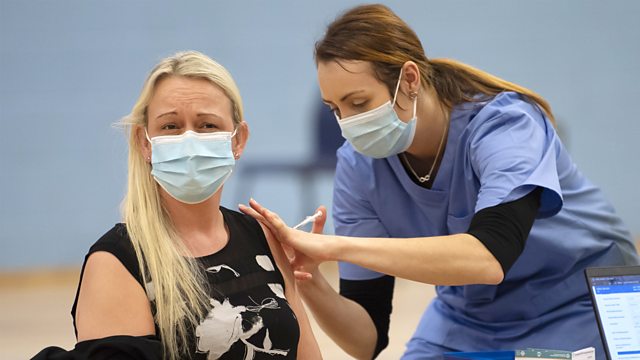
We hear from people with sight loss who've had the Covid vaccination. How did the process work for them?
The RNIB tells us why the charity is selling off its London HQ.
We hear from In Touch listeners who've now had the first of their Covid vaccinations. How did they hear about where to go? What was the process like when they actually got the jab?
And the RNIB has announced it's selling off its London HQ. The search is on for smaller London premises. RNIB Chief Executive Matt Stringer tells us why they need to make this move.
PRESENTER: Peter White
PRODUCER: Mike Young
Last on

In Touch transcript: 02/02/21
Downloaded from www.bbc.co.uk/radio4
THE ATTACHED TRANSCRIPT WAS TYPED FROM A RECORDING AND NOT COPIED FROM AN ORIGINAL SCRIPT. BECAUSE OF THE RISK OF MISHEARING AND THE DIFFICULTY IN SOME CASES OF IDENTIFYING INDIVIDUAL SPEAKERS, THE BBC CANNOT VOUCH FOR ITS COMPLETE ACCURACY.
IN TOUCH – Covid Vaccination Experiences and RNIB London Move
TX: 02.02.2021 2040-2100
PRESENTER: PETER WHITE
PRODUCER: MIKE YOUNG
White
Good evening. Tonight, we want to follow up on your reactions to our programme last week looking at the accessibility or, quite often the lack of it, when it comes to covid testing and vaccinations. Also, it’s moving day again for the RNIB.
Clip
Pre-covid we were seeing usage of the existing space that we did use being quite low on certain days. Life has changed, working practices have changed and the needs of the charity’s changed.
White
But why, after only 20 years in place, is the RNIB selling off its central London headquarters near St Pancras Station and looking for a new home? Well, we’ll be trying to find out from their Chief Executive a little later in the programme.
But first, thanks to all of you for your comments about last week’s In Touch which we dedicated entirely to the challenges and logistics for visually impaired people of getting covid tested and vaccinated.
Karen Brown was one of those who emailed us. She said: “I booked a covid test at my local walk-in centre. I was able to get to the centre on my own but once inside I found it very difficult as I was asked to look at a leaflet taped to the wall which showed how to carry out the swab. I explained I was visually impaired and asked if they had the same leaflet in large print. They said they didn’t. I was offered a child’s version of the leaflet but it was still in standard print. Luckily, I had a hand-held magnifier with me, so I was able to read it. After I did the test, I had to snap the swab stick at the place where it was indented but I couldn’t see this, so I had to feel for where it was and do it that way. I found the whole experience very uncomfortable and rather embarrassing and, as with a lot of things in life, I felt I was having to ask all the time and fighting for things which should be readily available for people in my position.”
So, Karen’s experience adding to the problems we heard about last week for people taking a home test. And having done a home test myself this week, I can confirm that I don’t think I could have managed it without some sighted help.
As for vaccinations, well we heard about concerns around how we’ll be contacted to tell us when it’s our turn for the jab. And worries about where we’ll be asked to go.
Well Marianne O’Brien and Bill Guest were amongst those who emailed us and they’re on the line now to share their experiences.
Bill, if I can start with you, you’ve had your jab now but you opted, I think, to call your GP when you weren’t happy with the original government letter that you received. Just explain what happened there.
Guest
Yeah, well on the 21st January I received a letter, in print of course, from the government inviting me to attend one of the vaccination centres in the North West of England. Well, I wasn’t too happy about this for two reasons. The first was I was invited to book the vaccination online, although I’m reasonably IT savvy I wasn’t very happy about doing this. The second reason was to get to the vaccination centre I would have to call on my daughter or son-in-law who are both key workers and to get them to do a 20-mile round trip I didn’t think was very good.
White
Did your original letter indicate that they knew of your visual impairment?
Guest
Oh definitely not, no, there’s no mention of it at all.
White
Now in the end your daughter took you to get the vaccination at a local clinic, so how did that go, what was the process like?
Guest
In the end I phoned my local GP and they were extremely helpful, they came back to me the following day offering me a vaccination on the following Monday at a clinic something like two and a half miles from where I live. When we arrived there, there was a marshal waiting to direct us to the parking area and the receptionist was out to meet us. A couple of minutes later she took me in through to the vaccination nurse, explained to her straightaway that I was a totally blind person. Vaccination nurse then took me over, read me all that was going to happen, asked me the questions and told me of the possible side effects, gave me the injection and my daughter was waiting for me at the other end of the clinic, which I was guided to. And the whole process, I was back and in my home within 40 minutes of leaving it.
White
So really once your GP got involved, because that’s presumably where all the information then came about your visual impairment, then things were okay?
Guest
Absolutely brilliant, yeah.
White
Let’s bring in Marianne O’Brien because initially you were worried, weren’t you, about missing any letter informing you about the vaccine?
O’Brien
Yes, I kept going and looking at the post each day and sifting through it.
White
You could see a little bit?
O’Brien
Yes, I’m partially sighted.
White
But in the end you actually had a phone call and a letter as well?
O’Brien
Yes I had a phone call from the surgery.
White
You literally had your vaccination over the weekend.
O’Brien
On Saturday morning, yes. The marshal said – go straight into the car park, there’s no charge today, regardless of your appointment, just go straight in. And my son was able to be with me the whole time because I had to hold his arm. The doctor – I don’t know it was a doctor or nurse – explained what he was going to do and I said I was worried because I was highly allergic in the past. Anyway, he said well you could change your mind and go for the other vaccine but you’d have to go back to your surgery. And I said, oh no let’s get it over with. I didn’t want to have to go through it all again.
White
Any after effects Marianne?
O’Brien
No. You go to another area and you have to sit there for 15 minutes.
White
Can I just ask you – your son took you, if you hadn’t had him to help how would you have gone about getting it do you think?
O’Brien
Well, for one thing I couldn’t get there. I’m sure somebody would have helped me there. They were extremely helpful all the way, everybody.
White
I just want to go back, finally, to Bill. Marianne, thank you very much indeed. Bill, I just want to know, given your worries at the beginning of this process, what would you like to see happen to make the situation easier?
Guest
If the authorities were aware that you couldn’t see that would make life a lot easier but I appreciate that that’s very difficult to put into train. But, as I say, my GP and the surgery were extremely helpful. And I think really it needs for the people concerned to realise that if they get a letter saying that they’ve got to attend one of these large centres, they actually don’t have to. And my advice definitely would be to do what I did and contact your local surgery because they were extremely helpful once they realised that I was contacting them. My surgery came back to me and said, look ignore that government letter, it’s from the government don’t worry about it, we will sort you out.
White
That sounds like very good advice. Bill Guest and Marianne O’Brien, thank you both very much indeed.
Oriel Briton heard last week’s programme as well. She told us: “The situation with accessibility of covid vaccination and testing is even worse than I’d thought. What with barcodes to read etc. To any sensible person it would surely be obvious to design in disability inclusion right from the start. It’s an unforgiveable shambles and one which was entirely predictable and avoidable.” And she goes on: “In terms of provision of accessible health information, the whole subject doesn’t appear to be tackled head on in a concerted way at a national level but rather to be problem managed piecemeal on a localised case-by-case basis.”
And a final word, for the time being at any rate, addressing the calls from some people for all those with a visual impairment to get the vaccine as a priority. Well, we did ask the National Infection Service at Public Health England about this back in November. At that time they told us: “As we don’t know if the vaccine will prevent transmission, vaccination of individuals who need to be accompanied by others has not been considered at this stage.”
Well in the light of the enquiries from a number of you, we’ve asked again about this. The response this time was: “The Joint Committee on Vaccination and Immunisation is meeting regularly to consider all available evidence for phase two of priority group recommendations. This will be published in due course.”
I’ve never understood the meaning of that phrase “in due course”, I suspect it often means shut up and wait. But it looks as if quite a lot of you aren’t prepared to do that. A petition is currently online calling for visually impaired people to go on the priority list for covid vaccine. It’s already attracted nearly 500 signatures, via the hashtag safe to help. We will continue to keep you informed on that.
Now, after 20 years in occupation the RNIB is selling up its Central London headquarters at 105 Judd Street near St Pancras and is looking for a new home. They say it’s all part of the modernisation programme for the charity. Well, to put some flesh on the bones of that I’m joined by the RNIB’s Chief Executive, Matt Stringer.
Matt, given the huge upheaval involved in moving an organisation as large as the RNIB, 20 years isn’t long to want to start doing it all over again. So, why are you moving?
Stringer
Well, we’ve occupied Judd Street for 20 years, as you say, we have far too much space there simply, we have about 57,000 square feet, we don’t occupy two floors out of four, which are empty. And pre-covid we were seeing usage of the existing space that we did use being quite low on certain days, it was an obvious decision to move to a smaller one.
White
Is that very different then from what the situation was 20 years ago because the question would arise then – why did you move to somewhere that was too big?
Stringer
Potentially, clearly, I wasn’t there 20 years ago so I can’t tell you the rationale. The aspiration to move from Great Portland Street to Judd Street 20 years ago probably had some very cogent reasons. Life has changed, working practices have changed and the needs of the charity’s changed.
White
So, what’s the timeframe for this move?
Stringer
We’ve two more years at Judd Street, so we’re there till January 2023 and we will find a building and move before the two years are up and I think we will probably move in the autumn of 2022 because there’s no point taking it right to the wire.
White
You talk about space, having too much space, but how crucial is it that you do this move from a financial point of view?
Stringer
It isn’t any sort of panic response to any challenge to our finances, either pre-covid or because of covid. We’ve done a good job this year of managing our operational expenditures – you know the money that comes in and the money that goes out. We’ll end up this year, which finishes at the end of March, pretty much being on sort of break even, so that’s a good performance through covid. And as you know, we’ve actually been improving our liquidity through the sale of some of our regulated establishments over the last sort of year or so, which has helped to improve our liquidity.
White
Do you know how much this is likely to save you?
Stringer
Yes, I mean we have an idea of that and it gives us options, which we’re clearly talking to the trustees about. Clearly, we’ll need some money to buy another building, as you say, and there are other options ranging from some sensible investment maybe in our pension fund through to sort of further investment in the infrastructure of the charity to better serve our beneficiaries.
White
One of the most tangible aspects of your headquarters from the consumer’s point of view is the RNIB’s shop, your products for life store where people can actually go and examine and run our hands over equipment we may need. Will this be re-established wherever you go or will there be a temptation to put it wholly online?
Stringer
No, I think we’ll still do that. I’m very clear that we have a building which is not only a great place for us staff to work but also can be used by the wider beneficiaries of the charity. As you say we have a number of people coming in to Judd Street at the moment to use our shop, our service centre, volunteering groups and other groups in London come and use our space and I absolutely believe that we will deliver those services going forward.
White
So, what kind of a site are you looking for and where?
Stringer
Well, we’re looking in the same sort of area. A number of reasons why where we are we think is quite a good place to be. Clearly, very good transport links in and around Kings Cross, St Pancras and Euston. So, we need to be accessible in a broader sense so people finding it easy to get work and adjacencies in the area also good – whether that’s being with other charities, Moorfield’s Hospital is moving to the old St Pancras hospital site a few years down the line. So, there’s a number of reasons why we believe we should stay where we are.
White
Good to find, possibly in terms of people who live in London but, you know, there is still the issue of where you are. Given that the issue of money is a very real one, wouldn’t this be a good time to move out of expensive London and look for somewhere far cheaper and for many people more central?
Stringer
Well, we are a very dispersed organisation already, Peter, as you know, so we have a large office in Peterborough where a lot of our sort of back office finance and IT work is done, where our helpline is based and other sort of commercial and transcription services. So, that’s our biggest office actually, it’s not in London, it’s in Peterborough. We have strong presence in the devolved nations, necessarily, to be close to devolved administrations. We have a large print facility and transcription facility up in Gateshead. The minority of our team is in London actually, the majority are dispersed and we think it’s right to have a London base just because of those adjacencies I mentioned and being close to the centre of UK government, actually, when it comes to campaigning and trying to effect change through some of those relationships.
White
One thing I would like to ask you a bit more about is you talked about being able to offer more services, you know, if more money because available. I’m just interested what you think you might be able to expand and what things you might do that you don’t think you are doing satisfactorily enough at the moment.
Stringer
Well, I mean we have aspirations in the current plan – and this should only help underpin it – to improve the way we interact with our customers. At the moment, if you’re one of our beneficiaries you can touch the RNIB in a number of different ways and we wouldn’t necessarily know that you’d touched us. You might borrow audio books, you might shop with us online, you might want to do some volunteering – at the moment we don’t know that you’ve contacted us three times and therefore we’re not able to talk to you as fully as we could and put the appropriate things in front of you that might absolutely be what you need. So, there is an investment around simply our sort of customer contact, in essence, to make that better for the customers. And that’s something which, I think, we want to invest a bit more money in going forward.
White
I’m trying to understand that. I mean do you mean in terms of telephone contacts, actually monitoring who gets in touch and how, which sounds like something that should be able to be done quite easily with technology the way it is now.
Stringer
Well no, it is. I mean we have aspirations to do that over the next sort of couple of years anyway. I mean I think, like most 21st century brands that we all engage with they know who you are, whether you’re ringing them up, whether you’re going online, whether you’re shopping in stores and we would expect to do the same for our customers. And, as you say, the technology’s not actually that difficult, it’s just a question of getting organised to implement it, which is what we’re keen to do at the moment.
White
Guide Dogs is also now based at Judd Street, at the moment, they’re moving too – presumably they have to really, is it your intention to move somewhere where you can continue to be based alongside each other again?
Stringer
Yeah potentially. I mean we’ve got a good relationship with Guide Dogs, so this has all been done, as you would expect, in a very sort of open way, very open negotiations. So, they’re with us for two years and depending on where we go it might well be that they come with us, it’s certainly one of the options and there are other options to work closely with other potential charity partners. I mentioned adjacencies earlier, there are other charities in our sector where it might make sense to do something clever and sort of site ourselves close to others, to create a bit of a hub – early days around that but…
White
Such as – which ones?
Stringer
Well I’m not going to name names but some of the big charities in our sector…
White
Thomas Pocklington?
Stringer
Well, I’m not going to name names Peter but there’s other people in the sector who we could talk sensibly to and I think you’d probably find it’s strange if we weren’t talking to those people. But certainly, with Guide Dogs, to your question, it’s been a very positive sort of conversation with them, they know they’re in Judd Street safely for two more years and as we firm up plans about going to a new London base, we’ll certainly be talking to Guide Dogs about whether they want to come with us into a new office.
White
Well, you’ll obviously know that one of your recent predecessors was very keen on a much closer cooperation between your two large organisations – Guide Dogs and RNIB – to the point of merger. Given that one of her arguments was cost saving, sharing administration, is it possible that idea is being reconsidered?
Stringer
I think you’re getting ahead of yourself Peter there. It’s simply a property sort of opportunity…
White
People will wonder Matt.
Stringer
…well no, look, let me squash that. I mean this is very much a property opportunity which the RNIB have taken as being an obvious thing to do. And, as you say, there are relations that we have with Guide Dogs who occupy space in our London office who it would be strange if we weren’t talking to them about moving with us in the context of a London office and that is the limit of the conversations.
White
Matt Stringer, thank you very much indeed.
Stringer
Thank you, Peter.
White
And that’s all we’ve time for but your thoughts on that and indeed anything else you’ve heard in the programme, will be as welcome as they always are. Our email is intouch@bbc.co.uk and you can go to our website for additional information or to listen again to tonight’s and many past programmes. That’s it from me, Peter White, producer Mike Young and studio managers Sharon Hughes and Carwyn Griffith. Goodbye.
Broadcast
- Tue 2 Feb 202120:40BBC Radio 4
Download this programme

Listen anytime or anywhere. Subscribe to this programme or download individual episodes.
Podcast
![]()
In Touch
News, views and information for people who are blind or partially sighted