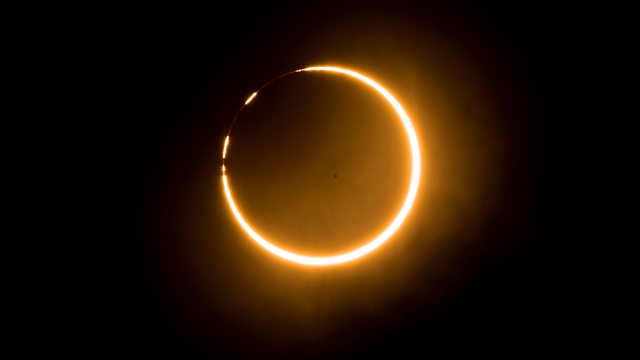
Eclipses
Melvyn Bragg and guests discuss the progress in our understanding of eclipses from the ancient world onwards, and how their predictability illuminates historical records and myths.
To celebrate Melvyn Bragg’s 27 years presenting In Our Time, five well-known fans of the programme have chosen their favourite episodes. Guy Garvey, lyricist and lead singer of the band Elbow, has selected the episode on eclipses, first broadcast in December 2020. Solar eclipses are some of life’s most extraordinary moments, when day becomes night and the stars come out before day returns either all too soon or not soon enough, depending on what you understand to be happening. In ancient China, for example, there was a story that a dragon was eating the sun and it had to be scared away by banging pots and pans if the sun were to return. Total lunar eclipses are more frequent and last longer, with a blood moon coloured red like a sunrise or sunset. Both events have created the chance for scientists to learn something remarkable, from the speed of light, to the width of the Atlantic, to the roundness of the Earth, to discovering helium and proving Einstein’s Theory of General Relativity.
With
Carolin Crawford
Public Astronomer based at the Institute of Astronomy, University of Cambridge and a fellow of Emmanuel College
Frank Close
Emeritus Professor of Physics at the University of Oxford
And
Lucie Green
Professor of Physics and a Royal Society University Research Fellow at Mullard Space Science Laboratory at University College London
Producers: Simon Tillotson and Julia Johnson
Spanning history, religion, culture, science and philosophy, In Our Time from BBC Radio 4 is essential listening for the intellectually curious. In each episode, host Melvyn Bragg and expert guests explore the people, ideas, events and discoveries that have shaped our world.
In Our Time is a BBC Studios production
Last on

LINKS AND FURTHER READING
Frank Close at the University of Oxford
Lucie Green at University College London
Eclipses - NASA
Total solar eclipse - why so rare? – BBC Learning
Lucie Green's eclipse watching tips – BBC Stargazing
‘Halley as an eclipse pioneer: his maps and observations of the total solar eclipses of 1715 and 1724’ by Jay M. Pasachoff - Journal of Astronomical History and Heritage, 1999
What are solar eclipses? – timeanddate.com
What is a solar eclipse? – NASA’s website for children
Eclipse - Wikipedia
READING LIST:
Frank Close, Eclipse: Journeys to the Dark Side of the Moon (Oxford University Press, 2017)
Frank Close, Eclipses: What Everyone Needs to Know (Oxford University Press, 2019)
Lucie Green, 15 Million Degrees: A Journey to the Centre of the Sun (Viking, 2016)
Mark Littmann and Fred Espenak, Totality: The Great American Eclipses of 2017 and 2024 (Oxford University Press, 2017)
Duncan Steel, Eclipse: The Celestial Phenomenon That Changed the Course of History (Henry Joseph Press, 2001)
Broadcasts
- Thu 31 Dec 202009:00BBC Radio 4
- Thu 31 Dec 202020:30BBC Radio 4
- Thu 20 Nov 202509:00BBC Radio 4 FM
- Sun 23 Nov 202523:00BBC Radio 4 FM
Featured in...
![]()
Science—In Our Time
Scientific principles, theory, and the role of key figures in the advancement of science.

In Our Time podcasts

Download episodes from the huge In Our Time archive.
The In Our Time Listeners' Top 10
If you’re new to In Our Time, this is a good place to start.
Podcast
![]()
In Our Time
Misha Glenny and guests discuss the ideas, people and events that have shaped our world.

