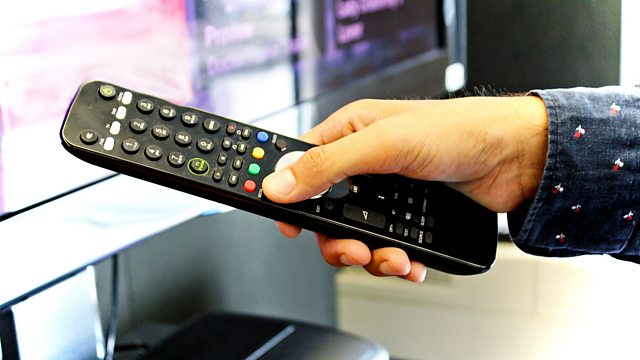
Freeview Play's New Accessible TV Guide; Calls to Save the RNIB's Giant Print Library
Can Freeview Play's new accessible TV guide work for you? And calls to keep the RNIB's giant print library open, particularly for children.
We hear about the newly launched Freeview Play Accessible TV Guide which you can find on channel 555. We hear from Gavin Ellis who led the development of it.
And calls to save the RNIB's giant print library which is due to shut in January. Are the alternatives to a borrowed large print book, particularly for younger readers, going to be as good?
PRESENTER: Peter White
PRODUCER: Mike Young
Last on

In Touch transcript: 24/11/20
Downloaded from www.bbc.co.uk/radio4
THE ATTACHED TRANSCRIPT WAS TYPED FROM A RECORDING AND NOT COPIED FROM AN ORIGINAL SCRIPT. BECAUSE OF THE RISK OF MISHEARING AND THE DIFFICULTY IN SOME CASES OF IDENTIFYING INDIVIDUAL SPEAKERS, THE BBC CANNOT VOUCH FOR ITS COMPLETE ACCURACY.
IN TOUCH – Freeview Accessible TV Guide and the RNIB's Giant Print Library
TX: 24.11.2020 2040-2100
PRESENTER: PETER WHITE
PRODUCER: MIKE YOUNG
White
Good evening. Tonight, the RNIB says its giant print library has to close. Parents of visually impaired children say it should stay open, at least for younger users.
Clip
A lot of children don’t have tablets, a lot of children can’t necessarily read off these devices because they might have eye conditions that mean they’re more sensitive to the light. Looking at a real book is so much better.
White
More on that in a moment. But first, from the written word to news of something designed to make using your TV a little easier.
It was back in 2018 that the communications regulator – Ofcom – called for TV providers to make their electronic programme guides or EPGs, showing what’s on when, accessible. Ofcom said there needed to be text to speech information, as well as magnified text and programmes that are audio described should be easier to find as well.
Well Freeview has now launched its accessible TV guide. Once the rollout is complete the guide will be available to anyone with a Freeview play television or set top box. To use it you dial channel 555.
Well Gavin Ellis led the development and launch of this accessible TV guide.
Ellis
We took it upon ourselves to deliver a simple to use, easy to access TV guide solution rather than relying on our manufacturing partners to deliver on those requirements.
White
And for visually impaired people filtering services for things like audio description, that’s what’s new here isn’t it?
Ellis
Absolutely, yes. So, filtering is one of the main features of the app, you can filter by audio description, obviously subtitles and sign language for people who are hard of hearing on all of the Freeview channels.
White
And one thing we ought to make clear, of course to use it you do need a television which has Freeview Play. Isn’t that going to limit its usefulness to people? I mean that is at the pricier end of the market isn’t it?
Ellis
No, there are a range of devices that, obviously set top box devices start at about £50 up to the newer televisions which obviously can be in the five hundreds of pounds, but there is the range there. Freeview Play is on a multitude of devices by a multitude of manufacturers. The only other thing you need is make sure it’s connected to the internet as well.
White
Well, stay with us Gavin because we asked our reporter, Fern Lulham, who does have a little sight to try this guide out for us.
Lulham
Okay, I am currently sat in front of my TV and if you’re wondering what this accessible telly guide sounds like, here’s just a little taster for you.
Freeview Play TV Guide
Starting at 7.10 pm Strictly Come Dancing Series 18 Week 4. Press okay for details, right to change channel or up/down to select previous/next programme.
Lulham
I mean who doesn’t love a bit of Strictly? After having a bit of a play around with the TV guide for about an hour now I’ve got some mixed feelings about it really. Was it easy to find – having the channel 555? Definitely. Could I figure out the basic functionality of it quite easily? Yeah, I absolutely could. I found the set up a bit of a faff and there were quite a few steps and quite a lot of information that I had to go through but, of course, once you’ve set it up you don’t have to worry about that. In terms of finding different channels, that’s fairly simple, you just scroll across using the right button. The only thing I’ll say about that is if you’re scrolling for a channel that is very far down the Freeview channel list, if you want to get to a channel that’s in the 50s or 60s you’re going to be scrolling a long time – I couldn’t find an easy way to hop from one channel to another if they’re far apart from each other. I think it’s very good at reading out the name of the show and what time it’s on. I think it would be helpful if within that initial information there could just be included whether it has audio description or sign language or any other accessibility features because with text to speech you have to go into the programme and listen to the full description of what the show’s about in order to know whether it has those accessibility features and it would be much easier and quicker to know that straight on the main menu. And obviously I know there are filters where you can find just audio described programmes, for example, but it would be nice if it just said the name of the show and then whether it includes audio description as a standard feature.
White
Well, more from Fern in a minute but Gavin, what did you make of that? I mean Fern says it can be hard to find out what’s on all the channels, particularly when they’re a long way apart. Are there shortcuts?
Ellis
I really appreciate that feedback, it’s really good to get feedback from people. At the moment, there is no shortcut and that is something that we will be working on going forward, taking this feedback. It has been something that we’ve thought about – maybe a double click will jump you through five channels at a time – but we need to finesse the current software that we have and then add on more features. So, no really appreciate that feedback from Fern.
White
Right, so there could be an answer to that because you want something like – if you can put in an initial letter or something, as you would on a computer, which would take you right there.
Ellis
Some kind of quick navigation mechanic would be really useful, so yeah, we’ll definitely think of that.
White
And what about the point Fern made – yes you can filter programmes so that you’re only offering ones with audio description but wouldn’t it be good if the guide told you right at the start if any programme is audio described or not?
Ellis
Yes absolutely, yes, so that’s something that we can definitely add in. We’re adding in a feature soon that will give you a little bit more information and read out the access services. But yes, adding in that quick announcement on the access service definitely is something that easily we can add in, so yeah, appreciate that feedback too.
White
Well let’s go back and see what else Fern found.
Lulham
In terms of the visual, if you do have some sight and you can read what it says, I think it’s very clearly set out – it’s bold lettering, white lettering on a dark background, so very easy to see; it’s spaced out nicely and highlighted very well so you can see where you are on the screen. And overall, I think it is great that this is a free option that is available now, making it more accessible to more people. However, for me, personally, because I’m used to using voice recognition technology, these days, in 2020, as many of us are, where you can just speak what you want into a device and it will either tell you what time it’s on or indeed take you straight to the channel or straight to the show that you want to get to, for me that’s so much more efficient, quicker, easier to use, especially if you have a visual impairment.
White
Gavin, what about Fern’s point there – voice recognition devices are now very popular, they’re going to be what some people prefer to use. I notice that my bank has suddenly gone over to voice recognition, rather than just letting me press the buttons, which I wasn’t exactly delighted about. Is that the next stage in this technology really?
Ellis
It’s the next stage in evolution of television technologies, absolutely. So, we’re currently working with our manufacturing partners who have relationships with Amazon and implemented the Alexa tool. Obviously, we work with Google as well and are working with their voice recognition tool as well. So, there will be features on newer devices that have voice recognition enabled but this guide will, hopefully, be a middle ground for the devices that don’t have that capability.
White
And I mean as Fern says, she was using this guide with some sight, what about users who are totally blind, like me, how different will their experience be do you think?
Ellis
I think there is definitely things that we would like to look at, with regard to how the text to speech works and that’s something that’s completely in our control and we will be doing updates and optimisations of that. So, I think, going forward, it will be more beneficial for blind users, fully blind users but the idea of the guide from its outset was to really have a broad reach and to, hopefully, help people with lots of different impairments.
White
So, would it be fair to say, that this is a first draft?
Ellis
Yeah, absolutely, a first release. We’re rolling out on multiple devices and we’re going to be optimising over the coming months and years until… well, things like this are never finished, in my opinion, but yes this absolutely could be considered a first draft.
White
Thanks to Gavin Ellis and to Fern Lulham. And if you have experience of using the Freeview Play programme guide or other ways of navigating the tsunami of TV channels that are now available to us, do tell us about them.
And thank you for all your emails to intouch@bbc.co.uk about many other topics as well. We had a big response to the RNIB’s announcement that it’s closing its giant print library in January. Paul Sullivan emailed. He says: “I thought that charities were in the business of supporting people whose needs are not being met elsewhere. If the majority of visually impaired people can access books via their smartphones and their computers and they’re happy to do so, that’s great, but as long as some people need books in giant print RNIB should provide them, otherwise what are they there for?”
And Lucy Whitcut also emailed about this. She says: “The RNIB claims that numbers of borrowers have dwindled but they openly say they loaned 10,000 books last year. The RNIB may say people can use alternative methods, such as iPads and Kindles, but thousands of children don’t have access to these, nor can afford to pay for them. The RNIB says parents can use the transcription service but it takes weeks to get transcriptions to you.” And she says, “I can say from the experience of raising two children with severe visual impairments that it is extremely difficult to engage young children in reading without the joy of holding a printed book, turning pages and studying the illustrations.”
Well Jenny Kaye also got in touch with us about this. She’s made a video on You Tube starring her son Jasper.
Video clip
He finds a book on the floor. Wow an RNIB giant print book.
Wow, I can read it.
Jasper carefully reads through the pages but then someone comes and takes it away, shaking their heads. Jasper then holds up a sign saying “Don’t close the giant print library, please.” Jasper drops the page to reveal another page.
“I need giant print books. From Jasper. This is me, see.”
White
And I think Jasper’s brother also had a hand in the editing, so he ought to get a mention as well.
Well Jenny Kaye joins me now, as does Laura Hughes, who’s Managing Director of Moorvision which is a Devon charity which supports visually impaired children and parents.
Jenny, how many times do you actually borrow books from the RNIB’s giant print library?
Kaye
We’ve probably only known about the service for less than a year because before that we were just trying to muddle by trying to see if we could borrow books from the local library or trying to find ones where the font was big enough. And as kids get older, font gets smaller, so it becomes more and more of a challenge. And then we found out about this service and it was just great and so we’ve been borrowing books for a while, you borrow the books, kids read them, then you post them back and then they post you more again.
White
Let me bring in Laura – Laura Hughes. Now you’ve set up a petition campaigning to save the giant print library for use by children. What’s the level of support that it’s attracted?
Hughes
We’ve had about 3,500 signatures now and that happened very quickly, within less than a week.
White
Well the RNIB has given us a statement and we thought we’d run through what they say in response to your efforts.
The first point, they say the giant print library currently only offers 24-point text and while that’s ideal for some users our customer feedback suggests that for many that’s too inflexible, compared with our free transcription service. There’s also the book share service where books can be downloaded to your tablet, your Kindle or your large format eReader. Laura, let me put that to you, what’s your reaction to that?
Hughes
I would have a few questions for them. One is how many of the current 3,000 giant print library books will be in that current collection, the current book share collection is about 20,000 and it’s very good but a lot of them are pdfs and they’re not easily transcribable and I don’t know how many of those 3,000 books will make the cut into that library.
White
And Jenny, I think you had a point to make about that as well.
Kaye
Well, it’s just basically that not all children have access to online books. A lot of children don’t have tablets, a lot of children can’t necessarily read off these devices because they might have eye conditions that mean they’re more sensitive to the light – like Jasper’s got nystagmus and ocular albinism, so starring at a bright screen’s not really ideal. So, looking at a real book is so much better.
White
Let me just put a quick point to you about technology, that the RNIB have answered. They say: “We recognise that not every family has access to a tablet or a Kindle and we can help there through technology grants to buy kit and direct text supplies.” Jenny?
Kaye
If they have these grants or if they’re happy to give out tablets or Kindles then that is fantastic but it’s just another service for people to have to fill in more forms when just borrowing a book is just so much easier.
White
Can I just put to Laura this point about the transcription service? We heard from Lucy that you can wait for a long time for them. The RNIB says they’re giving an undertaking that under the new circumstances there would be only a week turnaround for transcription services from February.
Hughes
I actually used to work for the RNIB transcription service for about 12 years, so it’s something I do know quite a lot about. The free pages are limited to about 600 a year and the turnaround time can be three months, six months, it can be longer, mainly because it’s an incredibly small team and they’re often doing very complex work. RNIB are not offering that, what they’re saying is that any book that is currently in the RNIB book share scheme, which is a totally different scheme, that that will be available as print on demand. So, if a parent contacts the personal transcription service they will be in the same position, which will be 600 pages and a long wait. But the print on demand service, that RNIB have introduced really in the last week, is very much if it’s in book share, we can print it on demand and get it sent to you. And they say that that will be cheaper than maintaining a library. I’m sure they’ve done their figures, it’s hard for me to understand how Harry Potter in very large print that’s needed on yellow paper would be cheaper to produce rather than lend but that’s what they’re planning to do. So, the two services are quite different, there won’t be an overlap.
I mean the library service was absolutely superb and I still feel it’s a shame to see it go. It’s never been advertised well, I’ve been working in Moorvision for nearly 15 years and I still have parents come up to me after five, 10 years and say where do I get large print books from and it’s been really poorly advertised, which might be why it’s not been as well used as they would like to have been.
White
This is going to rumble on. You have got your petition. We will continue to keep a very close ear and eye on it. Laura Hughes, Jenny Kaye thank you both very much indeed.
Before we go, just some reaction to our programme last week.
Alex Galbraith emailed after we revealed that Transport for London is now bringing back physical assisted guidance on the Tube. Alex says: “I wonder whether the solution to the difficulties we’re having about travel would be solved by putting registered blind people near the front of the queue when the vaccine comes, we can then publicise the fact so that everyone knows that we’re safe to touch. Social distancing is so hard for blind people…” Alex says, “…our lives are so restricted by coronavirus and others are so frightened of us. I would be very happy to have the injections and carry a certificate to show, then I could get on with my work and my life.”
And also last week, we broadcast an interview with Peter Wilkins. Now Peter’s wife, Linda, recently died in a care home and he’s barely been able to visit her there or in hospital due to covid restrictions. We received this email from a listener who prefers not to be named. They say: “I work on a covid high dependency ward, we found that one of the most distressing and traumatic experiences of the spring outbreak was watching people suffer and die without their loved ones. Our hospital has now made a proactive decision to enable critical visits, no matter how difficult. Our visitors don full PPE and isolate for two weeks afterwards. They’re able to hold hands and comfort each other. We’re aware of the risks and we inform people fully. I fear that the care homes are terrified of repeating the losses they endured last time, either through inadequate PPE or inappropriate environments to control covid outbreaks.” And our listener ends: “I struggle to defend their position but I feel they approach the situation with terror.”
That’s all for this week. If you want to get in touch you can email intouch@bbc.co.uk and do go to our website bbc.co.uk/intouch where you can find this and other editions of the programme. From me, Peter White, producer Mike Young and studio managers Owen Williams and John Cole, goodbye.
Broadcast
- Tue 24 Nov 202020:40BBC Radio 4
Download this programme
Listen anytime or anywhere. Subscribe to this programme or download individual episodes.
Podcast
![]()
In Touch
News, views and information for people who are blind or partially sighted