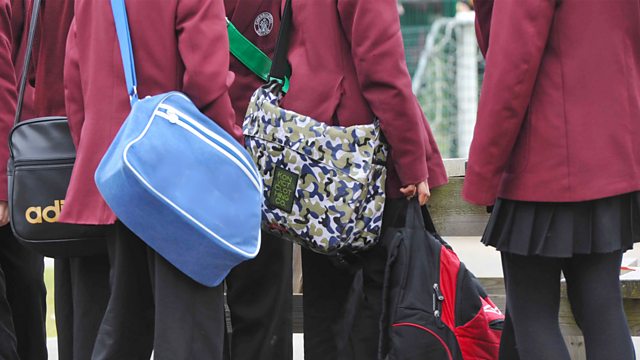
Back To School, Safer Travel On Public Transport
The efforts being made to protect blind pupils from coronavirus as they return to school. And what can you do to be as safe as possible when using public transport again?
A look at what specialist and mainstream schools are doing to help blind pupils get back to school safely. Can social distancing be achieved without leaving a blind pupil feeling isolated?
Advice from chartered environmental health practitioner Dr. Lisa Ackerley on using public transport again as safely as possible.
PRESENTER: Peter White
PRODUCER: Mike Young
Last on

In Touch transcript: 01.09.20
Downloaded from www.bbc.co.uk/radio4
THE ATTACHED TRANSCRIPT WAS TYPED FROM A RECORDING AND NOT COPIED FROM AN ORIGINAL SCRIPT. BECAUSE OF THE RISK OF MISHEARING AND THE DIFFICULTY IN SOME CASES OF IDENTIFYING INDIVIDUAL SPEAKERS, THE BBC CANNOT VOUCH FOR ITS COMPLETE ACCURACY.
IN TOUCH – Back To School, Safer Travel On Public Transport
TX: 01.09.20 2040-2100
PRESENTER: PETER WHITE
PRODUCER: MIKE YOUNG
White
Good evening. Tonight, how to juggle getting back to something like normal with staying safe. Listener Dennis Deacy sums up the dilemma many people face.
Deacy
It would be good to get back to the office to see colleagues. Obviously looking into that they’re now concerned about how to get from home to work safely and reduce the risk of getting the virus.
White
Well, we’ll be hearing more from Dennis and we’ve called up the cavalry to get some safety advice tailored to visually impaired people.
But first, Scotland and Northern Ireland have already embarked on it, England and Wales are just getting the process underway. It’s back to school. But in all the debates about what safety measures need to be put in place and how they can be made to work well, how much have you heard about how blind and partially sighted children will manage and how to keep everyone safe – staff as well as pupils – without compromising the independence of visually impaired pupils. The students, themselves, recognise the challenge. This is Carly Holder, who goes to the Royal National College in Hereford:
Holder
When I go out at the moment some people have the understanding of I can’t see them, so they have to go around me and my dog but at the same time it’s so much harder when two people can’t see each other before you’re too close or things like that, to sort of realise. Or for someone who hasn’t got any depth perception to think they’re two metres apart or one metre, or however far they need to be apart, but actually they’re not. But I think with RNC they will give the guidance that is needed and they would never put a student in a position where they would feel uncomfortable.
White
Well, like mainstream schools the Royal National College and other specialist schools have been offering online teaching throughout lockdown. But one school which won’t be starting completely from scratch when its students come back in a few days’ time is St Vincent’s School in Liverpool. After closing when lockdown began St Vincent’s reopened after half term this summer. So, what did they do and what have they learned from the experience for the year ahead?
Bob Birchall is Chief Executive of the Catholic Blind Institute, that’s the charity which runs St Vincent’s. He’s been telling me about their plans but began by giving a bit more background about the school.
Birchall
It’s primary and secondary. Now we’re quite – we’re relatively small in terms of pupil numbers. Our core pupil base is 37 pupils.
White
And when you started back last half term what changes did you make straightaway?
Birchall
Our first consideration was for health and safety and the health and wellbeing of all pupils and staff really. So, we were doing temperature checks, practising social distancing, allowing people in one at a time into the school building.
White
And did all the children come back?
Birchall
We bring people in from as far afield as Berkshire, so not everybody was in a position to come back, we ended up with 26 pupils back.
White
So, can we get into specifics a bit here – what procedures are you using to make social distancing practicable? How have you coped with Carly’s obvious point that two visually impaired people approaching each other from opposite directions might not always be able to achieve social distancing, just to give one example.
Birchall
We’ve looked at timetables to make sure that there aren’t too many peak congestion times within communal zones like corridors. We’ve enhanced cleaning regimes, so that areas that might be touched are cleaned and disinfected on a very regular basis and hopefully in between different groups going through.
White
I’ve heard of some schools for visually impaired children where what they’re doing is when you have a change of classroom it’s the staff who move, rather than the pupils – is that what you’re doing?
Birchall
No, we’re still having people move around. This is where our physical layout helps us because we do have the luxury of some space, we’re able to move people in a more orderly way than might be the case in a larger school.
White
I went to a blind school and anyone who has the idea that we all kind of walked around very carefully feeling our way along the walls can forget it, you know, we ran, we chased, we fought, so, how is it really going to work?
Birchall
We’re very keen to keep that vibrant atmosphere that you talk about. We’re going to have timed areas where individual bubbles can be together, so they can remain together; there can be zoned areas, so, in the dining hall we can have people in there but they can still remain socially distanced in there. So, we can retain that interaction but in a safe way.
White
I must ask you about masks, Bob. Given the extent to which masks can perhaps impede blind people’s natural sense of their environment, what’s your policy going to be about them?
Birchall
We’re quite comfortable that we have in place the strategies where social distancing can be practised, so it means that we feel a little bit more flexibility on the use of masks in those sorts of communal areas or corridors, which might be a problem in a larger school environment. There’s still an ongoing conversation about the use of masks but we’re making sure that we can provide masks and all PPE that’s sensible and appropriate if that’s what people want.
White
But you will – do I take it from that – you expect to be able to exercise your discretion as a school?
Birchall
Yes, we do. However, advice and guidance can change very, very quickly at the moment. The risk assessment programmes that we have in place will continue to be refined over that week before the school gates open.
White
Bob Birchall from St Vincent’s School in Liverpool.
Of course, mainstream schools are also facing the challenge of welcoming back visually impaired pupils after lockdown. We’d be very interested in hearing from pupils, parents and teachers about how that’s going as the term progresses. In the meantime, the preparations of one teacher:
Dwyer
Hello, I’m Haydn Dwyer and I’m a teacher at Chorley Wood Primary School in Hertfordshire. We’ve got two children with visual impairment at our school, both in the early years in key stage one. To prepare for these youngsters to come back to school we’ve spent a lot of time in preparation to ensure that the classroom environment and the adults that will be supporting those children are as prepared as possible. So, we’ve ensured that the children have had opportunities to visit the classroom settings without other children in them because that removes all of the visual clutter and all of the distractions for them and allows them to really familiarise themselves tactically with the environment. The largest challenge is educating the other children about how to navigate around them and how to interact with them. Typically, it’s harder for those children to recognise who they’re talking to or what’s around them, so we really just need to work with the other children for them to understand these children’s needs.
White
That’s Haydn Dwyer of Chorley Wood Primary School.
Wherever you are in the UK, whether involved with a special or a mainstream school, do email us, telling of your experiences of getting back to the classroom.
You’re also welcome to go to the useful contacts page on the In Touch website. Organisations like Guide Dogs have a free phone advice line and an email address as part of their children and young persons’ services, that may be of use to you.
And thanks, as always, for your emails to us. Just time for one this week. After hearing out item on the availability of medicines after leaving the EU Oriel Britton wrote:
“We’ll still have braille on medicine containers, which is an EU requirement, due, among other things, to the impracticality of making separate batches of drugs for the UK market without it. But…” she says, “…we also need braille to be made mandatory on food and other household packaging.” And she goes on, to get her retaliation in first, she says: “I know that some people will think that I’m asking rather a lot, they’ll argue that braille is rather a niche market, they’ll say – can’t you scan the box or use some app or take a picture or faff about with technology in some other way?” Well to those people Oriel says: “You don’t think we should have braille on the boxes? Fine, we’ll take away your print too.”
That’s telling them.
Now, let’s get back to going back – to work in this case.
Dennis Deacy is partially sighted, he lives in Walthamstow in East London. He wanted some specific advice when it came to travelling to and from work safely on public transport and what the best products are to keep himself as safe as possible as he leaves home regularly every morning. Well it seemed to us this could help a lot of visually impaired people, so we brought Dennis together with Dr Lisa Ackerley, who’s been a chartered environmental health practitioner for over 30 years. Dennis first:
Deacy
At the moment, I’ve been working from home since March. The kind of work I do I’ve been able to do it by computer over the internet and using telephone but obviously now they want people to come back to office. It would be good to get back to the office to see colleagues, it’s good to be in an office – interaction with other people face to face. So, obviously, looking into that I’m now concerned about how to get from home to work safely, reduce the risk of getting the virus.
White
Because I think you’re going to have to use a local over-ground train and a bus to get to and from work. How are you feeling about that?
Deacy
Yeah, two buses and an over-ground train. Concerned because I have on a number of occasions gone out on local buses to get the odd provision – the pharmacy or do some shopping – and I have noticed people getting on buses not wearing masks. I’ve been wearing a mask for the last month or two every time I go out and trying to keep my distance from people as much as possible, washing my hands and using sanitiser – all the usual things. But I’m concerned that other people are not acting so responsibly on public transport.
White
Okay. So, let me bring in Lisa Ackerley because you’ve been advising, I think, other blind and partially sighted people over the last few months. What have they been saying to you and how similar has that been to issues that Dennis has been raising?
Ackerley
Well very similar. One gentleman was telling me that he is frightened to go out, he’s being bumped into, people are not giving him some distance.
White
And I gather that although you’re fully sighted, you’re actually avoiding public transport yourself.
Ackerley
Personally, I am, I mean I’ve always worked – well worked from home for a long while. I think the first fact to think about is do you actually need to go, I know it’s really nice to interact with other people but in terms of a risk assessment the first thing is – are there any factors that make you more vulnerable apart from your sight, are there any other reasons why maybe you maybe cautious about going to work. And that’s the first thing – do you actually need to go; do you need to go onto public transport. I would rather try to carry on working from home as much as possible and avoid that problem. But if you do want to go then we’ve got to think about what can you do.
White
So, what would be your – because it sounds as if Dennis, on the whole, would like to get back into the swim of what we might call “real life”, what advice would you give him, bearing in mind that he said one of his main worries was how to keep safe from other people’s actions?
Ackerley
You know if you do have a stick or a dog with you then at least people are aware that you have a need for them to be careful around you and keep out of your way. But I would say one of the things you need to do really is to plan what your route is and maybe talk to the people at London Transport about your route, what are the rules on these buses and trains because everything will have changed since March, so there might be different entrances and exits, there may be different rules about where you can sit and there may be people who will be able to actually assist you to get safely on to a seat on public transport – if there are seats of course, let’s hope so.
White
Have you travelled at all yet Dennis?
Deacy
On some occasions though luckily the buses in my area, they’re double decker and I will go upstairs and usually I find there’s less people upstairs so I can keep my distance from other passengers on the buses. And thankfully TFL have been running buses fairly regularly and there’s been a lot fewer passengers on board. And sometimes what I have done is at times I have taken cabs.
White
And there is, of course, a fares to work scheme, which is a part of the Access to Work scheme that the Department for Work and Pensions runs, I don’t know whether you’ve thought of that or whether that’s something that you would feel that you’re eligible for.
Deacy
I have used Access to Work in the past for equipment for work but I haven’t claimed for fares to work in the past and I don’t honestly know what that actually would be just because there’s the Covid-19 situation, are they going to turn around and say – yes, now we will give you fares to work even though you’ve never claimed fares to work in the past.
White
Perhaps we’ll be able to do that. Can I also ask you; I mean Lisa made the point about making your visual impairment known to people, which is particularly relevant for partially sighted people because it’s not so obvious, do you do that?
Deacy
In one way it’s good to let people know by carrying a symbol – white symbol cane – but on the other hand, I feel it makes you easier to attack and to mug, so I just don’t advertise it by using a cane.
White
This is the problem, Lisa, isn’t it, for visually impaired people that there are other considerations, so, Dennis doesn’t want to look too vulnerable. Can I put another one to you and that is the problem for people with no sight is everything we do we have to touch and I’ve been struggling about this, knowing how you actually can sanitise yourself adequately while you’re travelling. The problem is if I take my face mask off the next thing I’m going to do, after I’ve sanitised my hands, is put my hand on my white cane, at which point I might transfer anything from my… you know, where do you stop?
Ackerley
I think one of the things to remember is that if you’re picking the virus up on your hands it’s the transmission to your eyes, nose and the mucus membrane in your mouth that is the issue, it’s not going to go through your hands. So, we have to all remember to try to keep our hands out of our faces. Now the other thing is, if you’re taking a face covering off what you need to do is actually sanitise your hands before you do that, as well as afterwards. So, I would take a wipe. Now you can get these antimicrobial wipes which are actually quite good for surfaces but they’re also safe for hands. So, they tend to be called two in one or that type of thing, you could wipe your hands with that, you could take your face covering off, there may be enough juice still left in the wipe to wipe your hands again after you’ve put the face covering away and then your hand is clean when you touch your cane. So, that’s good. If you’ve got one of these wipes then you could wipe some of the other things that you might have been touching on your route to work, so, you’re then in a safe zone. So, all the things that you’ve touched, like maybe your briefcase or your rucksack and your cane and your wallet, or anything else, you can just give them a quick wipe. And then you can feel a bit more comfortable when you get into the work zone, at your desk.
White
Dennis, how helpful is that and is there anything else you’d like specifically to put to Lisa, while you’ve got her here.
Deacy
That’s helpful alright. This brings us nicely to the question of cleaning products. I mean obviously companies are rushing to catch up and to come up with cleaning products that are designed specifically for this virus. You can buy a load of products that are all antibacterial and I did pick up one hand wipe but it said – it only mentioned one specific particular virus that it would deal with, as well as dealing with antibacterial. So, really, it’s knowing if there are products out there that will kill this particular virus that we could use.
White
It’s a big question Lisa but what advice would you give?
Ackerley
It’s a really important question as well because there are all sorts of claims flying around about how things work and so on. Many of the products are starting to get tested against coronavirus. One thing to remember with coronavirus is actually in terms of its resistance to cleaning products is actually pretty wimpy, so, many of the products that would be effective against bacteria will also be effective against the virus. And the catching up – you can imagine there’s a bit queue in the chemistry labs to get these products through so they’re tested against virus. So, the numbers to look out for are EN14476, that shows that it’s had an antiviral test but many of these products will be effective, if they’re effective against flu there’ll be effective against coronavirus pretty surely because it is a really fairly wimpy one in terms of being killed.
White
Do you want to give that number one more time Lisa, just in case people didn’t – couldn’t get a braille machine or a big pen or whatever?
Ackerley
Sure, it’s EN14476. The major products that are on the market, the ones from the reputable companies, which obviously we’re not going to list but you can imagine who they are, those will have already been tested, maybe some of the old stock hasn’t got those numbers on it but I think if you buy a reputable companies’ product you should be fine.
White
Dr Lisa Ackerley with Dennis Deacy.
Well do let’s have your comments on anything you’ve heard in the programme tonight. You can email intouch@bbc.co.uk or you can go to our website bbc.co.uk/intouch from where you can also download tonight’s and previous editions of the programme.
From me, Peter White, producer Mike Young and studio manager Mike Smith, goodbye.
Broadcast
- Tue 1 Sep 202020:40BBC Radio 4
Download this programme
Listen anytime or anywhere. Subscribe to this programme or download individual episodes.
Podcast
![]()
In Touch
News, views and information for people who are blind or partially sighted