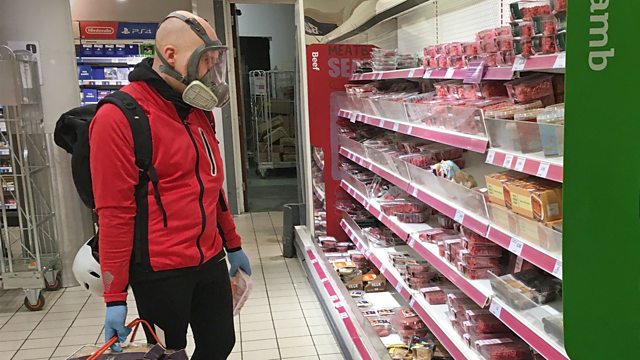
Shopping during lockdown and Braille library closure
Priority access to online food shopping slots requires being on a list of 'vulnerable people'. Should blind and visually impaired people qualify?
Keeping a safe two-metre distance during the Covid-19 lockdown presents a serious difficulty for people who are used to being guided when they shop.
So a new petition by leading blind organisations is calling on the Department for the Environment, Food and Rural Affairs to include the blind and visually impaired in its list of 1.5m vulnerable people who receive priority online shopping slots. We talk to reporter Mani Djazmi about his own quest for groceries and whether an exception should be made.
And The RNIB has announced the immediate suspension of its physical Braille library lending services. Dave Williams tells us what other reading options are being made available.
And another entry in our series of notable blind historical figures - the 16th Century recorder player and composer, Jacob Van Eyck, featuring the insights and music of Piers Adams.
Presented by Peter White
Produced by Kevin Core
Last on

In Touch Transcript: 07.04.2020
Downloaded from www.bbc.co.uk/radio4
THE ATTACHED TRANSCRIPT WAS TYPED FROM A RECORDING AND NOT COPIED FROM AN ORIGINAL SCRIPT. BECAUSE OF THE RISK OF MISHEARING AND THE DIFFICULTY IN SOME CASES OF IDENTIFYING INDIVIDUAL SPEAKERS, THE BBC CANNOT VOUCH FOR ITS COMPLETE ACCURACY.
IN TOUCH – Shopping during lockdown and Braille library closure
TX: 07.04.20 2040-2100
PRESENTER: PETER WHITE
PRODUCER: KEVIN CORE
White
Good evening. Tonight, calls for the government to add blind people to its priority list of vulnerable shoppers and why there’ll be no braille books delivered to your door for the foreseeable future. And some calm amid the crisis.
Recorder music
Clip
He was actually paid a little extra by the Chapter of St John’s Church, where he worked, in order that he would wander around the churchyard and play his recorder, entertaining the many visitors.
Recorder music
White
We’ll be hearing about Jacob van Eyck, another blind hero from history.
First though, by far the biggest response to our request for your lockdown stories has been about shopping – what else? Whether it’s managing to get an online delivery slot or what happens when you try to go shopping yourselves, as Gary Ankin and his wife did when they visited their local Tesco Express in Devon.
Ankin
What seemed to be a rabble of people gathered around left us not quite knowing where we should go. Nobody seemed to communicate – bearing in mind we have just come into this social distancing – when we asked – is this the queue – and they said no, but they didn’t offer any help. We thought, well, we can’t go forward because of all the people, so for safety’s sake we simply turned ourselves around and made our way back home, which was about a 25 minute walk, and left it for a good two or three hours and then we decided to redo the journey. There were still people around but there seemed a much more orderly queue.
White
Well a member of staff was then able to guide them around the shop.
Supermarkets in England can use a government database of one and a half million vulnerable shoppers to help prioritise online delivery slots. But that classification “vulnerable” relates to your susceptibility to the virus, so, blind people haven’t been included. The RNIB and four other visual impairment charities are pressing the government, and shops, to change this. And they’ve mounted a petition calling for visually impaired people to be regarded as priority cases for deliveries.
Our reporter, Mani Djazmi, is one of many blind people who’s struggled to shop for food online. And, as he told us, he couldn’t put it off any longer.
Djazmi
Well this is a very strange feeling – leaving my flat at 7.30 in the morning – I haven’t done this for a few weeks but I’m going out because the cupboards are bare and the fridge is empty, I need some food. And I’m going for the usual standard stuff – bit of fruit and veg, some meat, an emergency pizza, a couple of treats and pasta, which has assumed the status of gold dust in the last few weeks. And the reason I’m leaving so early is that every Monday, Wednesday and Friday Sainsbury’s dedicates its first hour to elderly people, disabled people and their carer, if they have one. Tesco does something similar. Two questions: one, is the question that everyone asks themselves when they go to the shop – will they have what I want? And the other one is, a bonus question for blind people – will I be able to get help to get what I want? Only one way to find out.
White
Well before we find out how he got on, Mani explained why he’s had to rethink his usual way of shopping.
Djazmi
Well, I mean, I do my shopping online most of the time anyway and the last time I was successful in getting a delivery slot was something like three weeks ago and I’ve kind – I mean you really do have to put in time to get one and I haven’t been successful. I’ve basically gone on the Tesco site every night, just before midnight, ready for the new day to come up and a couple of days ago I forgot and went on there about two minutes past midnight and it was already full, it was gone. So, it’s a bit of a scrum to get these slots and I haven’t managed one. So, it’s exercise for me, still, for the foreseeable future to go to the shops and do it myself.
White
Were people ever worried that you, as it were, you were getting too close to them because I mean that’s what I’ve found, that if you’re in a queue, for example, you know what we normally do, as blind people, you kind of almost follow their back and just follow the queue that way?
Djazmi
You’re right, I mean we are relying on sighted people to be aware of their surroundings and not to stand around on their phones and be lost in their own world because only they know if we’re close enough to them to be a concern. I went out last week, as well, there were a few people on the street but nobody was jumping out the way and saying – careful, blind man coming, let’s get out the way – or anything like that.
White
From a practical point of view, what were the kind of things that you found most difficult this morning?
Djazmi
To my surprise, everyone was extremely welcoming. I mean, I think if I’d gone in and said – I want you to guide me – there would have been an issue but I didn’t want them to guide me and they didn’t want to guide me for obvious reasons – of proximity. My solution was to take a list and give it to a member of staff and I said to her – look, I hate to send you on an errand but do you mind if I just give you this list, this is probably the safest way of doing it? She said – absolutely fine. So, she just walked ahead, I followed her voice to the till, we never had any contact.
White
Now there is a campaign to get blind people on to this list of vulnerable people who will therefore be a priority for online deliveries and yet we sometimes resent the idea of regarding us as vulnerable, is there a danger we’re trying to have it both ways here?
Djazmi
No, I don’t think so, I think this is a pretty unique situation and blind people are vulnerable. I think that there’s been a lack of imagination by whoever has drawn up this list, they’ve looked at age – 70 plus – okay, there’s a number and then what’s wrong with you, what’s your illness. But they don’t – they haven’t really thought that a blind person can’t be guided, a blind person can’t really go out with complete confidence that they won’t come into contact inadvertently with someone who may have coronavirus, or touch things, which may be infected. And so, I don’t think it’s a case of being too proud to be on a vulnerable list, I think it’s a necessity that fits the current time.
White
Mani Djazmi.
Now, there’s no central list of vulnerable people maintained in Scotland and Wales. Tesco told us they’ve expanded their home deliveries and click and collect slots have gone up to 800,000 from 600,000 two weeks ago. We’ve learned that late last week Tesco were given an initial list of 110,000 clinically and socially isolated people by the government, these are people who’ve asked for help. They’ve matched 75,000 of them, because they’re already their customers and they’re continuing to work on that list. They’re asking those who can shop safely in stores to do so.
We’ve asked for an interview with a minister from Defra, the Department for the Environment, Food and Rural Affairs, but we were told no one was available. And in a statement they said:
Defra Statement
We are working quickly to support people who do not fall into the category of being clinically vulnerable but still need help getting essential food supplies. We’re speaking to food retailers, delivery organisations and volunteer groups to help prioritise those individuals to access essential food. Wherever possible, people should continue to rely on friends, family and wider community support.
The British Retail Consortium, which represents the other major supermarkets, told us:
British Retail Consortium Statement
Retailers are working around the clock to expand capacity for online deliveries but as this accounts for around 8% of total food sales, physical stores will remain the most important way of getting food. Everyone must come together in the current crisis and we encourage everyone to consider picking up food for vulnerable, disabled or self-isolating neighbours.
And speaking of vulnerable people we’ve now got a little bit more information from NHS England about accessing the NHS Volunteer Responders Scheme, which can help with things like delivering medicine or trips to appointments. Healthcare professionals decide who needs access to a volunteer but priority is again given to the one and a half million people classed as “clinical vulnerable” to the disease. But they can make an exception if they think you really need the help of an NHS volunteer responder.
Do tell us if you’re able to use the service and how it went.
Meanwhile, if it’s food for the mind you’re after, I’m afraid there’s some more bad news. People who borrow books from the RNIB’s library lending services have been told the service is suspended with immediate effect.
Dave Williams is the RNIB’s Customer Experience Manager and I asked him why this had happened.
Williams
The landlord has taken the decision to close that site, so we’re not able to get access to books at the moment, or the equipment. The building is shared by several businesses, there is a shared reception with people coming and going, so, it obviously seems like a very sensible decision.
I guess the important thing is that we have got other reading options available to people, that we’re very keen to share.
White
You won’t be surprised to hear, some people are very upset about this. One braille reader’s already told us – I’m hopping mad, just when we all need the greatest possible choice of leisure time activities, braille books won’t be available.
Was this really unavoidable?
Williams
It is, we simply can’t get access to the building and to the books, at the moment and I’m really sorry. We, as blind people, we’re not exempt from the problems, obviously, arising from Covid-19. We do have a number of digital options that people can take advantage of. We’ve got braille magazines and there are also a small number of books that come from a different warehouse available to buy as well. So, there are some reading options for people. We’ve made our newsagent service free for three months, so people can receive a daily newspaper or magazine electronically. We’re also making available a small number of electronic braille readers, so people can download books and we’ll obviously try and help people with that, because we appreciate that not everybody is up to speed with the technology. But we can send books out on SD card and offer books available to download.
White
I’ll come back to some of those alternatives, that you’ve mentioned, but is there any danger, because people will worry about it, that this could be a permanent close down? You know, if the building is unavailable at the moment, could this be the start of a problem?
Williams
We’re absolutely committed to reinstating the normal braille lending library as soon as humanly possible, as soon as we can get access to those books and the equipment then we want to get the service back up and running. So, there’s absolutely no suggestion that we’re closing the library permanently, this is a suspension, so, like other libraries, we do fully expect to reopen in the future.
White
You mention this offer of technology to read electronic books, can you just explain what you’re doing and how much support there is for people perhaps who’ve not across this kind of technology before?
Williams
RNIB is making available to braille library members the Orbit reader, which is a low-cost braille display, and we’re offering that as a gift to library members, this is not a loan, you can have your very own Orbit reader. And then our technology for life team, which is a national network of volunteers and professionals, can assist with getting people up and running with that to enable you to continue reading braille while the braille library is unavailable. So, we have a small number of these displays at the moment, we’ve got more on the way, there may be a little bit of a delay initially, while we get those out to people and get you up and running, but we hope that’s just another way in which we can continue to keep people reading.
White
These reading machines, Dave, how would you get one of them?
Williams
You can contact our normal helpline number, which we’ve now extended the opening hours of that, so, Monday to Friday 8.00 am to 8.00 pm or Saturdays 9.00 am to 5.00 pm. And the telephone number there is 0303 123 9999, that’s 0303 123 9999. You can drop us a line, if you have access to email, and that email address is: helpline@rnib.org.uk.
White
That was Dave Williams.
We’ll repeat that RNIB number at the end of the programme.
Finally, many of you are entering into the spirit of marking the lives of some historic blind heroes. We’ve so far had a maths genius and a bell ringing legend in Nicholas Sanderson and John Ingersoll, respectively. And we have listener, Eleanor Chu [phon.] to thank for this suggestion, introduced by the professional recorder player Piers Adams.
Recorder music
Adams
Jacob van Eyck was born around 1590, we don’t know the exact date, and he lived up until 1657.
Recorder music
Nowadays, we know him largely in the recorder playing community because he left behind for us the largest collection of recorder music ever composed, in fact it’s the largest collection of wind music ever to be composed in all of European history and it’s called Fluyten Lust-Hof, the Flute’s Pleasure Garden. One hundred and forty-four very popular tunes of the day with extended variations and improvisations following them.
Recorder music
At the time, he was maybe far better known for his work on the carillon or carillon. It’s basically a keyboard which strikes bells and the keyboard is hit with the fists and pedal board with the feet and it will strike tuned bells, so you can play melodies. It’s a very – quite an obscure instrument. You hear it a lot if you, particularly, to the low countries these days it’s still quite popular there in Belgium and Holland and that’s really where the instrument was developed. And, in fact, van Eyck was one of the leading figures in the development of this.
Recorder music
The thing is, he obviously had very remarkable ears and I think because of this he was able to hear things in the sound that maybe other people couldn’t hear. So, he was able to hear the different partials, the different harmonics, in that very complex sound of a bell and with this particular oral ability he then worked on the sort of development and the shape and the engineering of bells to produce a kind of – a more pure tone. Right to this day that’s what carillon makers base their work on.
Recorder music
He really was a very influential figure and he was employed all over Holland. He worked on the bells and the carillons in churches right over Holland. And he was actually paid to maintain all the bells in the main churches in the city and he was actually paid a little extra, by the Chapter of St John’s Church, where he worked, in order that he would wander around the churchyard and play his recorder, entertaining the many visitors. This work, the Flute’s Pleasure Garden, is a really monumental work and really important for us, recorder players, it’s a fantastic instructive manual as well as being a really rich and wonderful source of melody and harmony.
Recorder music
So, van Eyck has really left a long and very important legacy, especially for us recorder players.
Recorder music
White
Piers Adams on Jacob van Eyck.
And that was Piers playing variations on – and apologies in advance – Wat Zalmen op den Avond Doen. Which very loosely translated means what shall we do this evening. Stay in?
That’s it for now but do continue to send us your stories and your ways of coping. You can leave us a voice message on 0161 836 1338. You can email intouch@bbc.co.uk. And that RNIB number again, that we promised you, 0303 123 9999. And you can also go to our website at bbc.co.uk/intouch, from where you can download tonight’s and previous editions of the programme.
From me, Peter White and producer, Kevin Core, goodbye, take care.
Broadcast
- Tue 7 Apr 202020:40BBC Radio 4
Download this programme

Listen anytime or anywhere. Subscribe to this programme or download individual episodes.
Podcast
![]()
In Touch
News, views and information for people who are blind or partially sighted