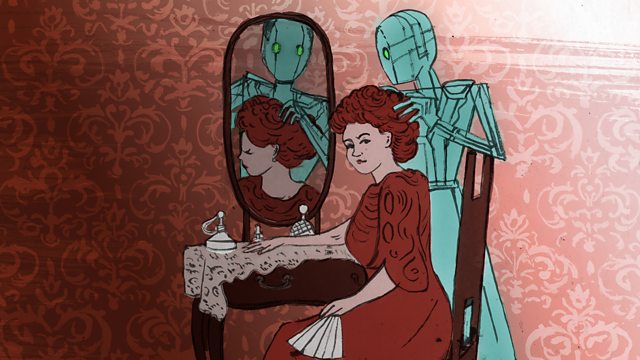
Subservience
Aleks Krotoski finds out if how we treat our subservient robots impacts how we treat one another.
Digital Assistant bots are becoming ever more common - Alexa playing music on your countertop, Siri taking notes on your phone, a little voice bubbling out of your watch to rattle off the things you almost forgot you needed to buy during the big weekend shop. They are useful little servants
But, barking orders at something that talks back, something that seems a little bit human but totally subservient… it can be a little uncomfortable. As with any new invention, domestic robots illuminate issues within human society that we may not have noticed before. Are we projecting old social norms of hierarchy and gender onto this new technology, and if we are, does how we choose to design and treat our subservient machines, impact how we treat our fellow humans?
Last on

Patrick Allitt

Cheryl Platz

Joanna J. Bryson

Joanna J. Bryson is a transdisciplinary researcher on the structure and dynamics of human- and animal-like intelligence. Her research covering topics from artificial intelligence, through autonomy and robot ethics, and on to human cooperation has appeared in venues ranging from a reddit to Science. She holds degrees in Psychology from Chicago and Edinburgh, and Artificial Intelligence from Edinburgh and MIT. She has additional professional research experience from Princeton, Oxford, Harvard, and LEGO, and technical experience in Chicago's financial industry, and international management consultancy. Bryson is presently a Reader (associate professor) at the University of Bath.
Kathleen Richardson

Rachel Withers

Rachel Withers is a tech culture critic based in New York. She wrote a piece about digital assistants and human interaction called "I Don't Men Who Yell At Alexa" for Slate. You can find her other work at rachelrosewithers.com
Broadcasts
- Mon 22 Oct 201816:30BBC Radio 4
- Thu 19 Sep 201923:30BBC Radio 4
Podcast
![]()
The Digital Human
Aleks Krotoski explores the digital world