Rowley Leigh: A Life Through Food
Rowley Leigh, 'godfather' of modern British cooking tells his food story to Dan Saladino. Along the way he cooks the perfect omelette and shares the secrets of cooking great pasta.
Rowley Leigh, to many the "godfather" of modern British cooking tells his story to Dan Saladino. Along the way he cooks the perfect omelette and shares the secrets of great pasta.
After dropping out of university at the end of the 1960s, Rowley Leigh says he was a young and lost soul. Desperate for cash he applied for a job cooking burgers and immediately fell in love with restaurants and kitchens.
It took him to Le Gavroche and an apprenticeship under the Roux brothers. Armed with that classical training and a curiosity for British ingredients and flavours he helped launch the British food renaissance of the 1980s. In Kensington Place he created one of the most talked about dining rooms in British restaurant history.
He is also a writer and so he takes Dan Saladino through some of the recipe highlights of his two decades worth of columns at The Financial Times.
Expect the perfect omelette, some great spaghetti and one of the simplest vegetable dishes you could probably add to your own repertoire.
Produced and presented by Dan Saladino.
Last on

More episodes
OMLETTE FINES HERBES
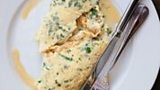
At Le Cafe Anglais we used heavy iron frying pans, which were never washed but polished with salt and stored with a thin filmof oil. At home I resort to a small non-stick frying pan. One tip: although an omelette does indeed cook incredibly quickly, many people panic and try to shake it and turn it too soon. All this activity can stop the omelette from cooking. Itis also worth knowing that it will not colour in the early stages and it is only towards the end that it is important to turn and agitate the omelette.
Serves four for a main and six for a starter.
Ingredients:
- a few sprigs of parsley, chervil, tarragon and chives
- 3 fresh eggs
- oil, for cooking 10g (1/4oz)
- butter
- salt and black pepper
Method:
Pick and wash the parsley leaves and then chop all the herbs: the parsley and the chives should be chopped quite finely, while the chervil and tarragon should be roughly chopped so as not to bruise them or damage their flavour.
Thoroughly whisk the eggs in a bowl with a fork or whisk so that yolk and white are completely integrated. Season with a small pinch of salt and a little freshly ground black pepper and add the herbs.
Heat the pan with the merest film of cooking oil with the suspicion of a heat haze. Add the butter and quickly, before it has a chance to burn, pour in the eggs. Do nothing for 30 seconds apart from keeping the pan over a high heat, and wait until the eggs start to bubble up. At this point scrape around the sides of the pan with a wooden spoon or fork and then, holding the pan slightly angled away from you and pushing it in that direction, give it a sharp jerk back towards you so that the raw mixture at the back is tossed back down to the bottom. Do this two or three times, making sure none of the mixture is sticking to the bottom of the pan.
When the mixture is still soft and runny, hold the pan at an angle away from you and give it a sharp knock on the stove so that the omelette slips down towards the edge of the pan. Roll the mixture from the side nearest to you down towards the opposite edge and then, inverting the pan, roll the omelette right out of the pan onto a plate.
SPAGHETTI CACIO E PEPE
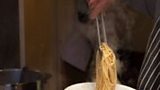
You remove the spaghetti from its water after a mere four or five minutes, when itis the sort ofal dente that breaks teeth, although it must have softened enough to bend in the pan. You then proceed to ladle in some of its cooking water so that a dish that starts like a conventional plate of pasta is cooked like a risotto, albeit one that is finished with nothing but waterand handfuls of pepper and cheese. Itis a recipe that is well suited to the non-Italian, most of whom can never manage the act of faith of removing pasta from its cooking water just before it is ready and can never resist the temptation to wait an extra thirty seconds and thus usually serve it slightly overcooked.
Serves four.
Ingredients:
- 1 tablespoon black peppercorns
- 100g (31/2oz) Pecorino Romano cheese
- 300g (101/2oz) spaghetti
- Salt
- olive oil, to serve (optional)
Method:
Using a mortar and pestle, pound the peppercorns to what the French call a mignonette, in which every peppercorn is crushed but not pounded to a fine consistency.
Finely grate all the cheese.
Bring a large pot of water to the boil with a small handful of salt. Add the spaghetti, stir with tongs or a long fork and bring back to the boil for just 5 minutes. Using tongs, lift the spaghetti out into a large saucepan or wok. Add a ladleful of the cooking water and continue to cook the spaghetti, stirring with the tongs.
After a minute add a handful of the cheese and a spoonful of the pepper and more cooking water: the idea is to produce a creamy emulsion of cheese, pepper, water and the starch from the pasta that clings to each strand of spaghetti. Continue for 2–3 minutes, alternately adding cheese, pepper and cooking water until the cheese and pepper are all used up and the spaghetti still has that authentic ‘bite’.
Serve the pasta immediately. Some Romans allow a little good olive oil to be trickled over it before serving.
ACQUACOTTA
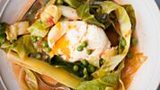
This is not so much a definitive recipe as an example of aquacotta.
Serves four.
Ingredients:
- 1 celery heart, quartered lengthways
- 3 tablespoons olive oil
- 6 spring onions, trimmed
- 1 small head of spring cabbage, cut into thick ribbons
- 150g (51/2oz) canned chopped tomatoes
- 2 handfuls of fresh peas
- a generous pinch of golden caster sugar
- 4 eggs
- vinegar, for cooking the eggs (optional)
- 4 thick slices of bread, toasted
- salt and black pepper
- grated Parmesan cheese, to serve (optional)
Method:
Place the celery in a heavy, flameproof casserole dish with the olive oil and cook gently for 5 minutes before adding the spring onions. Cook these for 5 minutes in turn before adding the cabbage.
After a further 5 minutes, add the tomatoes and peas. Season with the sugar, in addition to salt and freshly ground black pepper. Add enough water to just cover the vegetables and simmer gently for 10 minutes.
When the vegetables are tender – but still firm, rather than stewed – poach the eggs by slipping them one by one into a saucepan of simmering water (laced with a little vinegar, unless the eggs are freshly laid).
Place the toasts into soup plates and lift the eggs out onto the toasts. Ladle the stew – it should not be wet enough to call a soup – around the egg and take to the table. Serve with grated Parmesan, if liked.
Credits
| Role | Contributor |
|---|---|
| Presenter | Dan Saladino |
| Interviewed Guest | Rowley Leigh |
Broadcast
- Sun 16 Sep 201812:32BBC Radio 4
Featured in...
![]()
A Life Through Food—The Food Programme
The Food Programme profiles the great and good through their food stories.

Download this programme
Subscribe to this programme or download individual episodes.
Can comfort foods really make you feel better?

Yes they can, says Sheila Dillon.
Podcast
![]()
The Food Programme
Investigating every aspect of the food we eat