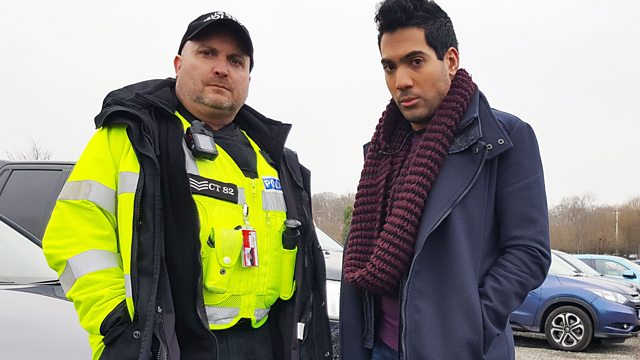
Welsh consumer magazine. Omar Hamdi goes on patrol with police at Gatwick airport to investigate the rising number of complaints about meet-and-greet parking firms.
Omar Hamdi investigates the rising number of complaints about 'meet and greet' parking firms. He goes on patrol with police at Gatwick airport and speaks to viewers from Cardiff and Caerleon whose cars have been damaged, driven at speed and used as a taxi! Rachel Treadaway-Williams looks into a Carmarthenshire-based outdoor equipment company which has left customers high and dry. And Lucy Owen reports on Japanese knotweed, the plant which is invading gardens and houses across Wales. Could a recent legal case bring new hope for homeowners?
Last on

Meet and Greet parking gripes
If you don’t want the hassle of parking when you go on holiday, then you can pay a company to do it for you. In fact, ‘meet and greet’ parking is soaring at UK airports – but so are the number of complaints.
Retired electrician Lyn Bigmore from Cardiff left his brand new SUV with WCP Bristol Airport Parking when he went to the Canaries last May. But when he got back to Wales he noticed new footage on his dashboard camera that stunned him.
He told X-Ray: “I’m seeing this vehicle of mine being driven and it’s doing like 76 miles an hour, something like that, and it has overtaken three vehicles in the hatched area. Dreadful driving for a professional driver.”
He’s since received an apology from WCP Bristol Airport Parking and had half his money back. The company says it's also taken disciplinary action against the staff involved.
But in Caerleon, there was a nasty surprise for another X-Ray viewer, days after she returned from a family holiday last October. Kathryn Bevis had made the mistake of entrusting her Golf to an unapproved meet and greet firm at Gatwick Airport.
In a letter from Sussex Police, officers explained that her car had been found in a street six miles from the airport – not in a secure compound as she’d expected.
The officers who found her car are based at Gatwick Police Station. Sergeant Darren Taylor took X-Ray’s Omar Hamdi on a tour of the parking blackspots close to Gatwick.
Sgt Taylor said: “These people who are scamming are undercutting the approved meet and greet companies because they’re not paying their insurance, they’re not paying their tax, their VAT and they’re getting away with it.”
As well as visiting the street where Mrs Bevis’s car was abandoned, they visit a muddy field where, last summer, over a thousand cars were dumped by meet and greet companies.
“You couldn’t even actually distinguish what some vehicles were, the mud was that thick, let alone what the registration was,” said Sgt Taylor. “And the keys were strewn round everywhere. I mean it really was chaos.”
At Gatwick, airport bosses are urging passengers to ditch the dodgy parking firms and only use ones on their approved list, which can be found on the airport website.
Whatever airport you’re flying from, it’s worth looking out for the blue ‘Park Mark’ symbol – it means the parking company’s been checked out and is up to scratch. And before dropping off your car, it’s also a good idea to take photos of its condition, inside and out, and the mileage – in case there’s a dispute.
Japanese Knotweed

Two men from Maesteg have won a landmark case against Network Rail because of Japanese Knotweed growing around their homes.
Neighbours Robin Waistell and Steve Williams took the company to court because the presence of Japanese Knotweed on the railway embankment behind their properties has left them struggling to sell their houses.
Japanese Knotweed was first cultivated by the Victorians; its roots can grow up to three metres in length and it spreads quickly. It can grow through walls and burst into homes. Anyone with Japanese Knotweed within seven metres of their property could struggle to get a mortgage unless they have a specialist treatment plan in place.
After Network Rail tried and failed several times to get rid of the Japanese Knotweed, Robin and Steve took them to court.
Earlier this month, Robin and Steve won their case and Network Rail were ordered to pay more than £4000 to each of them to get rid of the knotweed. The pair were also awarded an additional sum of around £10,000 each because the value of their homes had dropped.
A Network Rail spokesperson said: “All Japanese Knotweed sites reported to us by our lineside neighbours are included in our chemical control programme and sprayed on an ongoing basis.
“We are continually reviewing our processes for controlling Japanese Knotweed. This includes working closely with experts within Network Rail and with third party organisations.”
Rodger Burnett was the lawyer who represented Robin and Steve in court,
“I've spoken to hundreds of people who are literally at their wits end, banging their head against wall, tried to get Network Rail to listen to them, hopefully with this judgement these people will be able to take on these big landowners and be able to sell their property.”
If you’re trying to sell a house with Japanese Knotweed:
- - There's a property information form with a very specific question about Japanese knotweed. If you don't declare the presence of knotweed you could be faced with significant legal action from an unsuspecting buyer
If you’re considering buying a house:
- - Lenders won't lend against property unless there's a treatment programme in place, that treatment is carried out by a competent contractor and the treatment programme is underpinned by an insurance backed guarantee
Mobile phone misery

A family of loyal Vodafone customers from Killay in Swansea say they’ve come to the end of the line with their mobile phone provider. Despite Vodafone’s assurances of being ‘a network you can depend on’, over the last two years postman Mike Harries, his wife Penny and their 19-year-old son Luke have been cut off dozens of times, through no fault of their own,
The Harries family pay £73 a month for a family plan which allows them to share minutes and data.
The Harries have always paid by direct debit but Mike keeps receiving text messages from Vodafone saying they’ve not paid their bill and soon afterwards, everyone in the family finds themselves cut off and unable to make calls or send texts. Despite repeated complaints to Vodafone, who’ve promised to resolve the issue, the problem keeps happening.
In frustration, Mike contacted X-Ray. Presenter Omar Hamdi was shocked at the number of text messages the family have received from Vodafone. Omar met with Mike and also 19-year-old Luke, whose personal training business has been affected by the problems with Vodafone.
Mike told Omar the texts first began in 2015 and he’s spent many hours on the phone to Vodafone customer services. Every time it happens, Vodafone apologise and reactivate their contracts and Mike says they assure him it won’t ever happen again. So far it’s happened at least 15 times and happened as recently as last week. Mike says the signal in Killay is so patchy, Vodafone has the most reliable signal. “I pay the bill, but they don’t supply a service. I am basically stuck”, he told X-Ray. “Inside I am absolutely boiling and I just can’t do nothing about it.”
Credits
| Role | Contributor |
|---|---|
| Presenter | Lucy Owen |
| Presenter | Omar Hamdi |
| Reporter | Rachel Treadaway-Williams |
| Series Producer | Jo Dunscombe |
Broadcast
- Fri 24 Feb 201719:30BBC One Wales HD & Wales only
