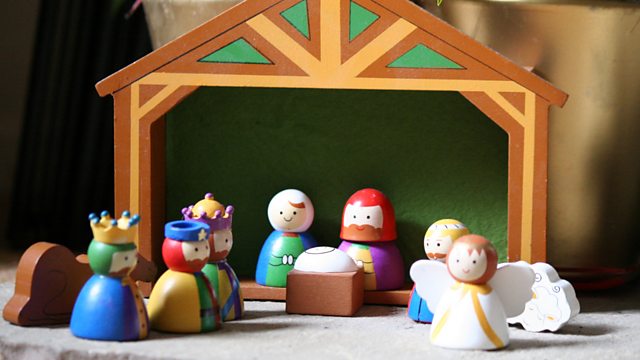
Nativity Characters - Beyond the Christian Story
Professor of Islamic studies Mona Siddiqui reflects on what Jesus and Mary represent to Muslims beyond the Christian story of the Incarnation.
"The same figures of Jesus and Mary appear in the Quran, but these characters don't tell the same story."
In a series exploring the enduring significance of the Nativity story, Professor of Islamic Studies, Mona Siddiqui reflects on what Jesus and Mary represent to Muslims beyond the Christian story of the incarnation.
Producer: Dan Tierney.
Last on
More episodes
Script - Nativity Characters
As a Muslim, I get asked this question all the time, “are you ready for Christmas?” It’s a difficult one because most people are so well meaning when they ask you this. They see you as one of them and don’t like to think you might be missing out. Sometime I try to explain and sometimes I just say yes – it’s the kindest thing to do.
Christmas was never mentioned in the religious stories my mother told me. When I was growing up, she would tell me stories of the prophets and messengers mentioned in the Qur’an. They were lifted out of their historical time and into a universal time as a way of bringing to life ancient wisdom. Prophets are central to the Qur’an because they are seen as God’s medium, they show how God connects to human beings and how the lives of these figures always points to a presence and power beyond us.
The stories were not simply tales of morality and fortitude, they contained a deeper truth, a higher reality which made them relevant for all time. So, I grew up listening and learning from my mother while she did the housework or cooked. I found the lives of the prophets intriguing and wondered why we as a Muslim family didn’t celebrate them. After all the lives of Abraham, Jesus, Moses and Muhammad were so rich, these were people with whom God himself had communicated. In our house we spoke respectfully of all the prophets, their trials and tribulations, but there was no event to celebrate or mark any particular life, not even the life of Muhammad. Such celebrations would be seen as innovation, outside tradition and faithful practice.
I knew of a few other Muslim families who did celebrate the Prophet’s birthday and also took part in some of the Christmas celebrations; they said well, `Jesus is a prophet, a very special prophet in Islam so we’re going to put up a tree.’ In my family, as no prophetic birthday was celebrated we were largely outside onlookers of the Christmas magic. While there was no tinsel, tree or turkey in our house – we did enjoy one thing – Christmas seemed to be all about presents – it was a defining gesture. My mother had presents for everyone, from the bin man, the milkman to all our neighbours and school teachers.
I used to feel that it isn't just that Christmas looks beautiful, the way its packaged, advertised but there was a sense that no other religious festival can quite match up to Christmas. I didn’t quite understand the nativity scenes as a child but the Christmas carols drew me in and I would find myself singing `away in a manger’ and `Once in Royal David’s city’ which remained my favourite. Alongside the singing and the festivities, there’s a palpable sense of an event and a mystery. Christmas captured our imagination and the Christmas story was part of my childhood as it has been for my children.
But this might be because outside the Bible the Qur’an is the only scripture where Jesus is really present. Both Jesus and Mary or Maryam appear several times in the Qur’an – the only character who is missing is Joseph. Yet while Jesus and Mary are mentioned in the Qur’an, their characters simply don’t tell the same story. Yes, the Qur’anic Jesus is named the spirit of God but he is not the son of God, not the saviour who died on the cross. Mary remains the Virgin Mary and she is revered by many in popular Islamic piety but she is not the mother of God. She is not in Islam what she is in Christianity, “the one who gave birth to the one who is God.”
The defining story of Mary and Jesus in the Qur’an is the miracle birth and prophecy but not one of the Messiah. It may come as a surprise to some that Mary is mentioned more times in the Qur’ān than in the entire New Testament. She is in the Qur’ān an example of virtue and obedience for the believers. She is also seen by many as an inspiring and reconciling figure between Islam and Christianity, a bridge between the two faiths. There is in fact a rather curious Islamic tradition that all of us are pricked by Satan at birth except for Mary and Jesus – their purity and goodness remain untouched.
But in the Qur’an Mary’s work is complete with Jesus’s birth and the prophetic mission of doing God’s work lies with Jesus and not Mary. Some Christians appreciate the Muslim recognition of Mary as embodying the highest virtues. The 9th century Bartholomew of Edessa declared, “In the entire Qur’ān there do not occur any praises of Muḥammad or of his mother Aminah, such as are found about our Lord Jesus Christ and about the holy Virgin Mary,’ and yet despite the elevated status given to both Jesus and Mary, the Qur’an seemingly rejects the Christian story. For Muslims, Jesus remains the messenger/prophet in a long line of prophets; for Christians Jesus is no longer pointing to a message, he is the message.
So we are left with figures who appear in both scriptures, whose stories remain strangely familiar and yet what they mean and represent is so different. Still, there are some similarities – if for Christians Christ is the primary source of future hope, for Muslims, his return marks the beginning of the end times. Jesus not Muhammad will return but Jesus will not return as saviour.
What I find really interesting is the concept of the Muslim Jesus, where the Jesus of the Gospels was over time embraced by the Muslim Ṣūfīs to become the Jesus of Islamic Ṣūfism. Here is a Jesus who leads by example, who takes on suffering and who utters eternal truths. Wonderful stories are told about Jesus in sufi literature. For example:
“Jesus owned nothing but a comb and a cup. He once saw a man combing his beard with his fingers, so Jesus threw away the comb. He saw another drinking from a river with his hand cupped, so Jesus threw away the cup.”
The explanation is that Jesus is an ascetic, so if he has possessions, these things could be construed as a love for this world. Another story is that Jesus said when someone turns a beggar away empty handed, the angels will not visit his house for seven days. Islamic religious literature loves these kinds of sayings and aphorisms, words attributed to prophets to show their wisdom, their solitude, their renunciation of this world and their love for the next.
I think it’s fascinating that poets and writers have also reimagined Jesus. The 13th century poet Rumi wrote, “When someone asks you “How did Christ quicken the dead?” Then give me a kiss in his presence.“ That’s how!”
This life giving breath (dam –i `Īsā ) became the quality most associated with Jesus so that Jesus’s breath brings life when it brings new concepts or possibilities to human imagination. Rūmī compares man’s spirit to Jesus and his body to Mary, that you have to endure the pains of the body to develop the spirit of Jesus.
Islam continues to revere Jesus but sees in him neither the fullness of prophecy nor the fullness of God. In emphasising Jesus’s humanity, however elevated, however mysterious, Jesus remains a prophet. For Christians, human prophecy is not enough to describe the eternal character of Jesus, God has revealed himself in Jesus. And it is in this self- revelation that we understand the true meaning of God’s love. At Christmas God gives us of himself in Christ to establish a personal relationship with humanity.
Christians speak of a loving God in a particular way. I’ve often been asked about the nature of God’s love in Islam. Many years ago I was lecturing in Rome to a group of Catholic students. A young nun stood up and asked, “How do you Muslims know God loves you?” I asked her how she knew God loved her to which she replied, “Jesus died for us, that is how I know God loves me, his only son died for our sins”. This young nun spoke with such conviction about her own beliefs and seemed to be genuinely puzzled as to how Muslims understand God’s love when there is no distinctive event to reflect this love. For her neither scripture nor prophecy were enough. It was what God had done to himself, his movement to show love for his creation which mattered. This conversation has been one of several in which I have often felt that many Christians understand the Christian concept of God’s love as being fundamentally different form other religions. God loves unconditionally in Christianity and he sealed his love through Christ on the cross.
This tragic and triumphant love is of course is what Christians mark for Easter but for me it’s there in the Christmas story. There in the humble birth, the shining star and the gifts of the wise men is the story of divine incarnation and redemption. The Mary-Jesus story ends in a dramatically different way in Christianity than it does in Islam.
Prophecy alone was not an adequate response to Jesus from a Christian perspective. But in Islam, there is no divine accolade bigger than the election of human prophecy. Whatever the relationship between God and his prophets, the divine and the human remain distinct.
So I am left with two stories about Jesus. Two stories which have shaped the world’s largest religions. Mary and Jesus are present in the Qur’an, their lives have been told and retold in many ways. But the Jesus Christ of Christmas is not the same as the Jesus of the Qur’an. As a scholar, I am intrigued by the similarities and the differences, as a person of faith I am drawn to the underlying message of hope.
Because I see Christmas as essentially a time of tender hope. I say tender because we know that for many Christmas can also be the loneliest time of the year. Yet still the sense of giving and sharing, simply being with one another shines through the glitz and the commercialism.
Traditions bring people together and strengthen us as a society. When I celebrate Eid, my friends wish me well – when I say happy Christmas to my friends or give presents, it’s a way of sharing in something that is special to those around me. During my childhood I expressed this by writing Christmas cards and wrapping presents. I wasn’t really aware of the theological differences. The absence of a Christmas tree in our home, marked our house as different but in giving presents, I felt included.
There are many ways to feel part of something bigger, there are many way to experience something of the divine in our lives. Muslims don’t have the cross in their lives but Muslim writers and poets have often used Christ as a symbol of healing and as a symbol of suffering and hope. The eighteenth century Urdu poet Mir Hasan wrote `If Jesus lives in heaven, it is because for years he roamed the desert lands of love. And the Pushto poet Kushal Khan Khattak, sighed:
“If winged words could have carried me in their flight up to the skies I'd be seated now in the heavenly sphere Where the prophet Jesus is.”
These writers were aware that Jesus’s prophecy was marked by a different kind of love. And in the end, despite all the differences between Christianity and Islam, it is love which connects us to the divine and it is love which connects us to our fellow human beings. This is what lies at the heart of the Christmas story and to some extent we can all feel touched and be part of this message. It’s strange but sweet that many of my neighbours know I don’t have a Christmas tree at the window but they still ask, ` did you have a good Christmas?’ I always reply yes.
Broadcast
- Wed 21 Dec 201622:45BBC Radio 3
Death in Trieste
A 1760s murder still informs ideas about aesthetics, a certain sort of sex, and death.
Watch: My Deaf World

Five compelling experiences of what it is like to be deaf in 21st-century Britain.
The Book that Changed Me

Five figures from the arts and science introduce books that changed their lives and work.
Podcast
![]()
The Essay
Essays from leading writers on arts, history, philosophy, science, religion and beyond.