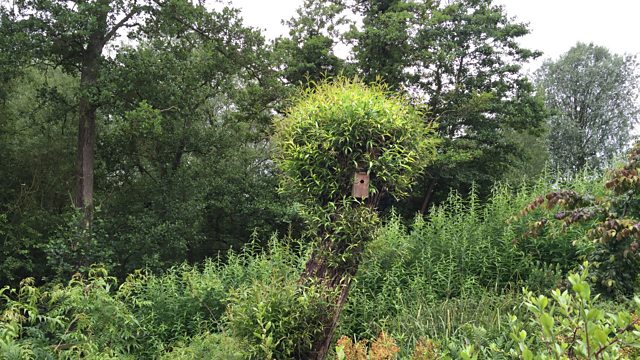
Braintree and Bocking Public Gardens
Eric Robson and the panel pay a visit to Braintree and Bocking Public Gardens in Essex. Matthew Wilson, Christine Walkden and Pippa Greenwood answer the horticultural queries this week.
Produced by Darby Dorras
Assistant producer: Laurence Bassett
A Somethin' Else production for BBC Radio 4.
Last on

Diamondback Moth
Factsheet
Q – Will several ants’ nests in a greenhouse cause any problems to crops?
Christine – No. They might move soil from the root system but other than that, no.
Q – My daughter had a Bamboo that she’s dug up. But it’s still coming up. She doesn’t want to use weed killer – what can we do?
Matthew – Best thing to do, rather than dig, is to pull off the root as aggressively as possible, because the snapping action will discourage regrowth. This method will either kill it or cause millions of offshoots. It’s a 50/50!
Q – What would the panel recommend that I could plant in a bed that never sees any sunshine?
Matthew – What you can get is lots of interesting foliage rather than flowering plants. For example: Pulmonaria ‘Blue Ensign’. I grow that with Dryopteris erythrosora, a tolerant fern. Matteuccia struthiopteris (‘The Shuttlecock’ fern) – a fern that’s good in wet shade. Deschampsia cespitosa – native grass.
Christine – Rheum palmatum. Many of the Heucheras will do well. Ligularias come to mind – they won’t flower as well but the foliage will look good.
Q – I planted a Bramley apple tree 35 years ago and it’s now making a lot of growth going straight up from the centre. It competes with a nearby Field Maple. I’d like to take centre out of it – can I do this or is the tree too old?
Christine – I would selectively prune it – nice and slowly. Take out a third of the centre each year, over three years, to open it gradually. If you really clout it it will produce water shoots ie non-fruiting shoots.
Q – I recently bought a lovely Hebe called ‘Purple Shamrock’ which is described as a new “sport” of the Hebe ‘Mrs Winder’. What is a “sport”?
Christine – A “sport” is where you have a mutation of growth caused by physical damage, or genetic interference, sometimes growing conditions. And all it is is a change in characteristic from the original plant. Quite a lot of our popular Chrysanthemum varieties are sports and they will come true if you propagate them; some others won’t.
Matthew – If you look at the ‘Lawson’s cypresses’ they are all sports taken from cuttings from different parts of the plant. Lawson’s arrow is taken from the top of the plant; Lawson’ bun is from towards the bottom. I was going to retire on the very contorted “sports” of Taxus baccata or ‘Common Yew’… but unfortunately the contortion was just caused by Bindweed.
Q – Our Lavender hedges are heavily infested with Lavender or Rosemary beetles and I’d like to know if there is a bee-friendly control for this pest?
Pippa – I would recommend that physical picking off is the best method for getting rid of them. Sorry!
Christine – Put yellow sticky traps under the plants, then when you give the plant a whack the beetles will fall off and you can take them away.
Q – Could the panel suggest what we could plant for minimal maintenance, all year round interest, and maximum interest in the Braintree and Bocking Public garden of 24m square.
Matthew – I would focus on one big, impressive blast per season. Summer – really good repeat-flowering Rose. So for yellow go for a ‘Port Sunlight’; white go for ‘Winchester Cathedral’ or ‘Hyde Hall’. Autumn – a nice clump of Euonymus alatus ‘Compactus’. Spring – lots of bulbs. Winter – I would go for orange ‘Midwinter Fire’ (Cornus sanguinea) or ‘Winter Bonfire’.
Pippa – I would stick to miniature bulbs in Spring – classic yellows like ‘Tete-a-Tete’, ‘Narcissus’ – to reduce maintenance. Herbaceous perennials like Herbaceous Geraniums in and amongst them would be good too. Also, try and get some Snowdrops and Crocuses in there if you can.
Christine – Sheets of Cyclamen coum (Spring) and sheets of Cyclamen hederifolium (Autumn) – but don’t put them together as the hederifolium will choke the coum. For bulbs go for the Scillas, the Puschkinias, the Anemones, the Eranthises – all great plants. For berries go for Viburnum opulus ‘Compactum’.
Q – I am very fond of Florence Fennel but all attempts to grow it have failed. Should it be possible or should I give up?
Christine – I’ve never been successful but I’m on a very light, alluvial loam and I think it prefers heavier soil. It needs an early start and can take two/three years to build to a reasonable size. It doesn’t really like dryness at first too. I’ve tried pot and garden.
Broadcasts
- Fri 1 Jul 201615:00BBC Radio 4
- Sun 3 Jul 201614:00BBC Radio 4
Six of GQT’s naughtiest gardening innuendos
When Gardeners' Question Time got mucky.
Podcast
![]()
Gardeners' Question Time
Horticultural programme featuring a group of gardening experts