Our Father, who art in heaven
The Reverend Dr Leslie Griffiths reflects upon the way the global Christian family is united through the Lord's Prayer. From Wesley's Chapel in the City of London.
In the first of an occasional series exploring the Lord's Prayer, the Revd Dr Leslie Griffiths reflects upon the way in which the global Christian family is united through this most familiar of all prayers, and how everyone enjoys the privilege of calling God 'Father.' The service comes live from Wesley's Chapel in the heart of the City of London where over 20 languages may be heard in its diverse international congregation.
With: St Martin's Voices
Music Director: Andrew Earis
Organist: Elvis Pratt
Producer: Simon Vivian.
Last on

More episodes
Script
Please note:
This script cannot exactly reflect the transmission, as it was prepared before the service was broadcast. It may include editorial notes prepared by the producer, and minor spelling and other errors that were corrected before the radio broadcast.
It may contain gaps to be filled in at the time so that prayers may reflect the needs of the world, and changes may also be made at the last minute for timing reasons, or to reflect current events.
Radio Four Continuity Anno
BBC Radio Four. It’s 10 past 8 and time now for Sunday Worship which comes live from Wesley’s Chapel in the City of London. It’s led by the Superintendent, the Rev’d Dr Leslie Griffiths, and is the first of an occasional series of services reflecting on the Lord’s Prayer.
MUSIC (SOLO: Robert Maginley)
Our Father, who art in heaven, hallowed be thy name;
thy kingdom come on earth as in heaven, hallowed be thy name.
2. SPEECH (Leslie Griffiths):
Good morning wherever you are from the heart of London. “Our Father,” the opening words of the most familiar prayer known to Christians in every part of the world, establishes the theme for this morning’s service. More of that in a moment.
Here in London, our church stands like the hub of a wheel whose spokes point out into different worlds. To the south of us lies the City of London, the Square Mile, with its banks and businesses and a history dating back to the Romans. To the east lie the thriving, throbbing, clublands of Shoreditch and Hoxton, flooded, especially at weekends, by hordes of young people up for a good time. North of us, the new kid on the block, is the high-tech world of start-up companies, thousands of them, all centring on the Old Street Roundabout now fondly referred to as Silicon Roundabout. And west of us, just across the street, is the Bunhill Fields cemetery - a centuries-old burying ground for people who trod the road of dissent, people like John Bunyan, George Fox, William Blake and Isaac Watts. Yes, we’re at the hub of all that. And we too have our own history to be proud of - we’re the mother church of world Methodism; ours is a bijou Georgian building put up by John Wesley, the founding father of Methodism. He lived, died, and was buried here and his soul goes marching on.
At the beginning of the service we heard the opening words of a Caribbean version of the “Our Father” sung by my colleague Robert Maginley, born and raised in Antigua. He’ll be the cantor now as we sing the whole prayer; this time we can all join in the responses.
3. MUSIC (antiphonally – Robert Maginley and the congregation):
“Our Father.” (tune: traditional Caribbean melody).
4. SPEECH (Leslie Griffiths):
Dear Lord, our father in heaven, we gather together in your name to sing your praise and to offer you our worship. In this joyous season of Easter, we thank you for the good news you have imparted to us – the story of a love that, even when assailed by cruelty and mockery, even when carrying an immense burden of suffering and pain, even when faced by the dark reality of death, remained unbroken, undiminished, untarnished, right to the end. Yours, dear Lord, is a love that will not let us go and we pray for faith and hope in sufficient measure never to let go of it. Accept our worship this morning as we seek to express those mysteries which lie beyond words and whose meaning breathes life into our deepest selves.
We offer this prayer in the name of the risen Lord Jesus who, with you and the Holy Spirit, is one God, now and forever.
ALL: Amen.
The Lord’s Prayer seems always to have been part of my life. Indeed, in my earliest days, it seemed to be part of our national life. All children were taught it in school and recited it at school assemblies. We weren’t church goers in our family and it’s salutary to think that I learned the prayer that Jesus taught his disciples in a secular environment rather than a religious one. What’s more, I learned it in Welsh as well as in English: “Ein tad, yr hwn wyt yn y nefoedd” here are words as familiar to me as “Our father who art in heaven.” And then, much later in my life, while living in faraway Haiti, these words wormed their way into my innermost mind in French and, marvellously, in Créole too. “Notre Père qui es au ciel”, “Bon dieu, papa nou, ki nan sièl la,”. All of this has served as a vivid reminder that the God we acknowledge in prayer is not the God of any particular nationality. He is “our” God, everyone’s God, whatever language they speak, wherever they live, whatever their cultural or ethnic identity.
This morning, we’re joined here in Wesley’s Chapel by St Martin’s Voices, and they’re now going to sing “Notre Père” – “Our Father” – a version of the Lord’s Prayer in French to a setting by Maurice Duruflé. And then we’ll hear a few verses from the sixth chapter of St Matthew’s gospel, part of the Sermon on the Mount, in which Jesus instructs his followers how to pray.
5.MUSIC (St Martin’s Voices):
(Notre Père by Maurice Duruflé)
6. SPEECH (Dr Joy Leitch): Matthew 6: v1 and 7-15
A reading from St Matthew’s gospel, chapter six, beginning to read at verse seven.
Beware of practicing your piety before others in order to be seen by them; for then you have no reward from your Father in heaven.
So, whenever you pray, do not be like the hypocrites: for they love to stand and pray in the synagogues and at the street corners, in order to be seen by others….Whenever you pray, go into your room and shut the door and pray to your Father who is in secret; and your Father who sees in secret will reward you….Do not heap up empty phrases as the Gentiles do…they think that they will be heard because of their many words. Just pray like this:
Our Father in heaven, hallowed be your name. Your kingdom come, your will be done, on earth as it is in heaven. Give us this day our daily bread. And forgive us our sins as we forgive those who sin against us. Save us from the time of trial and deliver us from evil.
This is the word of the Lord
ALL: Thanks be to God.
7. MUSIC (Hymn with organ)
Christ from whom all blessings flow (Tune: Vienna)
8. SPEECH (Leslie Griffiths) Sermon: OUR FATHER
No other prayer that I know opens in a more explosive way. Just those two words, “Our Father”, ordinary everyday words, are charged with enough power to change the world. And yet they so often get passed over, an unthinking familiarity breeding a craven contempt. How often have I heard the worship leader invite his congregation to say the Lord’s Prayer together by beginning it himself, “Our Father,” he says before everyone else joins in with the words “who art in heaven”? And those two precious words are lost, they become the property of a single person instead being proclaimed by the people as a whole.
The word “our” is where it all begins. Not “my” but “our.” We’re all in this together. Here at Wesley’s Chapel we have members from dozens of countries in every continent of the world. That first word hits the bullseye every time – the God we invoke is the God of everyone present, wherever they come from and whoever they are. In recent times we’ve wept with our American members at the senseless killing of people attending a prayer meeting in the Mother Emmanuel African Methodist Church in South Carolina; and with our Fijian members recovering from the devastating effects of hurricane Winston which struck their homeland; and most recently with our Pakistani members at news of the terrorist attack on civilians (especially Christians) in Lahore. For them and everyone else, our differences are subsumed in the word “our” – we belong to each other and all of us, along with the host of heavenly witnesses, - both past and future - belong to the one and only God whom together we approach in prayer. Great strength comes from our togetherness.
But the next word “Father” takes things much further, makes claims that are even more radical. To help us picture this, my colleague Jennifer Potter is going to help us to imagine a struggle that took place over a century ago.
______________________________
9. SPEECH (Jennifer Potter):
One day, in the summer of 1883, two Methodist ministers were in deep and earnest conversation as they walked together across Clapham Common. One was quite elderly and moved stiffly with the aid of a stick. He was Dr William Pope, a very fine scholar who’d written several influential books. The other was Scott Lidgett, a young man in his twenties who was already showing signs of the great leader he seemed destined to become.
The two men took this walk frequently but today there was definitely something special in the air. Dr Pope could hardly contain himself. “I’ve done it at last,” he declared with obvious delight. Scott Lidgett knew that the old man had spent the morning at a meeting of the Catechism Committee and couldn’t begin to imagine how anything that happened there could have filled Dr Pope with such deep feeling. He waited for further enlightenment from the old man and didn’t have to wait long. “I’ve been unhappy with our catechism since it was written,” he explained. (The catechism is the document which, in question and answer form, tries to offer a simple summary of the Christian faith for those joining the church.) “It’s the very first question that I’ve hated since day one,” he declared. “’What is God?’ that’s what we ask; and the answer to that question is even worse: ‘An eternal and infinite spirit.’ But we’ve changed it now. At last. The first question is no longer ‘What is God?’ but ‘Who is God?’ with the simple answer ‘Our Father.’ He ended this little speech with a smack of the lips, clearly over the moon with his success.
The young Scott Lidgett never forgot this conversation and spent the rest of his long life writing about the fatherhood of God and the brotherhood of man.
________________________________
10: SPEECH (Leslie Griffiths) Sermon continued:
The word “father” is not without its difficulties in these gender-inclusive days. We’ve had to learn some hard lessons about our patriarchal church and the dominance of men within its power structures. And quite properly we’re learning how to create systems and use language in a way that gives full respect to the role of women in the church. So the word “father” raises questions that need to be addressed. Perhaps we can agree to continue to use this word on the simple grounds that Jesus used it to describe his own relationship with God. And perhaps too we can rework some of our stereotypical thinking about fatherhood. Fathers are not always stern disciplinarians, lofty and unemotional members of the family. They are certainly capable of tenderness, affection, loving and laughing relationships with their families. We need to work to recover the richer aspects of fatherhood while we all, men and women alike, continue to commit ourselves to the struggle for a fairer world for women in and beyond the church.
The description of God as father carries one enormous consequence. If God is truly our father, then that makes all of us who say these words brothers and sisters to each other. What could be more radical than that? And here at Wesley’s Chapel, where people from 55 different nations worship and where two dozen languages other than English are spoken as mother tongue, we are faced starkly with the fact, every time we say the Lord’s Prayer, that are members of one single humanity every time we say the Lord’s Prayer. Just saying “Our Father” presents us with a reality we cannot avoid. Beyond everything that differentiates us from one another, race and ethnicity, colour and class, language and education, lies the over-riding fact that unites us as members of the human race, sons and daughters of our heavenly father. Just imagine what a different world we’d have if we could all live out our lives on that basis.
11: MUSIC (St Martin’s Voices):
Father we love you (Donna Atkins)
12. SPEECH (Two voices: Katherine Baxter and Alex Sarsah):
[A couple of bidding prayers here that will reflect matters being reported in the news of the day.]
ALL: Our Father in heaven,
VOICE: remind us constantly that you are parent
to all your children, whoever and
wherever they are or come from;
ALL: hallowed be your name.
ALL: Your kingdom come,
VOICE: establishing peace and justice,
hope and life for all peoples.
ALL: Your will be done on earth as it is in heaven.
ALL: Give us today our daily bread,
VOICE: Disturb us into an awareness of the needs of others.
ALL: Forgive our sins,
VOICE: our pride and also our prejudice,
ALL: as we forgive those who sin against us.
ALL: Lead us not into temptation,
VOICE: especially keep our hearts and minds
open to see the good in others.
ALL: Deliver us from evil.
ALL: For the kingdom
VOICE: just and true,
ALL: the power
VOICE: gentle and fair,
ALL: and the glory
VOICE: shot through with the colours of love,
ALL: are yours, for ever and ever. Amen.
13. MUSIC (St Martin’s Voices):
Old Time Religion (Spiritual, arranged by Moses Hogan)
14. SPEECH (Leslie Griffiths)
Jesus invited his followers to address God in exactly the same way as he did himself – with a familiarity and intimacy that are mind-blowing. The close walk with God which this implies allows us to approach the rest of Jesus’s prayer humbly and with confidence. As we continue to explore the Lord's Prayer in this occasional series of Sunday Worships that lie ahead, we can think about our daily bread, the nature of forgiveness, and facing our times of trial, in the knowledge that the God who has the kingdom, the power and the glory, is not a distant tyrant but a father we can trust, who loves us and will always love us, a great redeemer to sing whose praises we’d need a thousand tongues.
15 MUSIC (Hymn with Organ):
O for a thousand tongues to sing (Tune: Lydia)
16. SPEECH (Leslie Griffiths)
May we know the peace of God which passes all understanding,
the love of God which knows no bounds,
and the abiding presence of God in the deepest part of our being;
and may the blessing of God, - Father, Son, and Holy Spirit, - be ours now and always.
ALL: Amen.
17. ORGAN: Voluntary: Elvis Pratt
Broadcast
- Sun 3 Apr 201608:10BBC Radio 4
Lent Talks
Six people reflect on the story of Jesus' ministry and Passion from their own perspectives
No fanfare marked Accession Day...
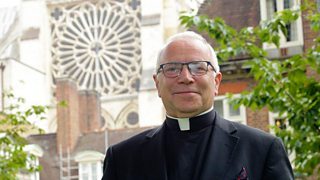
In the Queen, sovereignty is a reality in a life, says the Dean of Westminster.
The Tokyo Olympics – Stretching Every Sinew
Athletes' reflections on faith and competing in the Olympics.
"We do not lose heart."
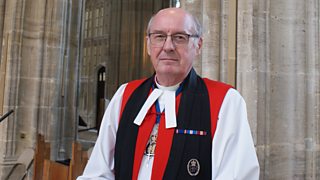
Marking the centenary of HRH Prince Philip's birth, a reflection from St George's Chapel.
St David's Big Life Hack
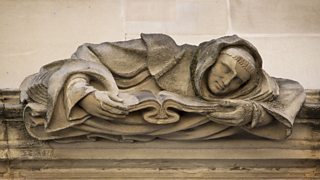
What do we know about St David, who told his monks to sweat the small stuff?
Two girls on a train
How a bystander's intervention helped stop a young woman from being trafficked.
Sunday Worship: Dr Rowan Williams
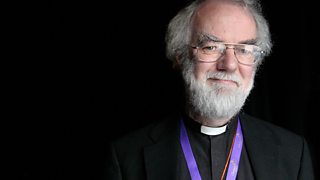
How our nation can rise to the huge challenges it faces, post-Covid-19.
